Forum
Clanker: Racism masked as AI-hatred
Anna Dorsey | Illustration Editor
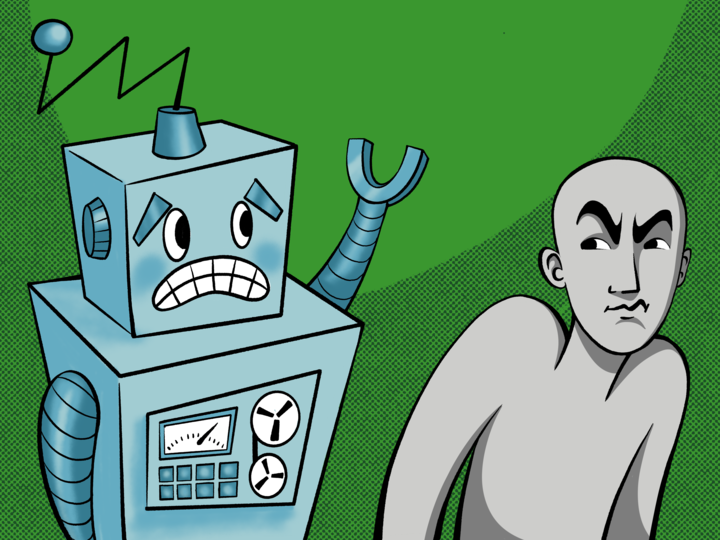
What might have once been an unrealistic fear of digital dominance by artificial intelligence (AI) is now alive and in the bloodstream of online culture. From this anxiety, a reassertion of human power is taking root in the form of a slur: “clanker.”
Originating from “Star Wars,” clone troopers first used “clanker” as a slur to mock battle droids. These days, online users have revived the term as an insult against robots, AI, and even people who defend machines or question the hostility toward them. The slur, however, has evolved not merely to critique technology’s rise, but as a cathartic loophole through which people channel class anxieties, reenacting the rhythms of racism without consequence.
“Clanker” has evolved quickly through various social media platforms, expressing hatred toward machines and employing the preexisting language that has been used against marginalized communities. Now, users differentiate between the “hard-r” and “soft-a” pronunciation of “clanker,” an echo of the pronunciation of the N-word. Users have also used phrases such as “wireback” or “shutdown town” (a repurposing of “sundown town” — an all-white neighborhood that enforced racial segregation) against AI, carrying clear parallels to racist insults. Others call AI “dirty tin-skinned,” language reminiscent of descriptions long used to dehumanize people of color.
While “clanker” spread through algorithms, it has also slipped into the real world, expectedly, among younger circles. People use the term in conversations in ways that mirror online comments, carrying the same undertone of bigotry and appearing only in contexts of bigotry. This casual use normalizes the hate “clanker” carries and opens the door for other, more explicit variations to enter the conversation.
Beyond slurs, the hate also manifests in short skits and memes online (with millions of likes). In one, a “robophobic” police officer pulls over a robot and uses racial profiling, insulting the driver with slurs against their identity. In another, the creator’s future child brings a “robot partner” home, and the disapproving parent directs “dark humor” at the robot.
The casting of skits also follows a pattern: “robophobic” characters that police and segregate AI or become the victim of “machine oppression” usually take the form of stereotypically “white” characters, the default holders of racial power. Creators adopt Southern accents and wear button-downs and khakis, visually coding their characters as white, middle or upper-class figures who have historically upheld racial hierarchies in America.
These scenarios don’t parody racism; they perform it. The “comedy” hinges on the audience’s understanding of racism and the creator’s simple substitution of the marginalized community for “robot hate.” The memes turn relatable because we are deeply fluent in the language of discrimination that “clanker” content brings into proximity. And we find it funny.
Some users say it can’t be racist if it’s about machines, but the punchline is not about technology. Instead, the joke often hinges on the basis that slurs are pleasurable to say and fun to hear.
Slurs are hate speech designed to dehumanize a specific community. By replicating the structure — swapping robots in for racial groups — users are not mocking oppression and standing “for humanity,” but rather performing hate speech safely without social cost. Some of the creators blatantly acknowledge the substitution with captions such as, “If the 2050’s become like the 1950’s (But instead it’s Robophobia).” These instances show how the term reproduces the contempt that slurs carry against the targeted community and how “clanker” becomes a loophole to enact this discrimination.
The “clanker” trend also taps into a familiar anxiety: the fear of being replaced. The trend sprang from the idea that AI will take our jobs and invade our spaces. This exact rhetoric is currently being used to discriminate and marginalize immigrants, especially people of color. It is not hard to imagine where scenarios portraying robots as “cheap labor” drew their inspiration from.
The “clanker” meme tests how far we can recreate racism without crossing the line. “Clanker” becomes a power trip for cowardly short-form creators and normalizes discrimination for their audience. Its appeal lies in the hypocrisy of its supposed harmlessness — pitting humans against robots as if we’ve outgrown racism and hate crimes among ourselves. The word only distances us from the violence it mimics: dehumanization. So, stop using the word — even if it feels satisfying to say.
Stay in Touch!
Get the latest and top news from StudentLife delivered to your inbox