News
CEO of The Atlantic encourages “engaged optimism” about AI in WashU talk
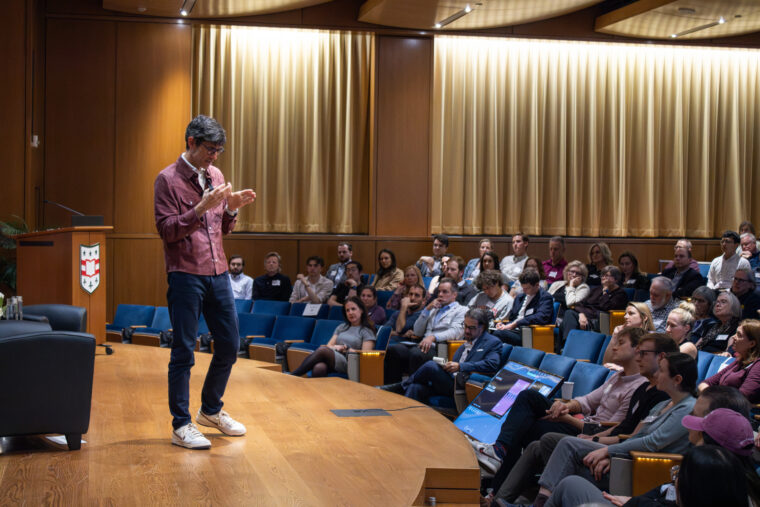
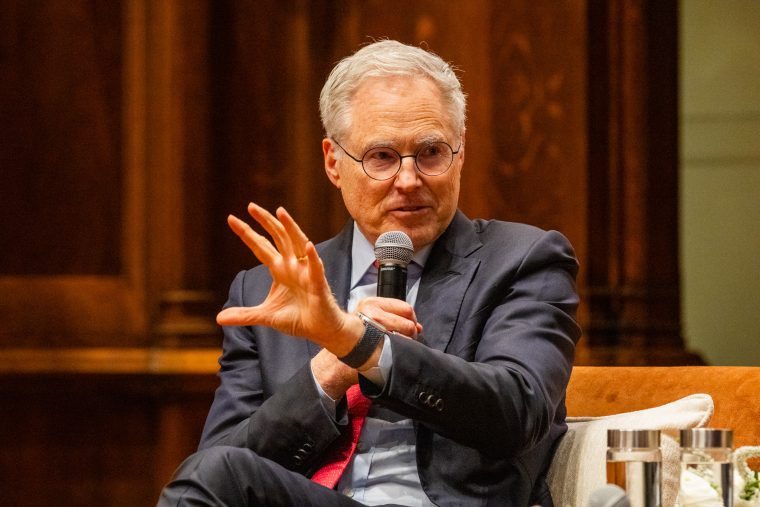
Nicholas Thompson spoke with a crowd of WashU community members about AI. (Rachel Benitez-Borrego | Staff Photographer)
Nicholas Thompson, former Editor-in-Chief of WIRED and now CEO of The Atlantic, has reported on artificial intelligence since 2017. As part of WashU’s +AI Perspectives Week, Thompson reflected on what he’s learned about AI and his advice for college students to a packed crowd of WashU students and community members on March 25.
Thompson mixed optimism and caution regarding AI, encouraging students and community members to embrace the opportunities presented by AI while warning about the societal risks and the threats posed by AI overutilization.
“[AI tools] are amazing. If you don’t use them, use them. If you’re a student, use them … ” Thompson said. “But remember also that they’re fools. They still hallucinate all the time; these agents make up garbage constantly.”
Thompson framed the talk through a series of 11 questions about AI and six principles to follow. In analyzing the questions, Thompson shared arguments for both sides of debates that split the academic community, such as how powerful AI will get, whether AI will make humans smarter or dumber, and the impacts AI will have on climate change, art, democracy, and more.
Thompson argued that early evidence hasn’t proved the claim that AI would cause massive unemployment in early-stage careers, though hiring is down in some fields like engineering and media that are having information taken from the industry for training data. Despite the threats to those industries, Thompson said those fields actually present the most opportunity for recent graduates.
“I was just talking to … undergraduates, and we were talking about a chart showing professions of ‘where there’s going to be the most churn,’ and some people were scared,” he said. “‘Do I want to go into a profession where there’s gonna be a lot of churn and a lot of change? Do I want to work close to AI?’ My answer is you probably do, actually, because that’s where the action is.”
Though he encouraged students to use AI, Thompson also cautioned against using it to replace important human skills.
“Every time you offload tasks to AI, you weaken muscles in your own body,” he said. “What about when the skill you’re weakening is actually thinking, solving logical problems, and working through the stuff that matters? That’s a huge risk.”
Ben Huebner, an alum of WashU’s MBA program, attended Thompson’s talk and said he resonated with this point.
“What are the muscles that you don’t want AI to take from you?” Hueber said. “Are there cultural things that you don’t want AI to do? Are there areas of our life that we’re like, ‘no, no, I’m gonna write the toast at my sister’s wedding’ … Are we gonna draw the line? And, [do] those lines exist?”
Thompson said that though he hopes AI will reduce inequality in society, there have been notable leaps in technology, such as the Internet, which have exacerbated inequality. He said using AI to reduce these divides is critical.
“If I were president for the day, I would do everything I could to try to figure out how to make it so the benefits of AI accrue most widely, because society will work better that way,” he said.
Along with concerns about inequality, Thompson expressed worry that the people who are developing the next generation of AI do not fully understand how their models work.
“I’ve interviewed Sam Altman, Dario Amodei … Just like we don’t really know how our brains work, they don’t know how the AI models work,” Thompson said. “They know that if you pour a whole bunch of data into a big bucket, and you put billions and millions of dollars of computer chips around it, and you stir it around, you somehow get intelligence. But they don’t know exactly what’s going on underneath it. They don’t really know how to control it.”
Though Thompson acknowledged the anxieties AI has caused for people, he encouraged listeners not to be a “doomer.”
“There could be a way to be very defeatist about what’s coming, but no, human society is very resilient. Work is very resilient,” he said.
In an interview with Student Life, Thompson said that he encourages people at The Atlantic to properly leverage AI, but he doesn’t make it a requirement for his employees.
“My strong preference is that everybody uses it a lot. When I hire people, I’m not going to tell [them] ‘You have to use AI’ … ” he said. “But probably, if you use AI smartly, you’re going to end up a lot more efficient than somebody who doesn’t, and if you don’t use AI, you’re probably gonna end up being pretty inefficient, so you’re gonna have a hard time here.”
Thompson also said that young people should be optimistic about how AI will shape their lives rather than focusing on the risks it poses.
“The world is going to get remade, and it’s going to get remade by people who know how to use these tools,” he said. “The folks who are 20, like you guys, you’re just gonna be the kings of this. You’re gonna learn how to use it, you’re gonna build stuff, and you’re gonna be ideally reaping the benefits.”
Sophomore Devin Wallace said he felt encouraged by Thompson to use AI but also to remember the things in his life that AI can’t do for him.
“I think it’s a powerful tool to learn stuff,” Wallace said. “But [Thompson] also talked about focusing on whatever’s most interesting to me or whatever makes me feel the most alive.”
Stay in Touch!
Get the latest and top news from StudentLife delivered to your inbox