Forum
In the age of AI, the humanities department should consider changing their course structures
Liam Thomas McManaman | Staff Illustrator
I’m a women, gender, and sexuality studies (WGSS) major and pre-health student at WashU, and in my time here, I have both seen and experienced the heavily prejudiced view STEM students have of the humanities. Being a STEM student, especially on the pre-professional track, implies that you are hardworking, intelligent, and likely to succeed. Humanities students, on the other hand, supposedly have a lighter and easier load since they “only have to read and write essays.”
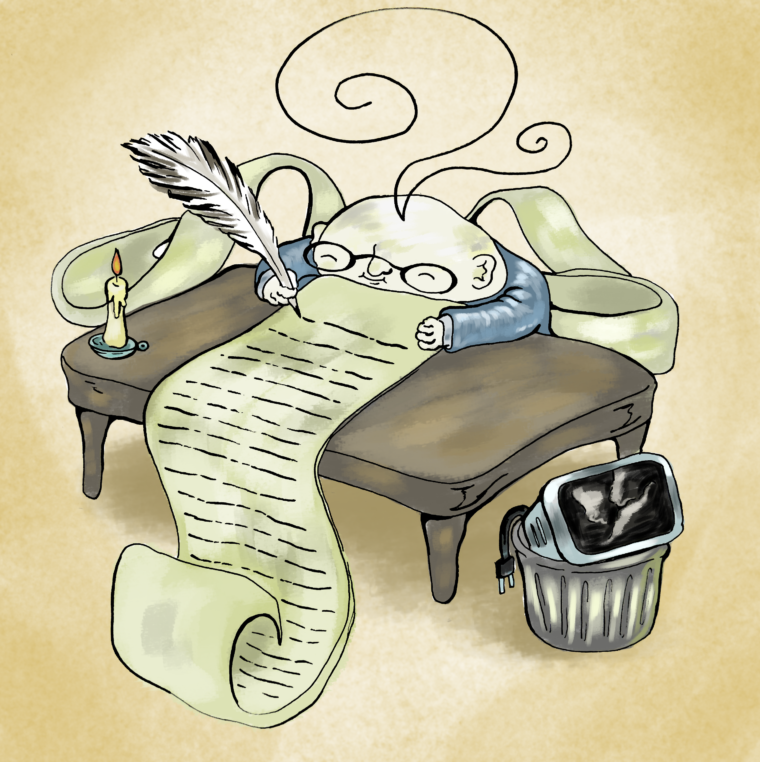
Many of these narratives come from students who take humanities courses solely to fulfill their humanities and social contrasts requirements in the humanities and social contrast for graduation. For them, humanities classes are simply a box to check rather than a space to engage with in a genuine way. And with the advancement of artificial intelligence (AI), it’s now easier than ever to avoid genuine engagement with class material. Essays can be written with AI, readings can be summarized rather than actually read, and in-class discussions can be skipped or superficially participated in with little consequence. The problem is not that humanities courses lack rigor, but that their current structure allows students to bypass it, especially with AI, which reinforces the perception that they are easy.
If a student can rely on AI and still walk away with a passing grade, then the problem is not just about individual laziness. It’s about what is lost: the opportunity to embrace critical thought. Courses stop being a space where students wrestle with their intellectual thinking and become mechanisms to produce the right academic performance. Students start to view engagement in humanities classes as optional, unlike engagement in STEM classes, where most grading structures more clearly depend on performance in in-class exams. This prejudice that the humanities have nothing to offer is reinforced by the assumption that students can get through them with little effort.
Humanities classes are a two-way street of learning, growth, and knowledge exchange between the instructor and the student. These classes are not simply about writing a 900-word essay; they are about understanding how power, social structure, language, and other factors shape people’s lives through that essay. They deal with identity, politics, culture, art, and systems that create the world as we know it. Students are already expected to invest effort. But this essay-based structure may also allow students to not engage in in-class discussion and to use AI wherever they can throughout the course.
When grades are heavily based on essays, it creates a system in which a generally well-written paper can pass. A student can rely on summaries and a few reference quotes instead of close reading. Thus, the issue is not that the humanities lack rigor but that a student can succeed in a course while skipping the parts that make it rigorous.
Even when instructors try to respond by using AI detection tools, that doesn’t really resolve the underlying issue of disengagement with course content. Those tools are inconsistent and often inaccurate, which make it difficult to rely on them as a real solution. It cannot just be about catching students after the fact anymore, but about whether we can design a course structure that doesn’t allow students to rely on AI.
If we want the humanities to be taken seriously, the structure has to be modified. Essays shouldn’t be the bulk of how students are evaluated. More weight should be placed on discussion, in-class engagement, and the ability to think through ideas in real time. Assignments that require direct interaction with the material, whether through presentations, debates, or in-class writing, make it harder to rely on AI or stay at a surface level. The goal of the humanities isn’t just to produce writing. It’s to produce thinking.
The irony is that the humanities are among the most important classes students take. They shape how we understand ourselves and others. The classes make us better people. But until humanities courses are structured to respond to the demands of our AI-driven era, they won’t be treated that way.
Stay in Touch!
Get the latest and top news from StudentLife delivered to your inbox