News
WashU- and Vanderbilt-commissioned report on the humanities comes under fire
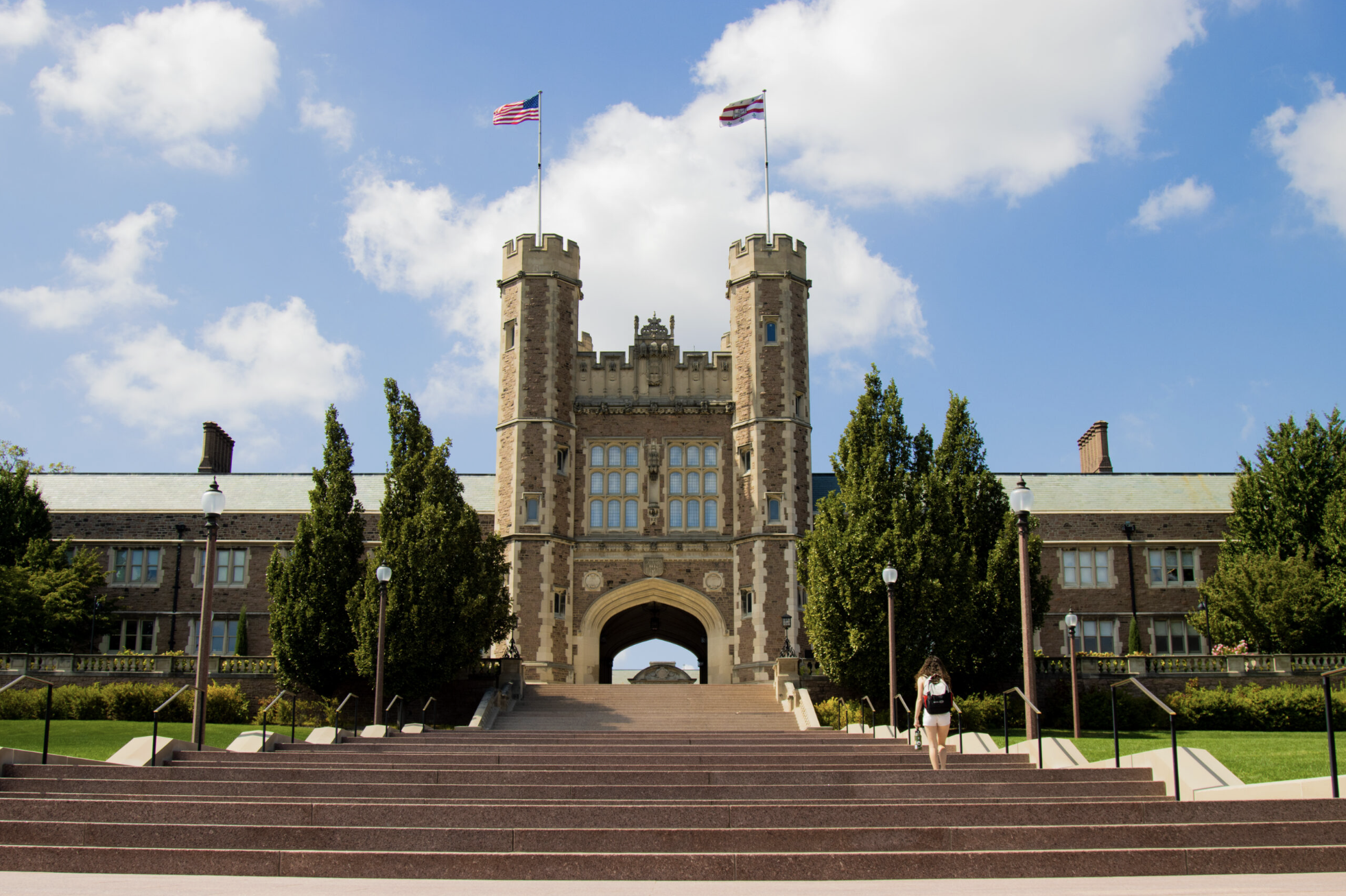
Brookings Hall (Bri Nitsberg | Student Life)
A recent report commissioned by WashU and Vanderbilt on the politicization of humanities research has generated significant pushback from humanities professors, the WashU chapter of the American Association of University Professors (AAUP), and the Director of the WashU Center for the Humanities, among others.
The report affirms the value of humanities research and argues that rigorous research continues in fields like anthropology and sociology. Nevertheless, it concludes that many humanities departments have prioritized pursuing political goals over seeking objective truth and knowledge.
Critics have raised questions about the source of the report’s funding, the preexisting beliefs of the authors, its philosophical focus, the report’s use of artificial intelligence (AI), and what WashU intends to use the report for.
For instance, the WashU chapter of the AAUP wrote in a statement that the report did not divulge the source of its funding or potential conflicts of interest.
“[These are] standard practice for any work of humanistic or social scientific scholarship. In sum, the report is itself a clear example of ‘politicized’ research that its authors attempt to decry,” the statement reads.
The University declined to comment on how much funding was allocated for the report and where such funding came from. In an email to Student Life, NYU philosophy professor and lead author of the report Paul Boghossian wrote that he was told that the committee’s work was funded entirely by internal University funds with none from external donations.
Following the release of the report on June 10, Provost Mark West emphasized in a letter to faculty that the goal of the report is to start conversations, and WashU has no plans to fire or discipline faculty.
Chair of African and African American Studies Shanti Parikh is concerned with the selection of Boghossian as head of the commission, given his longstanding philosophical commitments, including his critiques of social constructivism, epistemic relativism, social justice, and postcolonial thought, and his defense of absolute objectivity and truth.
“If you hire a consultant, and you tell that consultant, ‘I’m hiring you because I like the way you do this,’ that consultant hears their mandate,” Parikh said. “As Chancellor Daniel Diermeier explained in an interview with The Chronicle of Higher Education, he selected Paul Boghossian to lead the commission precisely because he was ‘extremely impressed’ by Boghossian’s views. … If we put [Boghossian’s] work against this report, they would probably be very isomorphic.”
Responding to the critique, Boghossian wrote that since the committee consisted of nine scholars, no one person determined the outcome of its work.
“Relativism (in the precise sense in which we define it) comes up because it is often used to justify a politicized approach to humanistic research. In the form in which it is invoked by some humanistic scholars, it is quite problematic,” he added.
Director of the Center for the Humanities Stephanie Kirk says even the results of a committee of nine scholars reflects just one opinion.
“You could easily assemble a group of people who are equally as eminent as some of these people are, and they would have come up with something completely different,” she said.
Boghossian also had a previous scholarly relationship with Diermier. In an email to Student Life, he wrote that they “had been talking about some of these issues for a while. 30 years ago I commented on the Sokal hoax which raised similar issues about the humanities. So the question whether there is a problem here is not new.”
In 1996, NYU physics professor Alan Sokal submitted a faux article to a cultural studies journal, Social Text, to test the journal’s rigor. The article was published after a lack of peer review, and the affair began international conversation regarding the rigor of the humanities, including Boghossian’s newest report.
Another issue is the new report’s use of AI to survey large bodies of text and identify themes. Boghossian said the exact use of AI tools will be specified with the release of internal reports, which have yet to be published.
Parikh questioned the commission’s use of AI.
“Analysis is greatly shaped by the questions that you ask AI and what you’re looking for in the first place. So, if researchers are interested in evidence of politicization, relativism, social justice, those assumptions are going to shape what AI returns to you,” Parikh said.
Despite finding some methodological issues with the report, Assistant Professor of Philosophy David Kinney is open to some of the report’s claims.
“I think there are some fields in the humanistic social sciences and humanities where a certain relativism about truth is completely taken for granted, and that’s actually a very controversial position among the people who study truth,” Kinney said.
However, Kinney takes issue with the timing of the report and what it might mean for any attempts at future conversations. He wishes that faculty were given the opportunity to engage in workshops on the topic of relativism in the humanities before its publication.
“It’s very hard to have a genuine scholarly conversation with this report when people feel like their livelihoods are being threatened and when people feel like their value to the University is being questioned,” he said.
Parikh also questioned the timing of the report’s release, given that faculty are leaving campus.
“If this was supposed to be a conversation starter, why was it released during the middle of the summer when we can’t have this conversation?” she said.
Kirk is currently working with other humanities professors to organize a forum for people to engage thoughtfully with the report, she said.
“I imagine that such a forum would be an exciting opportunity to exchange ideas, and we’re excited that the Provost is interested in co-sponsoring the event,” she wrote.
The report cites as evidence a 2021 presidential address to the American Anthropological Association by Akhil Gupta, an anthropologist at UCLA. In the address, Gupta claims anthropology is distinct from other social sciences because it has a political project to “challenge the culturally dominant common sense of capitalist consumerism.”
As Director of the Center for the Humanities and a humanities researcher herself, Kirk said that the humanities fields at WashU maintain the highest standards for research, requiring peer review and “the intense scrutiny of a national and international community of scholars that continues throughout their career.”
“Humanities disciplines are methodologically plural, but all aim for a rigorous reconstruction of the full, complex, and diverse reality of human history and culture,” Kirk added. “Everything we say must be supported by concrete evidence.”
Professor of African & African American Studies and Senior Adviser to the Chancellor Dwight A. McBride published an opinion piece in Inside Higher Ed, critiquing the report. Women, people of color, and other marginalized groups were previously excluded from academia, and thus, when included, McBride writes, “they asked questions that earlier generations of scholars often ignored because the people most affected by those questions were themselves excluded from the production of knowledge.”
Associate Professor of Mathematics Steven Frankel said the report attacks views that the authors themselves have manufactured and are not what most humanities scholars actually believe.
“The authors of the report have imagined a caricature of an opponent, with very specific beliefs about the philosophy of truth, and then argued with that person in their heads. A more appropriate title would have been ‘Report on an Imaginary Argument with Dead Philosophers.”
Despite finding logical and methodological issues with the report, Frankel still worries that it may become an excuse for critics of higher education and may affect public perception of research in the humanities.
“It’s something that people can use to confirm their pre-existing beliefs that there’s something wrong with humanities or with higher education, and so it, without giving any actual content or evidence, feeds a specific viewpoint. I think that’s very unhelpful.
Stay in Touch!
Get the latest and top news from StudentLife delivered to your inbox