Forum
The death of creativity and spirit in academic writing
Danesh Temirbekova | Staff Illustrator
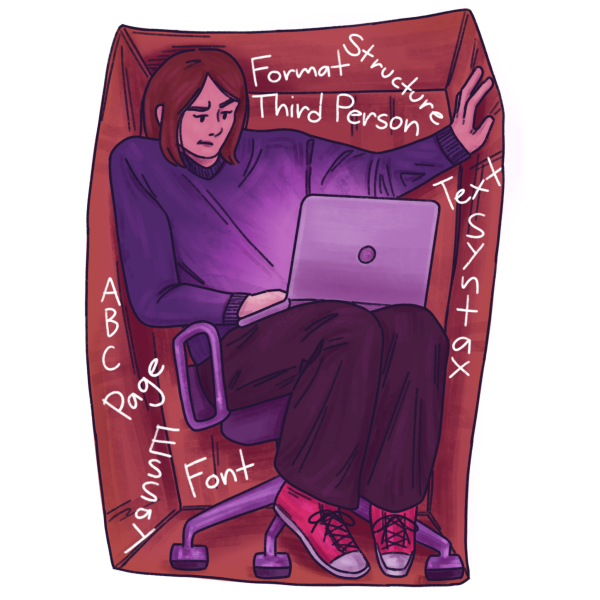
There are few things more frustrating than having something interesting to say and spending the next three hours figuring out how to make it sound more academic. I’ve sat down to write papers on subjects I genuinely care about only to find myself rearranging sentences, replacing perfectly good words with unnecessarily complicated ones, and wondering whether I’ve used “I” one too many times. By the time I’m satisfied with the result, I’m hangry, apathetic to the subject, and questioning the decisions that led me up to that point.
Over the past two years at WashU, I’ve become considerably better at academic writing. I know how to construct a thesis, organize my evidence, and develop an argument that meets the expectations of my assignment and audience. I’ve also become proficient at reproducing a particular kind of language. There are phrases that I reach for instinctively, transitions I use without thinking, and ways of introducing evidence that I repeat across papers on entirely unrelated subjects. I can recognize when a sentence sounds academic, even if I couldn’t explain what makes it better than the simpler version I started with. The frustrating and kind of efficient — depending on who you ask — aspect is that this familiarity makes academic writing easier. I know what is expected of me, and I know how to deliver it. I just don’t particularly enjoy doing it.
Individuality disappears when we learn to express different ideas through the same conventions. Two students can approach the same question with two entirely different experiences, interpretations, and intellectual commitments, yet produce an essay that sounds remarkably alike. One convention I’ve grown especially skeptical of is the preference for third-person writing, which implies that an argument becomes more credible when its author is supposedly objective and removed from the situation. Yet removing myself from a sentence does nothing to remove my perspective from the research.
As a Biology and Women, Gender, and Sexuality Studies double major, I encounter questions of objectivity in very different contexts. In scientific writing, distinguishing observations from personal interpretations is important. But even in research, questions are shaped by human decisions about which methods are appropriate and what conclusions are worth mentioning. In the humanities, where our social positions can directly influence how we interpret history, culture, and power, acknowledging positionality can make an argument more intellectually responsible. There’s room for more original writing when students can be honest about how their own experiences shape what they have to say.
Instructors also play a role in shaping what students come to consider good writing. In her 1982 study of instructor feedback, Nancy Sommers found that professors’ comments often directed students toward correcting surface-level errors rather than developing their arguments. In a more recent study from 2009 of more than 2000 college writing assignments, researcher Dan Melzer found that students were frequently writing for limited audiences and purposes, often primarily to demonstrate what they had learned to an instructor.
These findings show how much influence instructors have over what students learn to value in their own writing. I find that strange, especially for introductory writing courses designed to challenge established ways of thinking. I don’t think every essay needs to be experimental or particularly entertaining; however, I do wonder how many interesting arguments become less interesting simply because the writers learned to make them sound acceptable to someone.
Of course, some standardization is necessary. Scientific papers, for instance, depend on standardized methods and conventions that make findings understandable, comparable, and reproducible. But I’m less convinced that the same expectations of objectivity belong in humanities and social science writing, where interpretation is central to the argument. A historian’s understanding of an event or a sociologist’s reading of a social institution involves choices about how evidence should be interpreted. Pretending those choices are entirely detached from the writer does little to make the argument more credible. I’ve benefited from learning the conventions on how to structure an argument and support it with evidence, but I don’t see why doing so should require students to suppress the perspectives that make their interpretations valuable.
Perhaps the most disappointing part is how my own relationship with writing has changed. If you are anything like me, you enjoy the process of finding the right words for an idea, sometimes spending an unreasonable amount of time on a single sentence because you just knew it could be better. But now I make decisions on what I think the professor will reward. I plan paragraphs before I fully explore my arguments. Sometimes I read an assignment I’ve finished and then realize that it’s grammatically sound, persuasive, and utterly uninteresting to me. I can spend hours producing something that meets every expectation, only to realize I’ve spent very little of that time thinking about what I actually wanted to say.
I want to be able to write a rigorous research paper, understand the conventions of the disciplines I study, and know when those conventions serve a purpose. But I also want the freedom to develop a recognizable voice within them. I think we could all stand to question the writing habits we’ve adopted without much thought. And perhaps professors, especially in the more introductory courses, could leave more room for students to experiment with how they express their ideas within the boundaries of academic rigor that is expected. If college is meant to teach us how to think independently, our writing should be allowed to reflect that independence. I’ve spent two years learning how to sound like an academic. I plan to spend the next two exploring my own style of academic writing, and I hope you do the same.
Stay in Touch!
Get the latest and top news from StudentLife delivered to your inbox