News
Q&A with Chancellor Andrew D. Martin, Spring 2026
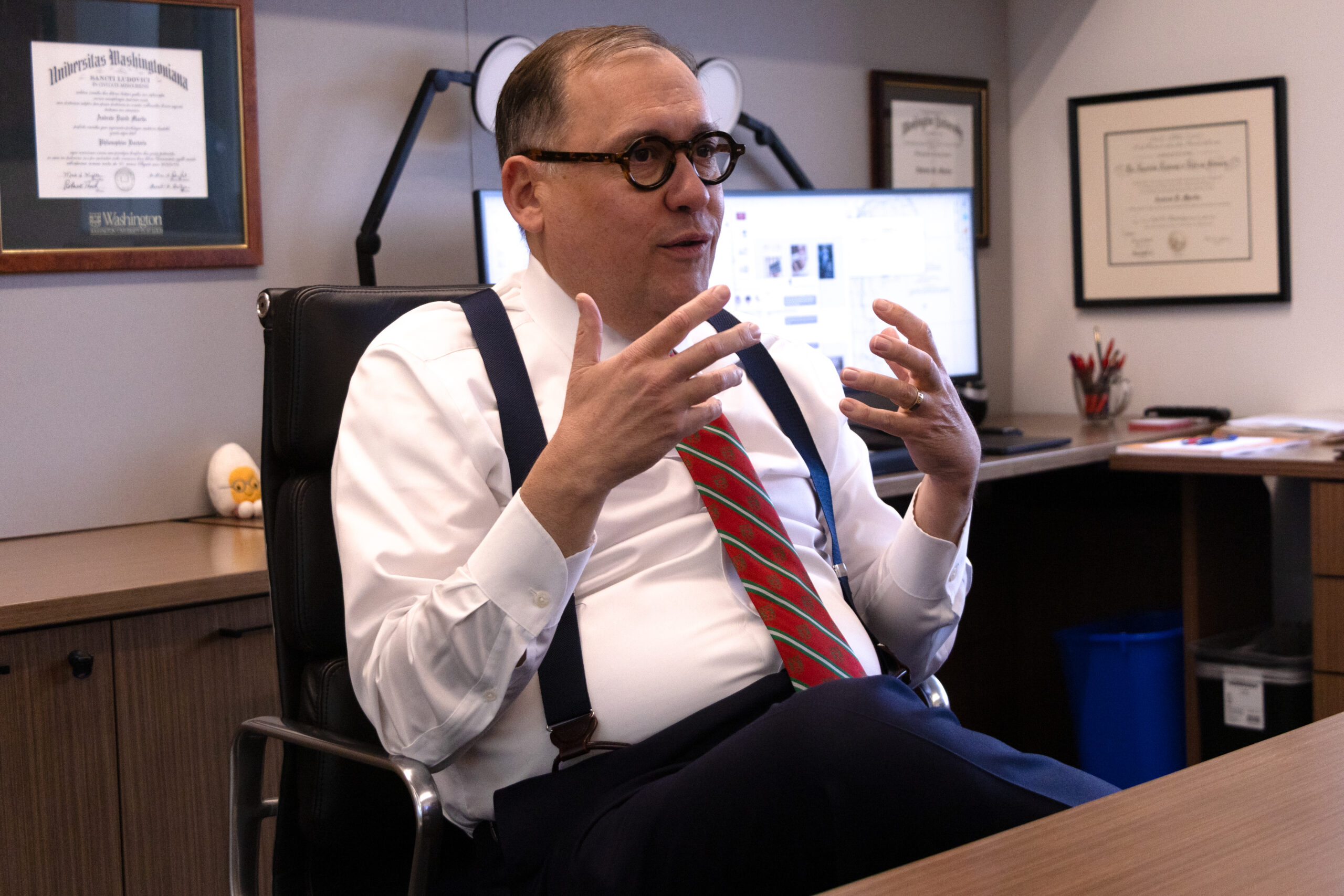
WashU Chancellor Andrew D. Martin sat down with Student Life for a Q&A on Wednesday, April 1. (Isabella Diaz-Mira | Managing Photo Editor)
WashU Chancellor Andrew D. Martin spoke with Student Life on Wednesday, April 1 about WashU’s engagement with the Trump administration and Congress, University finances, the addition of a new pharmacy school, artificial intelligence, emergency preparedness, and more.
The transcript of this Q&A has been edited for length and clarity. You can read a recap of the Q&A here.
Student Life (SL): We’re over a year into the Trump administration’s second term. What have you learned about how to navigate the changes to higher education so far?
Andrew D. Martin (AM): Meaningful engagement is really important. We’ve spent an enormous amount of time in Washington [D.C.] engaging with folks in the Congress and in the administration about things that are super important to us. The endowment excise tax was one of those issues, funding for scientific research is another one of those issues, and I think that sustained engagement around important issues and advocacy is really important.
SL: You met with the Trump administration in the fall to talk about the [proposed Compact for Academic Excellence in Higher Education]. Why was it important, in your perspective, to participate in those meetings?
AM: To be clear, the conversations with the administration weren’t explicitly about the compact. They were about the importance of American higher education, the importance of academic freedom, the importance of research funding, the importance of protecting our endowments so we can fund professorships and student scholarships and the like. There’s kind of a saying in Washington that ‘if you’re not at the table, you’re on the menu.’ So when we have policymakers that have an enormous amount of power over what we do, it’s important to be at the table advocating for the institution.
SL: How much of the University’s financial challenges have been caused by uncertainty regarding the Trump administration and federal legislation?
AM: We were dealing with an enormous amount of uncertainty a year ago. We didn’t know where we were going to end up with the endowment excise tax. We knew that there were proposed budgets to radically reduce the amount of [National Institutes of Health] funding, in particular, and the way in which we cover the overhead to support the research enterprise. A lot of that uncertainty has resolved, at least for this federal fiscal year, but we still really don’t know going forward what the level of federal research funding is going to look like. We know what the endowment excise tax is going to be, and, of course, it costs us more money than what we’ve been paying in the past.
SL: You said in your State of the University address that the University is in a far stronger position financially than last year. What changes do you think have enabled that improvement?
AM: First, we dramatically slowed down capital investing. The new building for [the College of] Arts & Sciences has been put on pause. We eliminated $50 million of expense out of the central administration. Each of the schools has been working carefully at their budgets to ensure that they’re stewarding resources appropriately. And at the medical school, we’ve seen some really outstanding performance by our clinical faculty, which has produced some additional revenue as well. It’s really a combination of all of those things that have put us in a stronger financial position, but as things move forward, it’s certainly the case, given the state of the federal budget, that we’re not going to enjoy the levels of support for NIH funding in the long term. We really need to think about how we operate the University under that type of constraint.
SL: You mentioned the Arts & Sciences building that was canceled last year. Is the University looking to revisit it now that there’s some more certainty?
AM: To be clear, we didn’t cancel the building last year. We put the building on pause, and it’s still on pause. In the next four to five years, I don’t think we’re going to be doing much new capital investing on either campus, except for dormitories on this campus, where there is a significant demand for more of our students to stay on campus. And it’s also the case that new dormitories produce new revenue because those rooms get leased. And at the medical school, we’ll be building more clinical space, because, again, that helps drive the clinical mission. As I think about academic buildings on the Danforth campus and we think about research buildings on the medical campus, I just don’t see us doing a lot of capital investment in the near future.
SL: Would you say that informed the university’s decision to buy the [University of Health Sciences and Pharmacy]?
AM: The pharmacy school was a once-in-a-century opportunity. Over the course of history, [the] St. Louis College of Pharmacy and WashU had discussions about coming together, and the timing never worked for either institution. Even though we are in a moment of looking at budgets and being very rigorous in terms of how we’re stewarding resources, this was an opportunity that we couldn’t pass up. We were able to work with UHSP to put together a financial transaction that not only preserves the legacy of the St. Louis College of Pharmacy, but actually opens up all sorts of opportunities for the University in the future. The same, too, with the opportunity to purchase the Fontbonne campus, which happened a couple of years ago. It’s unfortunate that Fontbonne wasn’t able to continue to operate, but we were able to acquire a significant amount of real estate contiguous with our campus, which, if you look around, is never going to happen again, because there’s no other real estate around the campus that’s available.
SL: With the purchase of UHSP, some students are able to come over as part of that PharmD program, but some students will have to go elsewhere.
AM: All of the PharmD students will hopefully stay and graduate from the WashU St. Louis College of Pharmacy. There are many pre-pharmacy students that are undergraduate students. They, so long as they have suitable academic performance, are guaranteed admission into the pharmacy school. Through our School of Continuing & Professional Studies (CAPS), we are offering teach-out opportunities for some of those students to come to WashU. UHSP has also worked with about a dozen or so other universities to provide opportunities for students to transfer credit and ultimately graduate.
SL: Some WashU community members have criticized the amount of money the University has spent transitioning from WebSTAC to Workday. How do you justify the cost of that project, and how has it been going so far?
AM: I think the project has been going okay so far. We’ve heard from many members of the faculty and for many students that there’s things that need to be improved, and the teams are working to do that. We made an enterprise decision some time ago that we could no longer run the University on these antiquated systems that we built ourselves. There’s an enormous amount of risk for the University to continue to operate with these legacy systems. In fact, there have been other universities whose student information system just shut down and went away for months, which is extraordinarily costly and quite disruptive. We decided at that time that we needed to move to a modern platform. There’s a lot of research that was done, we chose the Workday product, and I think the implementation has gone okay. There’s clearly an opportunity for improvement, but the idea of staying on these legacy systems was not a viable option for us going forward.
SL: WashU has seen a drop-off in enrollment of international graduate students, particularly from countries like China. What do you see as the major causes of the decline, and how does that factor into the financial picture of the university?
AM: The big cause is a decrease in demand. It depends on the local economies of the countries from where these students are coming. The slowdown in the Chinese economy is going to cause fewer people to be willing to come to the U.S. for graduate programs. It’s also the case that current U.S. immigration policy makes it challenging, and we saw last academic year, we had some of our students whose visas were canceled, and so it’s a less welcoming place for international students. It hasn’t affected us financially with the undergraduate program — that demand has stayed quite robust. We have so much demand from domestic students that if those numbers were to go down financially, it really wouldn’t affect us. It has affected us in a number of our master’s programs, particularly at McKelvey, Olin, and the School of Law, and some of those programs are seeing demand drops of 50% or greater, and so that has really put some financial pressure on some of the schools.
SL: Are the deans or the University in general trying to do anything to resolve that or make the University more welcoming for international students?
AM: We want to welcome all students. This isn’t a WashU issue, this is a U.S. issue. We continue to advocate for the importance of the international community and the value that international students, international faculty, and staff bring to the University. But this is really more of a national, systemic problem.
SL: I want to move to talking about a topic that is reshaping higher education in some ways, which is artificial intelligence. How do you use AI in your daily work?
AM: I use AI all the time, mostly to gather and compile information. I’m using AI to do a lot of research when I just need to find a bunch of facts and get it organized and put together. My team is using AI to manage all sorts of workflows that come through my office, whether it’s remarks or other sorts of things.
SL: With the integration of artificial intelligence into the University’s curriculum, how do you see it changing the way you view the role of a university like WashU in preparing students?
AM: That’s the most important issue facing American higher education today. The thing that we need to grapple with as an institution is, how do we make sure that every one of our graduates across all of our programs are able to be leaders in a world where AI is ubiquitous? That’s not like we’re going to become ‘AI University’ and there’s not going to be some new AI requirement or anything else. That’s going to require deep engagement by the faculty, deep engagement with partners outside of the University, whether it’s employers or others, and it’s work that we’re undertaking with great gusto. Our provost, Mark West, is leading that here on the Danforth campus.
SL: One event that happened this semester on campus was the armed person alert, which was later called off. What was going through your mind during those moments?
AM: I was scared and completely freaked out. The safety and security of this campus is our most important responsibility. Immediately, I got on the call with my team to really understand what was going on. But I was terrified. Thankfully, with extraordinarily fast and effective police work, we were able to lock down the campus. First response was less than two minutes from the time that the first phone call came in to dispatch, and we were able to clear the entirety of the campus in less than two hours.
SL: Are there lessons that the University can learn in terms of emergency preparedness for future situations?
AM: 100%. Thankfully, we were given an opportunity to learn this without it being a part of a real event. We had lots of gaps in our training, both for faculty and staff and for our students. The response of [the Washington University Police Department] and our collaborating law enforcement partners was extraordinary, and it’s something that we practice every summer, and it worked exactly as it should have. But we’ve learned that there are some real gaps, and one of the things we’re hearing from students is they’re interested in more training. We’re hearing the same from faculty and staff, and we’re working right now to roll that all out so that hopefully we don’t have to deal with this ever again, but if so, we can do so even more effectively.
SL: Since you appointed the Inclusive Excellence Advisory Committee to review WashU’s diversity, equity, and inclusion practices, what recommendations has the committee made for the university?
AM: The committee is still doing its work. The task of this committee is to look at our deep institutional values. Those are values about inclusion, the importance of having a diverse community where everyone can be successful and people are treated fairly, and at the same time, [making] sure across this very decentralized university with lots of distributed authority that we are doing things that are consistent with federal law. That committee is continuing to do its work. We will be engaging the University community when that work is complete.
SL: What’s the timeline on that work?
AM: At some point. It’s a significant amount of work. I’m not going to give you a date and light a fire under them. These are a group of super-talented professionals who are doing a bunch of other things, but have spent an enormous amount of time to get this right.
SL: What’s the current planning status for Fontbonne’s campus?
AM: We’re starting a capital planning process. We had actually planned to do so at the beginning of 2025 and, given all the uncertainty coming out of Washington, we decided to pause that process. We’re now beginning to think about the Danforth campus, the South 40, and now Fontbonne, to put together a 50-year plan for how we will use that space. There’s lots of different options, and every person that I talk to has strong opinions that all differ about how we should use that space. As I said, this is a once-in-a-generation opportunity, and we’re going to be really thoughtful about how we deploy that space.
SL: What are some of the options under consideration?
AM: Everything’s under consideration. We could have more student residential space, we could have some more student activity space, we could have academic space down there. There’s a fantastic gymnasium on that campus, so surely, there’s going to be some recreation facilities down there, and, of course, we could use it for administrative offices.
SL: After WashU Emergency Support Team (EST) lost Student Union (SU) block funding this past week, is the University considering steps to financially support EST or other student-run programs?
AM: I don’t know, I haven’t been briefed. I read your great reporting in Student Life on what happened in that election where the block funding wasn’t passed. I haven’t had an opportunity to talk with our folks in Student Affairs about the implications of that.
SL: How does the university work with SU to navigate things like this, involving the spending of the Student Activities fee? Is there a role for the University to influence those decisions, or is it all separate?
AM: We institutionally made a decision under Chancellor Bill Danforth to say, rather than have the University be involved in ‘this student group gets funded, and that student group doesn’t,’ to give it to the students. I think that was a very, very wise choice. Every year, I sign a contract which basically says that this amount of money is coming from the University to SU to do that work. Dr. G and her team engage with the leaders of SU on all sorts of issues, one of which is the responsible stewardship of these funds. For the most part, the process works really well. For now, we’re pleased with the idea that students will get this responsibility. I could imagine a scenario if things got really gnarly, that’s something we could always pull back, but I think it has served this University really well over a long period of time.
SL: Now, for some fun questions. How much of your closet is red?
AM: Probably 60% of my stuff in the closet is red.
SL: What’s your favorite part about spring in St. Louis?
AM: The best part of spring in St. Louis is when everything blooms. Whether it’s in Forest Park, around here on campus, the botanical garden, this is beautiful here in St. Louis. And then two weeks later, it’s 100 degrees and not so comfortable, but I think this is the prettiest time of the year here in St. Louis.
SL: The WashU Bear currently does not have a name. What do you want to name it?
AM: I don’t want to name it, I want [students] to name it.
SL: What do you think is a good name?
AM: So I got the question from Dr. G, ‘is it okay if we name the bear?’ I’m like, yes, it’s okay if we name the bear, but I’ll let you guys figure it out.
SL: I noticed you have a lot of baseball hats above your office. Any predictions for the MLB season this year?
AM: I will predict the St. Louis Cardinals will not make the playoffs, and I’ll predict that the Dodgers will win, and Dr. G will be the happiest person on the planet.
Editor’s Note: This article was updated at 7:25 p.m. on April 5 to include a link to a summary of the Q&A.
Stay in Touch!
Get the latest and top news from StudentLife delivered to your inbox