News
Breaking down Workday’s $265 million cost
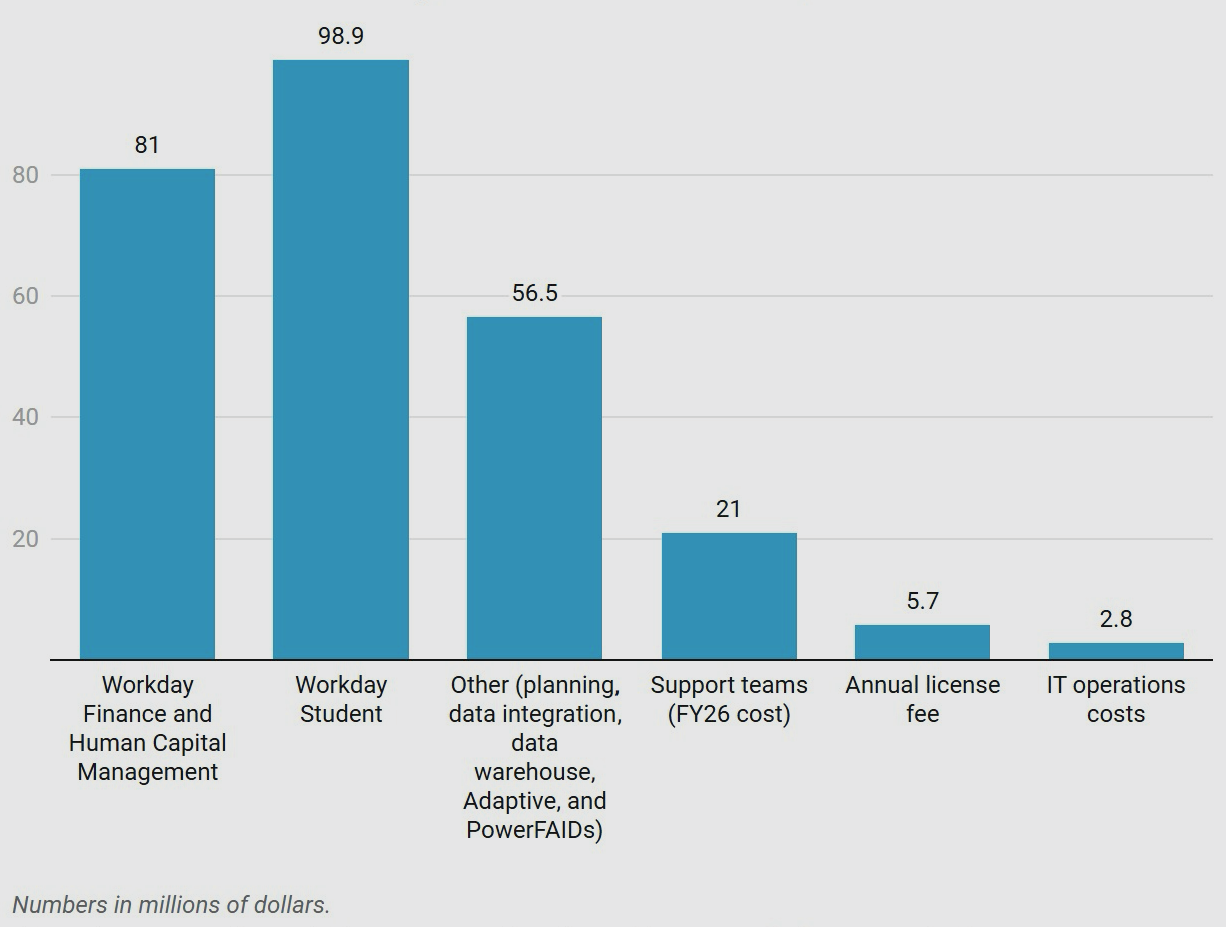
Chart: Riley Herron | Editor-in-Chief • Source: Data shared by David Gray
The total cost of the project and implementation of WashU’s Workday and Student Sunrise projects totaled over $265 million, spent over at least seven years, according to David Gray, executive vice chancellor for finance and chief financial officer (CFO) of WashU.
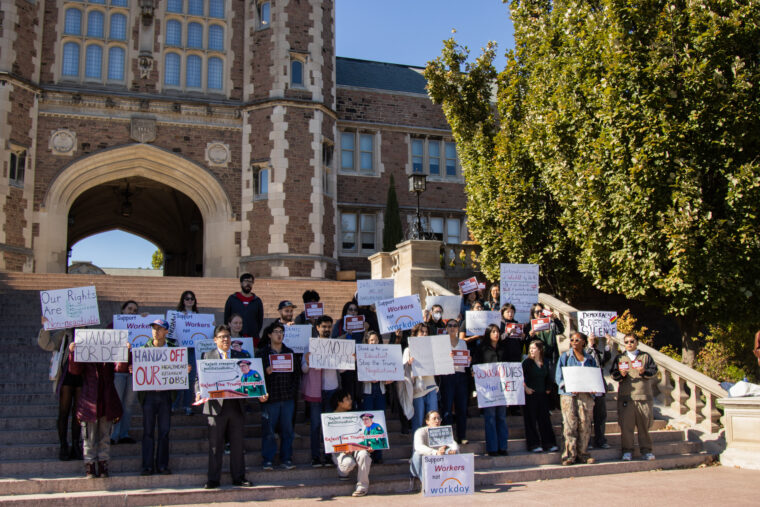
The cost of Workday has been criticized by some members of the University community. On Oct. 23, undergraduate and graduate students and faculty protested outside a meeting between Gray and the WashU Faculty Senate Council during which Gray provided information about current and past University finances. Some of the protesters held signs reading “support workers, not Workday.”
According to Gray, the Workday cost can be broken down into three main segments: $81 million for Workday’s financial and human resources services, called Human Capital Management (HCM); $98.9 million for Student Sunrise, which includes Workday Student; and $56.5 million for planning, data integration, financial aid support PowerFAIDs, and other costs related to Workday. The University is also spending $23.8 million in fiscal year (FY) 2026 for Workday support teams and operations and pays a $5.7 million annual licensing fee.
Workday HCM and finance aspects were in the works since at least 2018 and went live in 2021. Planning for Student Sunrise began in 2020 and went live over stages in 2024 and 2025.
The costs of Workday HCM and Student Sunrise have also drawn increased scrutiny as University prorations increased for the fourth consecutive time in this year. According to slides displayed by Gray at the Faculty Senate Council meeting, prorations increases accounted for an additional $200 million paid by WashU schools between FY 2022 and 2026.
Prorations are payments made by WashU’s eight schools to its central fiscal unit (CFU), which is the administrative body of the University and includes aspects like the chancellor’s office, the fundraising arm of the University, and the library system, among others.
When students pay tuition, it goes to their individual school, not the CFU. Tuition at WashU has been steadily increasing over the past decade.
Gray wrote in an email to Student Life that prorations are only used to fund ongoing costs for Workday and Student Sunrise — the $23.8 million for Workday support and operations, as well as the $5.7 million annual licensing fee — and that the other expenses were funded centrally.
He also wrote that proration rates were determined by estimates of the total CFU budget, and each school’s proportion relates to its “direct expenditures, student [full time equivalents], and square feet occupied on the Danforth Campus.”
“The biggest cost [drivers] of the CFU are the staff in areas such as Advancement, IT, Facilities, Marketing & Communications, Human Resources, Office of the General Counsel, and Financial Services,” Gray continued.
The University’s annual budget — including the anticipated costs of the CFU — is put together by the chancellor and the Office of Finance and approved by the board of trustees.
Erin Culbreth, senior associate provost and executive director of Student Sunrise, wrote in an email to Student Life that the project was needed to replace a number of outdated systems.
“The legacy student information system was in its last phase of life. It was a 1990s era set of fragile, homegrown applications including WebSTAC, WebFAC, SIS Admin and other platforms. With the transition, the University replaced nearly 80 separate student systems with Workday.”
A document titled “The Business Case for Workday” on the Student Sunrise website says that WashU struggled to find developers able to code on the old system. It also says the old system created unnecessary manual labor for faculty for special cases like Beyond Boundaries classes and that it did not provide consistent data for decision making.
Culbreth also wrote that she believed students’ experience with Workday would improve over time.
“Transitions of this scale are always difficult,” Culbreth wrote. “Overall, the transition is proceeding as planned, but that doesn’t mean it isn’t a frustrating change for students, faculty, and staff. Using Workday will get easier and more familiar over time. And the University will continue to make improvements.”
Michael O’Bryan, a senior lecturer in the department of English and the secretary of WashU’s American Association for University Professors (AAUP), has been one of the most vocal in calling for more information from the University about the cost of Workday.
“I don’t think that the faculty have generally felt that there’s been a particularly high degree of transparency with the specific costs associated with Workday,” O’Bryan said, “It’s just hard to see how a software transition should cost a quarter of a billion dollars.”
WashU’s financial situation has become increasingly more complicated as the Trump administration has cut research funding and increased the endowment tax earlier this year. In early October, the school announced layoffs of almost 300 staff members, citing both the anticipated reductions in NIH funding and existing financial inefficiencies prior to Trump cuts.
In response to faculty and staff questions about finances after the layoffs, the University released a webinar about the current state in October. University leadership said they projected to finish FY 2026 in a narrow deficit of $7.4 million, bringing in $5.04 billion in revenues, while spending $5.047 billion in operating expenses.
As part of the Workday and Student Sunrise projects, Gray said WashU employed Huron Consulting for a readiness assessment for Workday HCM and its finance aspect, and Huron assisted with the budgeting and planning implementation. Additionally, WashU employed Cognizant (formally named Collaborative Solutions), another consulting firm, as the implementation partner for Workday HCM and Finance.
Gray wrote that the costs for the respective consulting groups were included in the project and implementation costs of Workday HCM/Finance and Student Sunrise listed above. Gray served as interim senior vice chancellor for finance and WashU CFO from 2024 to 2025 while employed as a senior advisor at Huron, but said he performed no work at any time related to Student Sunrise in that role or in his previous role at Huron.
WashU is also not the first school to pay millions transitioning to Workday or employing Huron. Between 2013 and 2023, the University of Wisconsin system spent $121 million on Huron, and between 2019 and 2023, it spent $51 million on implementing Workday.
The Business Case for Workday document, from 2021, says that WashU was “early in implementing Workday Student,” but its adoption has accelerated since then. According to the Workday website, 28 universities began using Workday Student in 2024.
O’Bryan felt the prevalence of Workday at other schools did not make it a good choice for WashU.
“Just because that’s what a lot of other schools have done doesn’t mean … that it’s wise to do, or a thing that is even good management,” O’Bryan said.
The University has also made several other large and small investments in recent years. These include constructing a new neuroscience building on the Medical Campus, buying Fontbonne, and undergoing a rebrand — the latter two costing $39 million and $2.8 million respectively according to Gray. The University also instituted a no-loan policy in fall 2024, which Gray wrote costs $8 million annually, though he said it is funded by existing scholarship endowment payouts through FY28.
Stay in Touch!
Get the latest and top news from StudentLife delivered to your inbox