News
WashU announces highest tuition increase in over 10 years amidst Trump administration
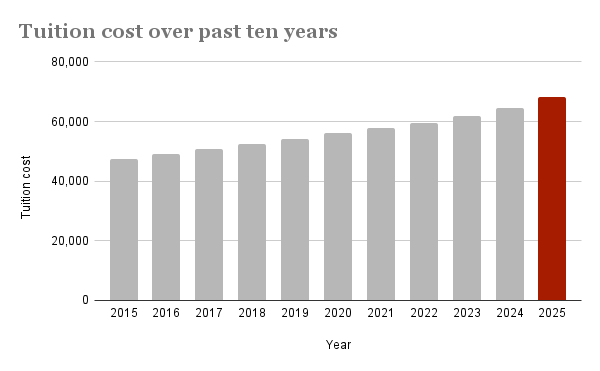
Tuition costs over the past decade. The 2025-2026 year’s tuition will rise to $68,240, a $3,740 increase from the current tuition. (Sydney Tran | Editor-in-Chief)
Washington University students and parents were notified of a tuition increase for the 2025-2026 academic year via an email on March 27. Tuition will be $68,240 next year, reflecting a $3,740 increase — 5.8% higher than this year’s rate — making it the largest tuition increase in the past 11 years.
Beverly Wendland, provost and executive vice chancellor for academic affairs, told The Record that the abnormally large increase in tuition was necessary, in part, due to the loss of research funding as a result of federal actions from the Trump administration and a potential increase in the federal endowment tax.
Wendland explained that either a significant loss in federal research funding or an increase in the federal endowment tax would cause the school to seek out funding from various sources, including tuition.
“We are looking closely at all possible avenues for addressing a potential shortfall,” Wendland wrote in an email to Student Life. “The tuition rate is only one part of the equation, but we do rely on funds from tuition to help support the education of our students, which is inextricably entwined with all the work we do at WashU.”
Wendland said that the University also relies on other means of funding beyond tuition, such as payout from unrestricted endowments, philanthropy, and indirect costs from research grants.
Aside from tuition, costs such as housing, meal plans, and fees will rise as well. Next year, the cost for a double room will range between $13,970 and $14,568, meal plans will range from $5,880 to $8,770, the student activity fee will be $682, and the health and wellness fee will be $672.
The cost for a double room has increased by at least $728 on the lower end to $760 on the higher end. Meal plans have risen by $560 to $724, depending on the plan. The student activity fee increased by $36, and the health and wellness fee increased by $26.
The increase in meal plan rates comes amid complaints from students this year about the high pricing of food and limited purchasing power of meal points. The added expense of the meal plan will make the ratio of dollar value to meal points greater next year, if the number of meal points per plan remains the same. Put another way, the increase in cost means there is now a ~$1,200 fee to convert dollars to meal points, up from $885 this year.
An article from The Source answering frequently asked questions about the tuition increase explains that the increase in meal plan cost reflects rising food prices.
“The price of meat, produce and dairy is growing faster than the rate of inflation. The Platinum Meal Plan will continue to serve the majority of students’ daily needs by offering the most flexibility and variety across our dining locations,” reads the article. “WashU remains committed to providing tasty, satisfying, and healthy meals that meet the needs of our students.”
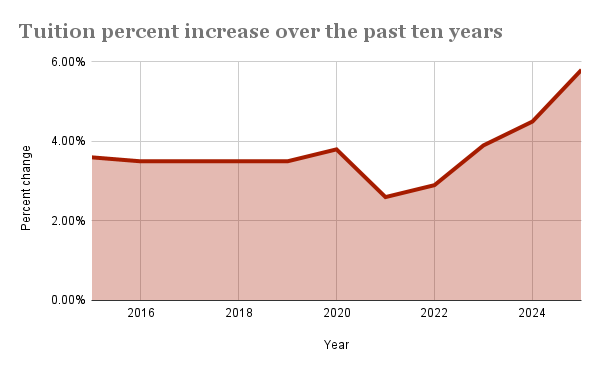
Percent increase of tuition costs over the past decade. The 2025-2026 year’s tuition will rise to $68,240, a 5.4% increase from the current tuition. (Sydney Tran | Editor-in-Chief)
Wendland emphasized that students who qualify for need-based financial assistance will continue to receive consideration for cost increases. Wendland also highlighted the “no-loan” policy and the WashU pledge, which makes undergraduate tuition free to students from the Missouri and Southern Illinois area with an annual family income of $75,000 or less.
The University also introduced the Instant Net Price Estimator to calculate tuition costs. Julie Flory, vice chancellor of marketing and communications, explained that this calculator differs from those used by other colleges, which commonly rely on the MyinTuition calculator. Unlike other tuition calculators, the University’s new tool requires students to answer fewer questions.
First-year Olivia Hart said that while the increase in tuition makes sense based on what is happening federally, it is frustrating for students.
“I think at first glance, [increasing tuition] makes sense, since the school is trying to make research opportunities available for students,” Hart said. “But, from the perspective of [that tuition increase] becoming the student’s financial burden, [that’s] almost convoluted. They’re presenting this idea of having research opportunities, but the student now has to be financially responsible after research funding cuts.”
Editor’s Note: This article was updated at 10:09 P.M., on March 27th, to include the perspective of Julie Flory, vice chancellor for marketing and communications at WashU.
Stay in Touch!
Get the latest and top news from StudentLife delivered to your inbox