News
WashU announces over 300 layoffs and cuts to 200 vacancies

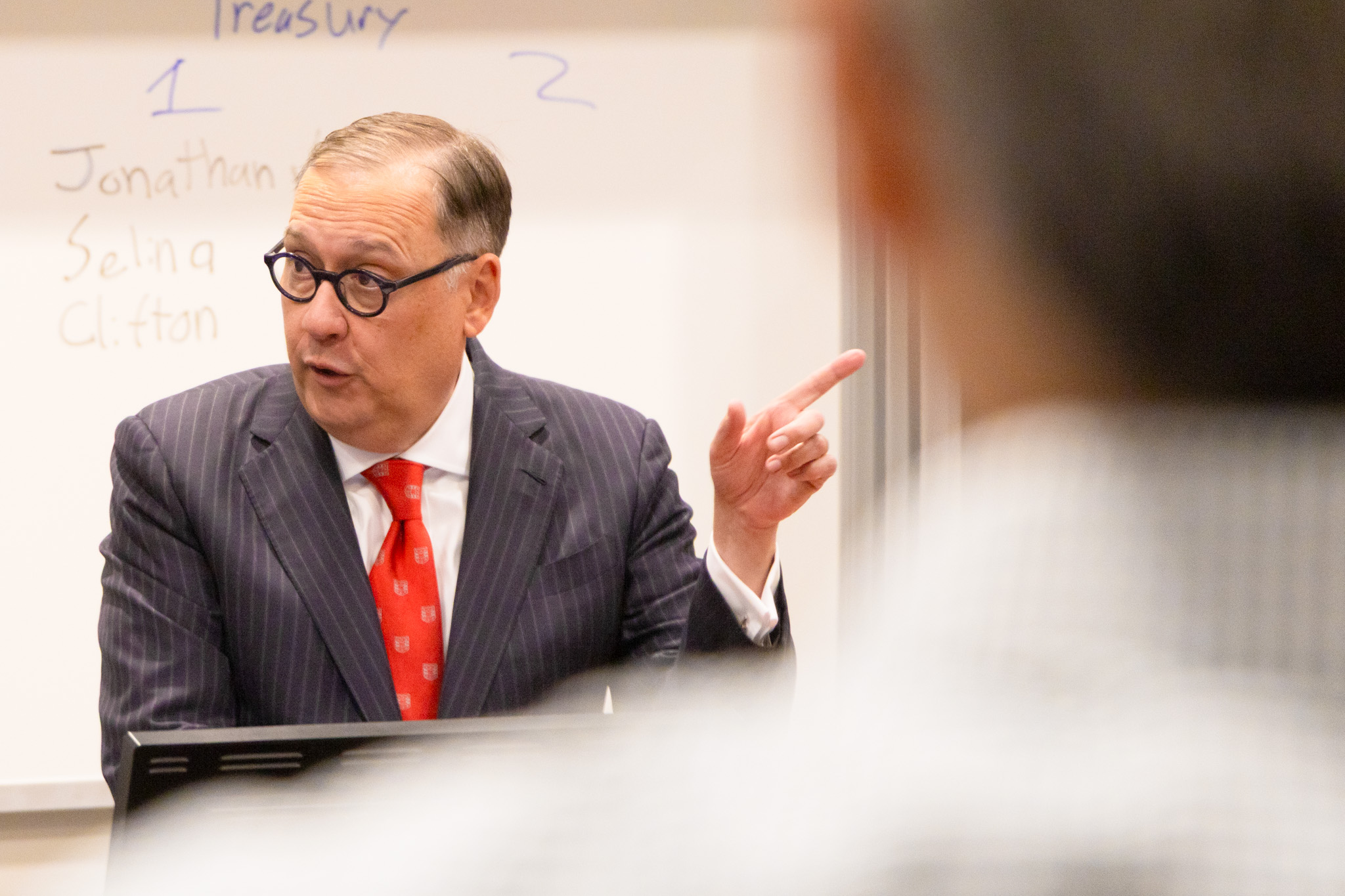
Chancellor Martin announced widespread layoffs in a Tuesday email, including in its University Advancement division located on WashU’s West Campus. (Dylan Whiting | Contributing Photographer)
WashU has eliminated 316 staff positions and “closed 198 open and vacant positions” from the Danforth and Medical campuses and the Central Fiscal Unit (CFU), Chancellor Andrew Martin announced in a University-wide email addressed to faculty and staff on Tuesday afternoon.
Martin wrote that the layoffs are estimated to account for $52 million in annual savings. He said that some of the terminations “stem from external pressures that … include the changing needs of our students, emerging technologies, and innovations in teaching and learning.”
He also attributed some of the layoffs to longer-term internal inefficiencies as well as to the proposed cuts to federal research funding.
“Other [terminations] come from internal decisions and structures that have, over time, created ineffective processes and redundancies in the way we operate,” he wrote.
This is not the first time that Martin has alluded to cuts within the University’s central administrative unit. In his Fall Q&A with Student Life on Sept. 9, he said that in addition to cutting spending across WashU’s eight schools, the CFU was working to reduce its own internal expenses.
The CFU is the administrative body of the University separate from WashU’s eight schools and includes sectors like the chancellor’s office, the fundraising arm of the University, and the University’s library system, among others.
Martin wrote in the message Tuesday that it was necessary for the University to make cuts to be well-positioned financially to fulfill the school’s central mission.
“Our mission – in support of teaching, research, and patient care – drives everything we do. Our ability to fulfill it requires us to be in a strong financial position. If we want to be great, and not just good, we must focus our resources where they will have the most impact and ensure that we’re positioned for success in the long-term,” Martin wrote.
One branch of the University’s CFU, University Advancement (UA) — which coordinates fundraising from donors and alumni — laid off 38 people on the morning of Monday, Sept. 29, according to an internal email. Per the UA’s website, 273 people had been employed on its team, meaning nearly 14% of the division’s staff was laid off.
Executive Vice Chancellor for UA Pamela Henson wrote in an email to her whole staff that the layoffs were related to WashU being subject to both “internal decisions and external pressures.”
“WashU’s Central Fiscal Unit was asked to resize areas and programs to reflect our current operating environment,” Henson wrote in the email.
According to a list of the positions and ages of the terminated jobs obtained by Student Life, administrative roles such as the “Executive Director of Engagement” and an “Associate Vice Chancellor” were among those terminated. The ages of those impacted ranged from 26 years old to 76 years old.
One employee who was terminated from UA spoke with Student Life about the firings on the condition of anonymity out of fear of retaliation.
The UA employee said that they went into work on Monday believing it to be a normal day, but they received an email around 9:30 a.m. saying that they needed to free up their schedule for the next two hours of the day.
They said they were told by a UA supervisor and an HR official that their position was being terminated due to “financial difficulties” and to “not take it too personally,” and were then escorted from the UA building. They collected a personal bag from their office but were not allowed to gather any other personal items.
The employee said they were told that they will be provided with severance pay during the month of October and their belongings from their office will be shipped to them.
They said that their family relied upon WashU’s health insurance and they were “banking on” sending their children to college with assistance from WashU through its free tuition policy for staff and faculty employed by the school for at least seven years.
“What makes me the most upset is that I am going to struggle to provide for my kids both with healthcare and college,” the former employee said. “This will set us back generations, I mean we are going to go into severe debt because of this [since] we had no warning.”
The employee alleged that no one from UA’s “fundraising vertical” team was cut in spite of the team not hitting their fundraising metrics, saying the “behind-the-scenes” roles which supported the fundraisers’ work were among those cut.
“I would just say people are shocked at who was let go and who could stay,” they said.
This employee was most struck by the suddenness of the terminations after having worked at the University for a number of years.
“This isn’t the WashU that I knew,” they said. “They treated us like trash [during the termination process].”
The employee alleged that of the 38 who were fired, 37 of them were women. When asked about this claim and other details of the UA terminations, Vice Chancellor of Marketing and Communications Julie Flory referred Student Life to Chancellor Martin’s Tuesday email about the layoffs.
In the conclusion of his message, Martin acknowledged the impacts of the layoffs and said that the Employee Assistance Program and other well-being-focused resources were available to those in the community impacted by the cuts.
Martin added that there will be a webinar produced by him and other university leaders shared with students and faculty on Oct. 6 which will go into detail about budgeting during both fiscal years 25 and 26.
Michael O’Bryan — Senior Lecturer in the English Department and Secretary of WashU’s American Association for University Professors (AAUP) — spoke about some of WashU faculty’s concerns about the financial situation.
WashU’s chapter of the AAUP, which was founded in April 2025, works to “channel the energies” of the aggregated faculty and graduate students of the University by hearing individual faculty member’s concerns and addressing issues as a collective.
Most recently, the chapter publicized a petition stemming from the concerns of several faculty members about WashU’s budget and the level of financial transparency from the administration.

The petition alleges that some recent cuts do not align with the University’s core mission such as Arts & Sciences’ 12% reduction to all departmental operating budgets and the McKelvey School of Engineering’s elimination of 25 positions this past summer.
The petition also specifically requested a session with the University’s Chief Financial Officer David Gray and the Vice Chancellor for Administration Nichol Luoma, which the University complied with. The session will take place in-person on Oct. 23 from 1 p.m. to 2:30 p.m. and will not be open to the public.
The session is separate from the webinar mentioned in the chancellor’s email to students and faculty.
O’Bryan said that one of the faculty’s concerns was that communications from administrators about fiscal problems referenced issues that predated NIH cuts and increased taxes to endowment funds.
“There are these offhand references to an existing fiscal situation, which precedes Trump’s budget cuts, and until these emails started coming out, nobody had really known that existed,” he said.
O’Bryan said that faculty were surprised by the announced cuts, given that the University had not done anything to indicate financial troubles in the past.
“We’ve certainly spent like a University that’s flush with cash, in many ways, for the past several years, putting up new buildings, buying a whole University, and now it turns out that maybe we don’t have money, and that that was going on before [the federal cuts],” O’Bryan said.
O’Bryan mentioned that other main concerns of the faculty included reductions in staff such as the recent firing of two subject librarians, the removal of DEI content from the University’s websites, and the pause on merit raises for the 2026 fiscal year.
“The various staff reductions concern faculty if for no other reason than because oftentimes those are staff members that many of us knew and relied on, particularly with reference to the two librarians, both of whom were fairly beloved figures within their communities and even outside their departments,” he said.
O’Bryan alleged that among some faculty there was a wish for greater transparency from the administration.
“I think there’s a growing sentiment that there’s a very opaque and top-down management style, which leaves many people feeling cut out of the decision-making process in a way that spreads some suspicion and mistrust,” O’Bryan said.
Martin said that this cycle of layoffs is finished, but that reassessing the efficiency of the University’s operations is a continuous process.
“While this particular round of staff reductions is complete, we must continue to evaluate how we work and identify additional ways to operate more effectively in support of our mission, if we are to be successful,” he wrote in the message.
Stay in Touch!
Get the latest and top news from StudentLife delivered to your inbox