News
Q&A with Chancellor Andrew Martin, Fall 2025
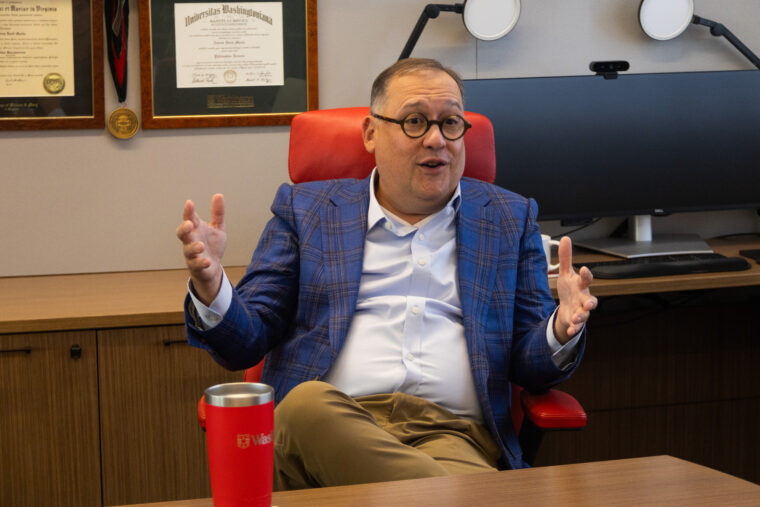
Chancellor Martin shared that his mindset entering the academic year is focused on “opportunity” during a Q&A on Sept. 9. (Bri Nitsberg | Managing Photo Editor)
WashU Chancellor Andrew Martin sat down with Student Life on Tuesday, Sept. 9 to discuss how the University is advocating for WashU in Washington, D.C.; navigating financial obstacles; supporting international students; protecting diversity, equity, and inclusion (DEI) initiatives; and approaching long-term construction plans. The Q&A has been edited for length and clarity.
SL: As chancellor and as a leader of this university, what is your mindset going into this upcoming year?
AM: My mindset coming into this academic year is focused on opportunity. We have a lot of challenges that are being thrown our way. I think this year is an opportunity, in a way that’s not going to be terribly visible to students, to really change the way in which we run the business of the University. The better that we can do with that is going to free up more resources for our core academic mission and student support. I’m trying to view things as more half-full as opposed to half-empty.
SL: An article in The Atlantic this summer labeled you and Vanderbilt Chancellor Daniel Diermeier as leaders of a “reformist camp” embracing higher education reforms in contrast with other university presidents who are more resistant to the Trump administration. How would you label that distinction?
AM: That article was a little bit over the top. There’s no hating or despising or anything else. There is, though, a principled disagreement about two things. One disagreement is about whether higher education has communication problems, or whether higher education has problems and communication problems. I’ve been very clear about some areas where I think that we have an opportunity to do better, which is really important in terms of regaining the trust of the totality of the American people, which is necessary if we ever want to get the high levels of bipartisan support that we once had. The other area of disagreement is, what’s the nature of what we’re dealing with? Are we dealing with a really hard moment, but three and a half years from now, we’re going to snap back to what things looked like before, or are we at a moment of structural change in higher education? I firmly believe we’re at a moment of structural change. You can’t deal with a structural problem by just temporizing and burying your head in the sand and waiting for things to work out. You’ve actually got to take a structural response to structural change.
SL: One of the things that you had mentioned was about communication and specifically regaining the trust of the American population. What specific steps is WashU taking to restore this trust with the public?
AM: There’s things we’re doing publicly and there’s things that we’re doing behind the scenes. Publicly, we’re out there talking really clearly about our institutional values. The publication of the Vanderbilt-WashU [Statement of] Principles last year was probably the biggest manifestation of that. But we’re taking opportunities to talk about this in a bunch of different forums. I’m headed down to Miami to speak at a Bench & Bar conference, to speak with a bunch of lawyers and judges in Florida about higher education, what’s happening at WashU, and what makes us different than some of the other universities. Even the Atlantic article was an opportunity for us to sort of get the name out there and explain what we’re doing differently, all geared towards working to regain trust. The private stuff is happening behind closed doors. I’m in Washington, D.C., almost once a month, and have been for almost two years now, building relationships with folks across the political spectrum, initially, to build a relationship, to hear what their concerns are, to share what’s happening on this campus. When there’s areas of concern, to talk about things we’re doing to deal with those things, and to advocate for the University on important political issues like endowment tax and federal research funding.
SL: Focusing on that research funding, a lot of WashU research programs have had funding and grants cut. What are you doing to support researchers who are losing access to federal funding?
AM: The way that funding works, particularly at the medical school, is a soft money culture. You get a grant, you’re able to hire the staff to be able to perform what’s on that grant. When that grant goes away, the staff positions go away. Thankfully, today, we’ve had a very small number of grants that have been canceled across the enterprise, some of those that we have appealed, and we are party to a class action lawsuit to get some of the NIH [National Institute of Health] grants reinstated that were canceled. We continue to work with our faculty to support them. They’re also in a situation, though, when the grant goes away, they’ve got to downsize their operation. That’s the thing that’s so frustrating about the uncertainty we have in this environment. It’s unclear how long this is going to take. We’ve invested for generations in building this amazing scientific engine on both of our campuses, but particularly at the medical school. That’s not something you can just recreate out of whole cloth, and it’s one that we have to work to figure out how we keep that engine going when the amount of federal support is almost certainly going to go down on a going forward basis.
SL: At a meeting with Student Union (SU) last week, you said that three of WashU’s eight schools are running at a deficit. What schools are those and what actions are you taking to help improve the situation?
AM: I’m not going to get into the details about what the particular schools are. We’re working really closely with the deans of those schools to ensure that their budget gets to balance in the out years, so two fiscal years ahead.
SL: What kind of directives have you been making to departments in terms of setting their budgets for this year at levels different than you’ve had in the past?
AM: Each school has handled this in slightly different ways, and some schools had to cut a little deeper than others, but what we’ve instructed each of our deans to do is to get to a scenario where revenues outpace expenses within the next three years. We’re also working to eliminate costs in the central fiscal unit, which is the administrative overhead that runs the University, and we’ve made progress there as well. I’ve also charged everyone who’s responsible not to do dumb things. There was a rumor floating around that we removed toilet paper from some buildings because of budget. Not true. Yes, we need to tighten our belt, but we also need to do it in such a way that our people still are supported, and there’s still plenty of toilet paper around the campus.
SL: At this SU meeting, you also said that 11 WashU students faced visa revocations last year. Have any of those students, or any other international students, been unable to return to WashU this fall?
AM: Not to my knowledge. We worked really carefully, and I really want to give the OISS [Office of International Students & Scholars] huge props for working with our students last year. Some of those were graduates who were on OPT but still had their visas held. OISS was proactively looking and scanning the databases so we would catch it and be able to notify these students and then connect them with resources. All 11 of those students were able to keep their status.
SL: WashU has a very large international student population, and it’s growing this year. In your opinion, what is the importance of the international student population to the University?
AM: We’re in the talent business, and we’re also in the community-building business. We want to find talented students wherever they are and make sure they have opportunities to come here and live up to their full potential. Our international students bring an enormous amount to this university. They bring talent here that we wouldn’t see otherwise, and they also contribute meaningfully to the culture that we have built, both on the Danforth Campus and on the Medical Campus.
SL: This summer, you appointed members to the new Inclusive Excellence Advisory Committee to review WashU’s Diversity, Equity and Inclusion (DEI) practices. What value do you see in diversity programming, and can you commit to protecting initiatives on campus such as the Center for Diversity and Inclusion?
AM: We appointed this task force to provide guidance for how we should implement best practices moving forward for programs that could be characterized as a DEI program. There’s basically two things going on. First, our institutional commitments remain the same. We believe that a diverse student body and a diverse faculty and a diverse staff is a good thing, that diversity of perspective, diversity of background, makes us the richest intellectual community it possibly could be. We need to make sure we welcome every student so they can come here and thrive and live up to their full potential, and that we got to treat everybody fairly. Those are our institutional values, and those haven’t changed. What we are looking at is making sure that the programming that we do isn’t in violation of federal law. We can’t give a material benefit to individuals based on whether they’re a member of a protected class. We used to have scholarships just for African-American students. We’ve had to get rid of those scholarships because that’s not allowable. This happened years and years ago. We’re just looking at every one of our programs to ensure that those programs are inclusive and not providing benefits in this way. Unlike some universities, which would have renamed their Center for Diversity [and] Inclusion their “Belonging Center” or something, we still have the Center for Diversity and Inclusion, which is an important part of our community-building and an important part of student success. We’re going to continue to do the programming that we’ve been doing. If you want to label it DEI programming, okay. I mean, I view it as student success programming. We just have to make sure that what we’re doing doesn’t cross the line, and this committee is looking at how we should do that moving forward.
SL: Another task force has recently been created to re-evaluate the organization of a number of departments in Arts & Sciences, including African and African-American Studies; Women, Gender, and Sexuality Studies; and a few others. Why do you believe that a task force to consider this reorganization is important right now?
AM: This one is one that’s not on my radar. The academic leadership of Arts & Sciences is provided by the dean, and I’d encourage you to reach out to Dean Hu if you want to get some perspective on what’s happening there, or the provost. Not in my domain.
SL: Construction projects have faced a number of challenges recently, including financial uncertainty and pushback from the local community. How do you balance the University’s long-term goals, such as developing the Fontbonne or Concordia campuses or even redoing Mudd Field, with these current challenges?
AM: Everything that we do, we have to do in a way that’s financially responsible. And at a moment of great uncertainty, particularly around federal research funding, it was certainly the prudent thing to do to slow down major capital projects. The Arts & Sciences building, which was announced, and we put in the utilities and were ready to build, we decided to pause for the time being. We are continuing on the more modest alumni career facility which is so mission-aligned to what we’re doing. We’ve got to do everything in a financially sustainable way. We haven’t done any serious programming yet about the Fontbonne campus because of the amount of uncertainty that we’re facing. And we’re going to continue when opportunities present themselves to get once-in-a-generation parcels of land.
SL: When the Riney Hall and Mudd Field renovations were paused you said that you hoped to revisit it in the future. Is that still the hope? And do you have an idea of a potential timeline on that?
AM: I would hope we can revisit it in the future. I have no idea on timeline. The biggest piece of uncertainty with regard to the University budget, and it doesn’t just affect the medical school, has to do with federal research funding. Until we know what the new model for federal research funding looks like, then we’ll be able to understand … the amount of research that we’re going to be able to do. Until we get to that point and get adjusted to that new equilibrium, we’re not going to be doing a lot of investing in new academic building. You’re not going to see new academic spaces on the Danforth Campus. You’re not going to see new research facilities on the Medical Campus. We are going to continue to make some investments around the student experience. There’s a new dormitory project that we’re working on [and] we’ve been talking about a building centered around healthy excellence that would have student health and other wellness resources all in a central location. At the medical school, we’re going to continue to build out clinical spaces, because those clinical spaces can produce revenue that helps with the research mission.
SL: Can you talk more about that new dormitory building and how it fits into your longer-term plan for students living on campus?
AM: Last year, we were able to renegotiate the regulations on the South 40. For decades, we’ve been under a conditional use permit, and we were able, with the support of the mayor and the city manager of Clayton, to change the way in which the South 40 is regulated. Now we just have a set of parameters: how high you can build buildings, how much density you can have, how much lighting, the noise, and everything else. As long as we’re within those parameters, we can sort of do what we want on the South 40. You also know that we have some dormitories that are, I’d say, toward the end of their life. The idea is to be able to guarantee that all freshmen and sophomores can live on the 40 and then continue to add to the other on campus residential portfolio. The demand for students to live on the campus is up, up, up, and so too is the demand to live on some of our off-campus properties as well. Fontbonne provides us some really interesting opportunities there, but we’ve got a lot of planning to do, and we’ve got to get to a point that we understand what the financial model looks like going forward.
SL: Are there specific plans right now for building a new dorm building within the next few years?
AM: Yes, there are, and this community will learn more about them over the course of this academic year.
SL: When do you expect that we will know more about them?
AM: At some point during this academic year.
SL: Speaking about noise, when you had proposed plans for Concordia Seminary, it received a lot of local opposition. How do you plan to work with the local community to make sure this isn’t disruptive to their daily life?
AM: We work carefully with our neighbors in Clayton. The initial deal that we had contemplated with Concordia had us siting a bunch of athletic fields there, and I think that there was a misunderstanding of what that would mean. As wonderful as it was to see our stadium full for the football game on Saturday night, we’re not going to have 20,000 people show up for a soccer match. The noise disruption and the lighting and stuff, I think isn’t nearly as disruptive as it was portrayed. That deal didn’t happen, and if we were given the opportunity to purchase that Concordia portfolio, we wouldn’t plan to use it for athletic purposes.
SL: Are there any other spaces that you’re looking at for athletic fields? A part of the plan was to build new baseball or softball fields that could have been a replacement for the fields that are right next to South 40.
AM: Not at this point. I can’t imagine that we would be moving the baseball or softball fields anytime in the next 10 years. Now, what it looks like on a 25- or 50-year time scale? That’s to be determined. But if you can just think about what are the dormitories that are going to have to be replaced, there’s a lot that can happen before we’d have to touch those fields.
SL: Let’s circleback to when you mentioned your visits to Washington, D.C. earlier. When talking with elected officials, what is your pitch about WashU, and what conversations are you having with them about building a relationship?
AM: The first pitch is to build a relationship, right? To understand where they’re coming from, what they care about, what concerns that they have. And I’d say that many elected officials and many members of the American public have drawn conclusions about what’s happening on every college campus based on what happened on a couple of college campuses, primarily in the Northeast. Those conversations were really along the lines of what’s happening on our campuses. I spend a lot of time talking about student access. Most people can’t believe that it’s actually more affordable, if you can get in, to come to a place like WashU than to go to one of our great public universities and are astounded to see the amount of money that we pour into financial aid. We talk a lot about student access, and some of the work that we’re doing intentionally to try to attract a broad cross-section of students. Also [we] spend a lot of time talking about research. We’re in the billion-dollar club in terms of our research spending. That’s important on two levels. One is, what are the discoveries, therapeutics, devices, and cures that are able to come out of the laboratories? But also, what does it mean for St. Louis to have this massive research engine, the majority of the dollars that go to personnel? And so these are people who come to St. Louis, live in St. Louis, invest in St. Louis, and have families in St. Louis, so it’s an important part of the local economic engine.
SL: When you said that what’s happening on a certain few college campuses isn’t happening on every one, what are you referring to? Is that a reference to student activism?
AM: So it’s a reference to a lot of different things. It gets back to the first conversation that we had. [The] leadership of many universities assert that these are the glory days for American higher education, and things have never been better, right? I would say that collectively, these institutions are extraordinary, but there are places in which we can do better, and that’s a lot of the work that we talked about in the Vanderbilt-WashU Principles.
SL: WashU, unlike a number of its peers, is located in a red state, where Missouri has two Republican senators and a Republican governor who might be more sympathetic to the Trump administration’s cuts. How have those relationships been built? And have you felt like you’ve been able to convince the Missouri politicians of WashU’s importance?
AM: We have been able to have really constructive conversations on both sides of the aisle about the University and what it brings to the community.
SL: Do you feel like Missouri’s politicians are advocating for WashU’s needs?
AM: Yes.
SL: You recently announced the Ordered Liberty Project with intentions of promoting viewpoint diversity. Can you talk about why you created this and why the classic liberalism ideals are something that you’re looking to promote at WashU?
AM: At this moment in time, it’s really important for our educational program, and for the research that we do, to ensure that we have a broad set of viewpoints on the campus. Being able to flex our faculty muscle in this area is going to bring a lot to the institution. This is the second time that we’ve made an investment like this. The previous time was back in 2020 when we committed to doing a big cluster hire to hire scholars studying race. After George Floyd and coming into the discussions that happened thereafter, it became clear to me that it would be very beneficial for the University to flex its muscle there and go and hire outstanding scholars who work in the area, who can teach our students, who can do research and weigh in on important issues of the day. This is the same thing, right? We need more voices that are looking at the rule of law, that are looking at freedom of expression, that are looking at the power of markets, in order to ensure that our students are able to see multiple perspectives.
SL: We’re going to move on to some rapid fire questions to end the interview.
If you could take a WashU class unrelated to your academic background, what would you be interested in taking?
AM: I would take Art History.
SL: What is your favorite St. Louis small business?
AM: If I just sort of think about where I spend my money, House of India.
SL: I noticed you have a lot of sports memorabilia. What’s your favorite sporting event you’ve ever been to?
AM: The NCAA men’s football championship where Michigan beat Washington for the national championship a couple years ago. I was sitting next to 60% of the Fab Five. We were like 15th row, 50-yard line, and we’re sitting there and [Jalen Rose, Jimmy King, and Ray Jackson] sat down right next to us, and so we sat next to those guys for the whole game. That was awesome.
SL: Finally, what does the D in Andrew D. Martin stand for?
AM: David.
Editor’s Note: This article was updated at 5:19 p.m. on Sept. 15 to clarify that the Inclusive Excellence Advisory Committee is providing guidance for best practices moving forward related to diversity, equity, and inclusion. The WashU administration, not the committee, is reviewing existing programs for compliance.
Stay in Touch!
Get the latest and top news from StudentLife delivered to your inbox