News
WashU rolls back and alters DEI-related content across its websites
Over the past few months, WashU has removed content related to its diversity, equity, and inclusion (DEI) programs from various University websites. Although some DEI-related content remains, websites of several University offices, departments, and schools have edited descriptions of DEI initiatives, deleted links to pages focused on DEI efforts, and erased content promoting WashU’s efforts towards equity.
The updates to the websites come as WashU and universities across the nation face increased scrutiny from the federal government about their practices. When asked about the future of WashU’s DEI programs at his annual State of the University Address this past February, Martin said he is committed to maintaining WashU’s community but isn’t necessarily committed to the letters “D,” “E,” “I,” or any combination of the three.
“I don’t actually know what DEI is, and, in fact, I think that most people who are out in the world talking about ‘DEI this, DEI that’ don’t have a precise definition of what DEI is,” Martin said in his address. “We deeply believe that diverse communities and people from diverse perspectives allow for greater knowledge, discovery, and understanding.”
In May, the University announced the formation of a committee charged with reviewing and recommending changes to the University’s DEI programs and activities. The University named the 13 members of the Inclusive Excellence Advisory Committee (IEAC) in a press release on July 25, including co-chairs Eva Aagaard, Vice Chancellor and Senior Associate Dean of Education, and Sean Armstrong, Dean of the School of Continuing & Professional Studies.
“Our focus is on ensuring that the University community has a shared understanding of the important values outlined in our mission and goals and legally compliant strategies for realizing those values,” Aagaard and Armstrong, wrote in an email to Student Life. They added that the committee will not make decisions about “specific programs or activities” and has not made any recommendations thus far.
Student Life, however, identified significant changes to a number of WashU’s DEI-related websites by utilizing the Internet Archive’s Wayback Machine.
When asked about these changes, IEAC co-chairs Aagaard and Armstrong said that the alterations to the websites “are not connected to the work of this committee,” pointing to departments and schools as the ones responsible for altering and removing the websites.
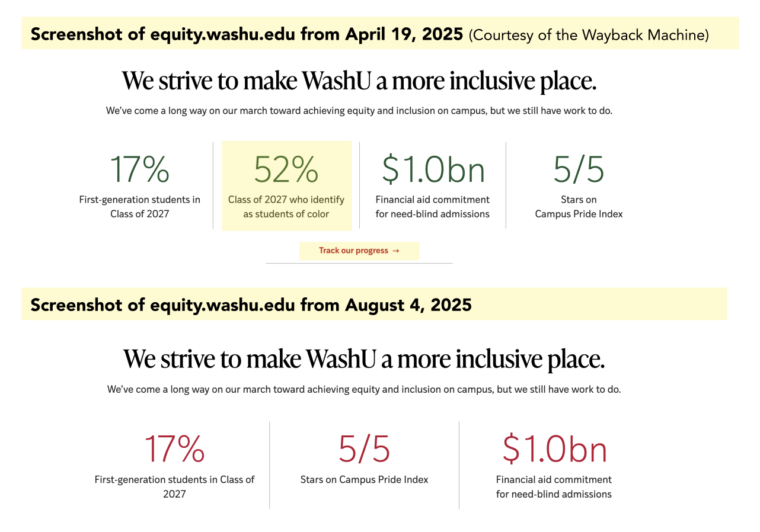
A comparison of WashU’s EDI webpage, from which a statistic about the number of students of color was removed. (Sydney Tran | Editor-in-Chief)
WashU’s University-wide “Equity, Diversity, & Inclusion” (EDI) page serves as the online hub for the University’s EDI resources, promoting its commitment to equity and highlighting the progress made to increase WashU’s diversity. While the webpage is still available online, it was edited sometime between April 28 and May 14 to remove a statistic that 52% of the Class of 2027 identify as students of color.

Screenshots of the former and current description of WashU’s Center for Diversity and Inclusion. (Sydney Tran | Editor-in-Chief)
Additionally, on the EDI webpage, the description of WashU’s Center for Diversity and Inclusion (CDI) was altered. It no longer describes the CDI as a resource that “supports and advocates for undergraduate, graduate and professional students from underrepresented and/or marginalized populations, creates collaborative partnerships with campus and community organizations, and promotes dialogue and social change among all students,” instead saying, “The CDI fosters belonging for all. Together, we inspire students to build a positive sense of belonging on campus.” It was edited sometime during May.
None of the five CDI employees contacted by Student Life for an interview responded as of the date of publication.
In addition to the university-wide DEI initiatives, almost all of WashU’s schools had school-specific DEI pages. As of the time of publication, the links to the pages from the Olin School of Business, McKelvey School of Engineering, Sam Fox School of Design & Visual Arts, and School of Law are either no longer accessible or redirect to the main EDI page. The websites for the School of Arts & Sciences and the School of Medicine still include pages promoting DEI.
The heads of school-specific DEI programs for McKelvey, Sam Fox, Olin, Arts & Sciences, and Law either did not respond to requests for comments or declined to comment. Representatives from the School of Medicine referred Student Life to the statement from the IEAC.
Notably, the Olin DEI page has been changed at least twice this spring. Sometime between March 24 and April 24, the website was updated to remove mentions of participation in the PhD project, a program to support business students from underrepresented backgrounds, which has faced scrutiny from the federal government. On March 14, the U.S. Department of Education’s Office of Civil Rights announced that it was investigating 45 universities, including WashU, over alleged “race-exclusionary practices” through its partnership with the Ph.D. project. Now, the entire Olin DEI page is no longer publicly available.
Further, departments and offices across the University also took measures to scrub content about diversity. Academic departments, such as the Department of Mechanical Engineering, have pulled down their EDI-specific webpages, while the University’s Office of Human Resources no longer displays a page showcasing WashU’s commitment “to creating an environment that is diverse, inclusive, and nurturing of people from all backgrounds.”
WashU is not alone in the scale-back of its public DEI presence. Other universities, such as the University of Pennsylvania and the University of Chicago, updated their websites in the early months of the Trump administration; Harvard University and others have done so more recently.
Although WashU’s next steps at the University-wide level remain uncertain, Aagard and Armstrong emphasized that the IEAC’s review of WashU’s DEI work “is just getting underway.”
“We are beginning important conversations about what it means for WashU to support inclusive excellence — and how our programs and activities can reflect that commitment in meaningful ways…” they wrote. “As we focus on what comes next — we are committed to helping WashU continue to build a culture where all members of our community feel included, supported, and that they belong.”
Stay in Touch!
Get the latest and top news from StudentLife delivered to your inbox