News
Chancellor Martin charts path forward in annual address amidst political uncertainty
During his annual State of the University address, Chancellor Andrew D. Martin expressed the need for WashU to stick to its core values during political tumult.
Martin addressed a live audience in Emerson Auditorium and via livestream. During the event he covered a spate of topics, including potential job and budget cuts, Diversity, Equity, and Inclusion (DEI), and capital investments, such as the Fontbonne University acquisition.
Martin devoted significant time to discussing how WashU and other higher education institutions will be impacted by cuts to National Institutes of Health (NIH) funding, which provided WashU with $731 million in subsidies in 2024 — more than all but one university nationwide.
“Will budgets likely need to be cut at some point down the road? I suspect the answer is yes,” Martin said. “Will the nature of some of our community members’ employment need to change in the future? Probably. And that’s just the reality of what we’re facing.”
Martin noted that the University has yet to take action because they first want to gain a better understanding of the situation. He also stated that WashU will not be alone among universities in confronting these issues.
“Whatever happens with federal research funding is going to happen anywhere. Everybody’s going to be affected.”
Martin dispelled the notion that WashU could dip into the University endowment to avoid budget cuts, citing legal, strategic, and sustainability-related reasons.
“The Washington University endowment is not a big old pile of gold that sits in North Brookings Hall that I rub once in a while and smile about. It’s also the case that the endowment isn’t a savings account. The majority of our endowment is restricted money.”
Martin also commented on the recently-announced Vanderbilt-WashU Statement of Principles, which, Martin said, has been in the works for a long time but is especially salient given the current political climate.
“We stand strong in our values — whichever way the political winds blow –– as we have for many, many decades,” Martin said.
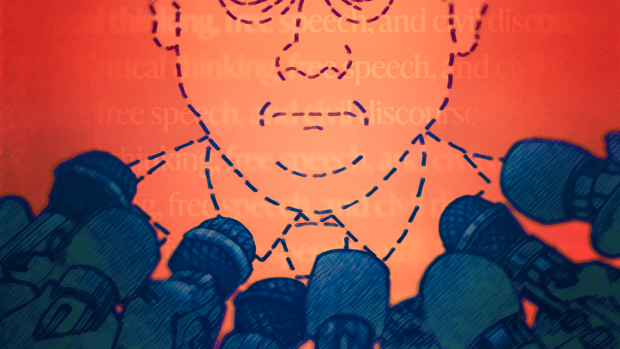
These principles, which largely concern issues of institutional neutrality, freedom of speech, and educational access, were the focus of the recent op-ed titled “Universities Must Reject Creeping Politicization,” co-authored by Martin and Vanderbilt University Chancellor Daniel Diermeier.
Martin also emphasized a commitment to diversity on campus while declining to specifically refer to such programs as “DEI.”
“We believe that every member of this community belongs here and needs to be able to build a community to live up to their fullest potential,” Martin said. “I have no particular commitments to the letters “D,” “E,” or “I,” or the concatenation of the three, but what I am committed to … is the work to drive excellence.”
Furthermore, Martin related the positive nature of conversations between WashU and elected officials in Washington, D.C. and Jefferson City in recent months. Martin explained how demonstrating the scholarly, creative, and community-oriented work done at WashU resonates with elected officials.
“I come away from those conversations encouraged and a little bit energized,” Martin said.
Amidst political uncertainty, Martin spoke at length about positive developments on campus over the past year and reasons to be excited for the future.
Highlighting the achievements of students, Martin congratulated the varsity women’s soccer team on their undefeated season and NCAA National Championship victory.
Martin also lauded student leaders for their advocacy on campus, particularly advocacy concerning the Terry collection. The student advocacy, per Martin, has led to ongoing discussions by the Naming Review Board on what to do with the collection going forward.
As for academic opportunities, when asked in the Q&A whether prospective pre-med students should still apply to WashU in light of the aforementioned potential NIH funding cuts, Martin said they should not be deterred — if anything, they should feel more compelled to apply.
Furthermore, Martin assured community members that research, particularly at the undergraduate level, will not only continue, but increase, due to new research and academic opportunities through the new School of Public Health.
“We might have to do things a little bit differently, we might have to fund things a little bit differently, but those opportunities are not going away,” Martin said. “I think you can make the argument that no matter what happens with NIH, we’re the best place to come today.”
At a University-wide scale, Martin championed the long-awaited rebrand actualized in August 2024, emphasizing its potential to catapult WashU into the limelight among American research institutions.
Martin also spoke about numerous projects, such as Riney Hall (which he said is slated for completion in 2028), a revitalized Mudd Field, and the cutting-edge Gary C. Werths Building at Siteman Cancer Center.
Martin, commenting on the university’s acquisition of Fontbonne University, said no decisions are close to being made as to how the land will be used.
“I swear that there is not some grand plan that you’re going to wake up [to] one morning and you’re going to get an email that says, ‘Here’s What’s Happening at Fontbonne!’” Martin said.
Martin said that the University is convening a committee to examine the future of all University real estate holdings, including Fontbonne, and that changes to federal funding may complicate future — as well as ongoing — projects.
“The capital investments that I talked about today are completely mission-aligned, and so, as long as we’re not facing catastrophic circumstances, we’re going to continue to drive those projects forward,” Martin said, “Some might have to be slowed down. Others might have to be reimagined.”
Martin concluded by commending the WashU community for its resolve, and hoping that next year’s address would be more celebratory in nature.
“We’ve got a bunch of really smart people … that are going to improve our community and improve the world — it doesn’t get any better than that.”
Stay in Touch!
Get the latest and top news from StudentLife delivered to your inbox