News
Chancellor Martin strikes optimistic tone in State of the University address amid a year of challenges
 Lakme Bergeret | Contributing Photographer
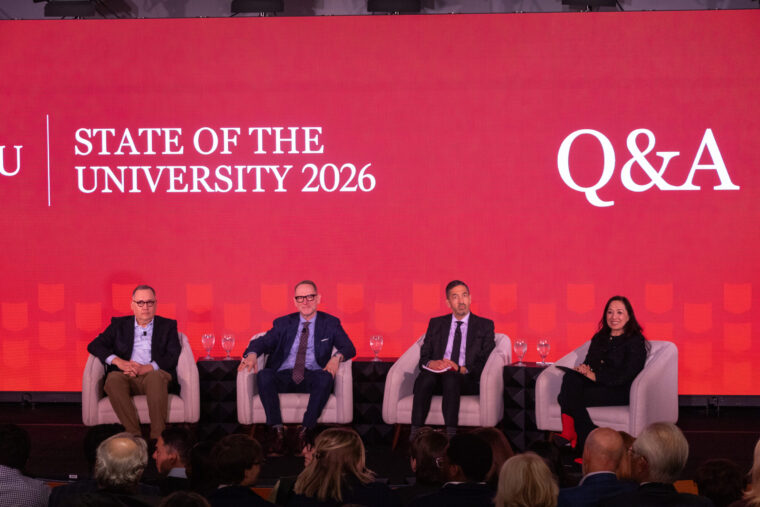
 The speakers each shared the “wins” of WashU, projecting an optimistic overview for the 2026 year.
At his annual State of the University address, Chancellor Andrew D. Martin expressed optimism for the future despite significant struggles during the past year.
During the March 2 address — which took place in Emerson Auditorium and was livestreamed — the chancellor was joined by Provost Mark West; Margaret C. Ryan Dean of the School of Public Health, Sandro Galea; and Vice Chancellor for Student Affairs, Anna “Dr. G” Gonzalez. The address mainly focused on topics such as the current financial environment, artificial intelligence, research breakthroughs, and the student experience at WashU.
Martin began the address by acknowledging the challenges the University has been facing, but he said that WashU was ultimately in a good situation.
“When we gathered last February, we were anticipating some rough waters in the higher ed world,” Martin said. “I think we’d agree it’s been a little challenging, more than a little for many, but we’re here together, and I’d argue that we’re better for the work we’ve done to advance our mission during this time of uncertainty.”
Martin also acknowledged the shelter-in-place that happened on Feb. 24.
“This is the type of scenario that, sadly, we hear about taking place all too often in our country, and that we fervently hope will never happen here,” Martin said. “It was a frightening and unsettling time while we all waited for the situation to be resolved. Thankfully, it turned out to be a false report, but what we all experienced that day was real.”
The chancellor commended the response of the Washington University Police Department and the campus community, while saying that the situation “identified some important opportunities for continuous improvement” in emergency preparedness.
Martin pointed out several examples that he considered victories for the University’s financial state, such as an appeals judge blocking a proposal from the National Institutes of Health to put a 15% cap on grant funds for indirect costs, which he said could have cost WashU $200 million per year. He also referenced the federal endowment tax that only increased from 1.4% to 4% instead of the originally proposed 21%. Martin said the University is on track to break even this fiscal year.
Martin also shared that University faculty and staff can expect merit raises this summer.
“We have made some tough decisions, and we’ve had to tighten our belts considerably, but those decisions are paying off,” Martin said. “We’re in a far stronger position than we were a year ago.”
West discussed a number of initiatives the University has been working on, including restructuring and expanding partnerships at the School of Continuing & Professional Studies to better serve St. Louis and support for technological innovation through the Digital Intelligence & Innovation Accelerator (DI2). West highlighted WashU’s “In St. Louis, for St. Louis” efforts, mentioning that WashU contributed $9.3 billion to the local economy in the last fiscal year.
Martin and West spent a significant amount of time talking about AI at WashU, such as how the University has created tools for individuals to create custom chatbots without coding experience, with support from DI2.
“These are just a few of our examples of our work in a domain that we can’t afford to be left out of and, moreover, in which we intend to lead,” West said.
During his portion of the address, Galea pointed out that WashU offers a “unique vantage point” for public health since it is located in a state that generally votes Republican in the middle of the country. He stressed that public health should be depoliticized to best serve the general public. Galea shared that though the WashU School of Public Health opened a year earlier than expected, it already has about 220 graduate students, and the Public Health & Society program through the College of Arts & Sciences has 110 undergraduate majors and minors.
Martin and Gonzalez also shared updates on construction plans for WashU’s campus. While the University has paused some construction projects, Gonzalez said that WashU is able to construct a new dorm on the South 40 because of the revenue it will generate and its role in meeting student demand for on-campus housing.
Given uncertainty around federal funding, Martin said it is difficult for the University to plan ahead for other major capital expenditures like redeveloping Fontbonne University’s campus, but pointed out that it could be used for opportunities like student housing, academic purposes, or temporary usage by community partners. Additionally, Martin explained that South Campus, which is currently being used to support club athletics, could be “taken off our books” and turned over to a developer in the community in the upcoming years.
During the Q&A portion of the address, Jade Beauregard, a fourth-year Ph.D. student in Biological Anthropology, asked the University what it is doing to support graduate students in the face of funding cuts to the social, behavioral, and economic sciences.
In response, West said he “[hasn’t] dug into that much yet,” but emphasized the University’s commitment to supporting students who are feeling the effects of funding cuts. Martin added that the University is prepared to ensure all doctoral students currently on campus have the resources to finish their degrees, but he said that the future is “going to require some difficult decisions.”
The panelists were also asked about WashU’s “With You” campaign, a fundraising initiative announced last May. Martin shared that the University has already raised more than $3.3 billion of its goal to raise $5 billion by 2030.
With the institution centered on new initiatives, financial positioning, and long-term goals, some members of the WashU community saw an overall optimistic outlook for 2026. Second-year MBA student Omotunde Oguntoyinbo commented on the tone the University carried throughout the address.
“The University has a distinct sense of where it’s heading,” Oguntoyinbo said. “They provided updates and initiatives that we talked about last year, as well as some of the things that we learned to adapt to at the University.”
Eric Fournier, director of Educational Development at the Center for Teaching and Learning, shared a similar sentiment, noting the shift in tone compared to last year’s address.
“Well, it certainly feels a lot more optimistic than last year,” Fournier said. “I think the big change in federal funding has made a difference in that, in some of the resolutions, I think [it] was important.”
Fournier also echoed concerns raised during the Q&A portion of the event, specifically regarding graduate student support.
“Right now, the graduate students make up about half the enrollment of this university,” Fournier said. “I’m really concerned about their future, both the support and the focus of the University.”
Similarly, sophomore Courtney Lucas II described funding as “both WashU’s biggest accomplishment and the biggest concern.”
Referencing WashU’s “With You” campaign, Lucas expressed cautious optimism about how financial success will translate into long-term impact.
“In terms of WashU ‘With You,’ they raised $3.3 billion. I think that that’s really incredible, and that’s a huge accomplishment,” Lucas said. “But I think also continuing to secure funding for the future and making sure that undergrads and also professional students who appear on the Danforth campus and on the Medical Campus continue to [complete their] degrees.”
As a first-time attendee of the University’s address, Lucas also left sharing WashU’s optimistic stance.
“I learned that WashU has started a lot of initiatives that have been really impactful, and they’re doing great work in the St. Louis community and also in the WashU community,” Lucas said. “I’m really looking forward to how the initiatives that have been started continue … and the ways that WashU continues investing in the community.”
Stay in Touch!
Get the latest and top news from StudentLife delivered to your inbox