News
Students and faculty reflect on shelter-in-place following reports of armed person on campus
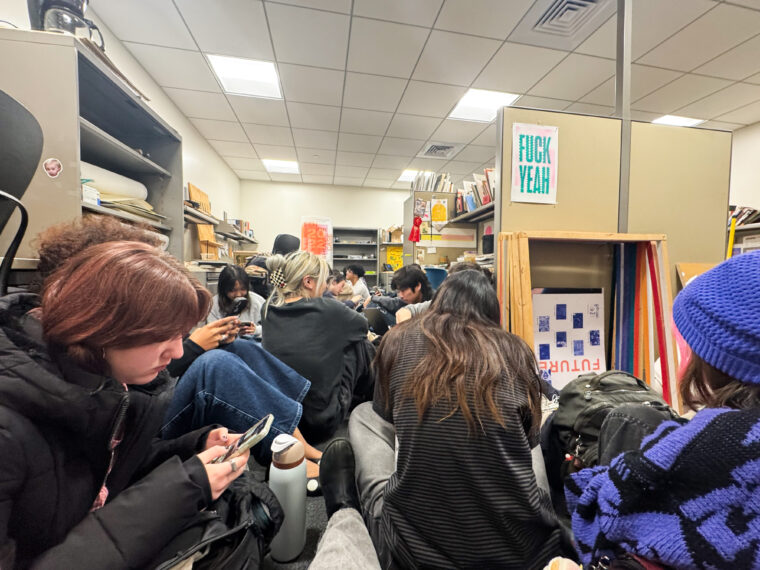
WashU students hid in classrooms after reports of a potential armed individual on campus. (Photo Courtesy of Robin Pyo)
On Tuesday, Feb. 24, WashU’s Danforth Campus went into shelter-in-place protocol following false reports of an armed person on campus, according to the Washington University Police Department (WUPD). WashU Emergency Management first notified campus of the potential armed individual at 9:19 a.m. after WUPD “received multiple calls reporting an individual with a weapon on the Danforth Campus.”
WashU Emergency Management declared there was no active threat in a message at 10:21 a.m. after police completed their search of the Danforth Campus. In an 11:30 a.m. email, WUPD Chief Angela Coonce said WUPD believed the reports “were not a credible threat.”
Some individuals also claimed that Saint Louis University (SLU) received similar calls, but SLU Senior Media Relations Specialist Maggie Rotermund told Student Life that SLU did not receive such calls.
Student experiences
Senior Robin Pyo was in her Sculpture Practices course when two classmates alerted the class that they had received a text saying to run, hide, or fight. The class hid in the basement of Walker Hall, where the course took place.
“I was concerned, for sure, but I felt pretty safe in the basement,” Pyo said. “It felt like it could just be a false alarm, but at the same time, [after] the Brown shooting, it definitely felt more real.”
Pyo appreciated the emergency alerts she received but said she would have preferred Emergency Management to share more information alongside the all-clear alert.
“Afterwards, when we’re being told we are released and free to go around campus and that they had searched the premises, I feel like a lot of people were concerned about the fact that there was no arrest, and people still feel unsafe going to their next classes and being on campus today,” Pyo said.
Some students, like sophomore Lexie Rooks, expressed concerns when they realized that the locks on their classroom doors didn’t work.
“Once we turned off the lights, we figured out that the door wouldn’t lock, and so we just shoved all of the chairs and desks in front of it so that you couldn’t open it from the outside,” Rooks said. “It was still very nerve-racking to sit there and hide, knowing that the door wasn’t locked and that if the potential perpetrator were to try and enter, they would probably be able to.”
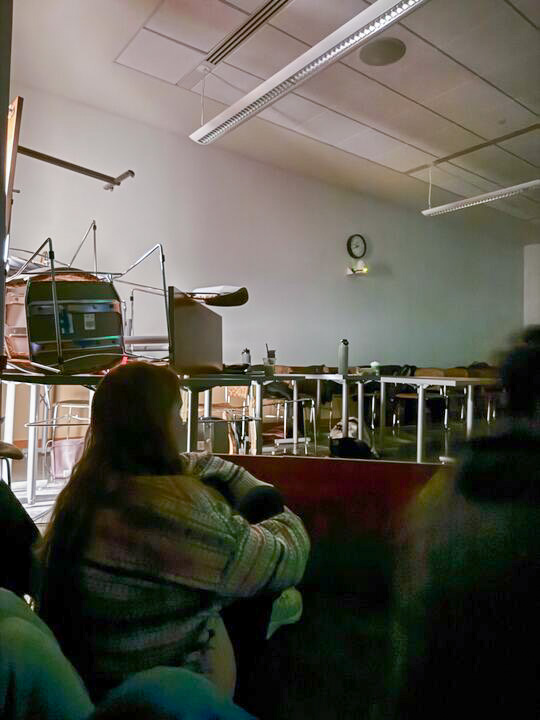
Students used items like desks and chairs to barricade the doors to classrooms. (Selina Son | News Editor)
Some undergraduate teaching assistants (TAs), like senior Alexia Leek, were directing classes in the absence of a professor. Leek was leading her Environmental Systems class alongside graduate teaching assistants on the second floor of Givens Hall. When the alert happened, she said other students on the floor went to hide in the room her class was in.
“The room is actually too small for the [amount] of people we had,” Leek said. “We had some people that were in the hallway, some people were in the bathroom. We just tried to grab anyone who was there. … We just grab everybody, get inside, and then we close the doors and we lock it, and we forget the lock is broken on that door. It’s been [finicky] for years.”
Leek said some students moved heavy tables in front of the doors and, after fidgeting with the door, were able to lock it. Later, Leek said she and the other students realized a student was left outside.
“As the TA, you’re like, ‘Okay, well, I need to keep these students safe. How do I know the person is not possibly the shooter?’” Leek said. “Again, we don’t know at this moment, how do we know that they’re not with him, or they’re not using him to get into the room? … I felt super bad because I’m like, man, there’s a chance that that’s one of my kids who’s going to possibly be out in the hallway and not know where to go. The student who was in contact with him [told] him to go to the bathroom.”
She said that though police was doing the rounds on rooms in the building, the students did not want to make their presence known out of fear for their safety.
“[Police] swept the building, and we’re staying silent,” Leek said. “[We didn’t] open the door for anybody. [They said,] ‘Police, let yourself be known,’ and we stayed quiet again. But we’ve all seen the videos of people pretending to be police just to get into the room. … But what really freaked us all out was [when police] tried to get in the door, they [were] rattling [it] full-blown.”
Senior Julia Peppe was in Design of Thermal Systems and said that during her class, undergraduate teaching assistants proctored the course while the professor, who was out of town, instructed over Zoom. When a public address system announced the armed person alert and advised students to “run, hide, fight,” students were unsure what to do.
“People were frantically debating if we should stay, hide and lock the doors, or run, but without an adult or a professor [or] any kind of faculty presence, there was a bit of panic,” Peppe said.
Senior Nina Fischer, one of the TAs in the class, noted that she wasn’t trained on how to deal with a situation like this.
“We don’t get trained on this,” Fischer said. “We’ve been doing lockdown drills since we were kids, but it’s different when you’re doing it in real life.”
During the shelter-in-place, students in the Danforth University Center hid in a storage space, according to junior Matthew Isaacs.
“The workers and the manager knew exactly what to do. They closed the door, they turned off the lights, [and] we sat on the floor,” Isaacs said. “Then it seemed like the manager coordinated with someone and made the decision to have us all go down to this storage facility-slash-kitchen.”
Isaacs said he was “touched” by the generosity of the dining workers, who passed out candy and drinks to try to keep everyone calm while they were waiting.
After the all-clear was sent by the WashU Emergency Management, students and faculty remained hypervigilant while exiting campus. First-year Owen Hotra noted that the message sent did not make him feel safe and many around him were still cautious of their surroundings.
“We ran into a couple seemingly stray professors [and] they seemed very jumpy to see us and it startled us to see them,” Hotra said.
Leek said she didn’t feel truly safe until she returned home.
“Honestly [the experience] didn’t even hit me until I got home and I felt the safety of my own door lock,” Leek said. “[When I entered the door], I just kind of crumpled to the floor.”
Faculty handling of the situation
Professors across the University handled the situation differently. Some professors cancelled classes in response to the situation.
One lecturer — who is anonymous due to concerns as an untenured instructor — decided to cancel his classes and described the decision as difficult.
“It is not an easy [choice] for instructors to make as it constitutes a significant lost learning opportunity,” the lecturer wrote in an email to Student Life. “However, in this course, we have contingency plans in place and the ability to reschedule and accommodate the missed lab in a way which minimizes this loss, but this is due to resources which are available to us, which may not be available to every course on campus.”
The lecturer emphasized that the health of their students was paramount during the situation.
“All of this, in my view, is background noise to prioritizing the safety and mental health of my students…” the lecturer wrote. “Sharing support resources, minimizing contribution to that stress where possible, and doing what I can to empathize with students who were stuck in rooms, fearful, earlier that day, is exactly what I would like to do.”
Other courses, particularly those scheduled for later in the day, continued with normally scheduled class programming. Some professors continued teaching during the shelter-in-place notice. For students who did not feel comfortable attending class on campus, some professors also created virtual options or eliminated mandatory attendance requirements.
Isaacs praised the ability of the WashU community to continue in the face of the morning’s events.
“I had to go right into a presentation soon thereafter, but I think it’s actually good to return to a sense of normalcy,” Isaacs said. “It was really impressive how the campus really bounced back.”
In Fisher’s class, the professor sent a message encouraging students to stay safe and made the in-class worksheet optional.
“She sent a message to the entire class being like, ‘Stay safe.’ But she also told them immediately, this is optional, and also the topic covered today won’t be on the midterm,” Fisher said. “I know a lot of other professors who did something similar.”
Professors also reacted in varying manners during the incident. For example, Rooks said that her professor was “in shock” during the situation. Since her professor didn’t immediately give instructions, the students took the lead in responding to the situation.
“It kind of surprised me to hear that professors and actively teaching faculty aren’t really informed on what to do in situations like this,” Rooks said. “It took the students, more so than our professor, to take it upon ourselves to make sure we were safe.”
In an email, Coonce praised the WashU community for their handling of the situation.
“I’d like to thank our students, faculty, and staff for responding quickly and appropriately to the alert by sheltering in place and following instructions as they were communicated through WashU Alerts and officers on the scene,” she wrote. “Your cooperation made it possible for our officers to do their work quickly and safely.”
Coonce also said that WUPD will “investigate and pursue charges against anyone who is found to be responsible” for the false reports that caused the shelter-in-place.
Stay in Touch!
Get the latest and top news from StudentLife delivered to your inbox