News
Q&A with Chancellor Andrew D. Martin, fall 2026
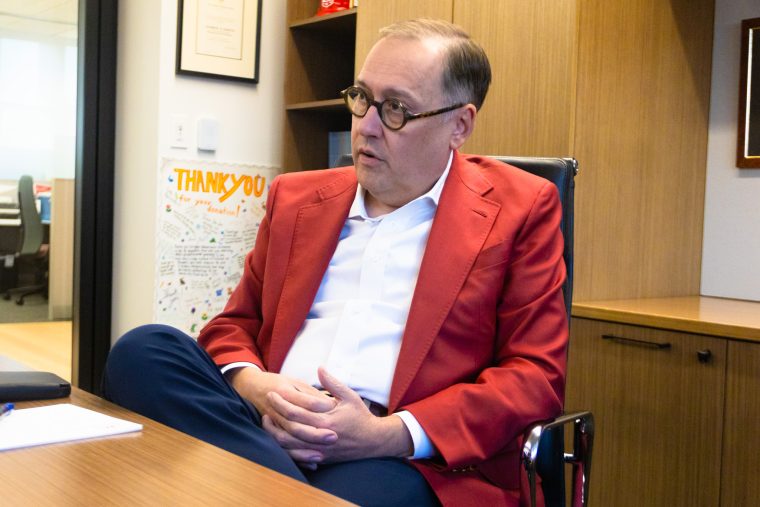
Chancellor Andrew D. Martin sat down with Student Life for a Q&A on Nov. 16 (Isabella Diaz-Mira | Managing Photo Editor)
Student Life sat down with WashU Chancellor Andrew D. Martin on Monday, Nov. 16, about federal changes to international student regulations, AI’s role in higher education, plans for Fontbonne University’s campus, and his workout routine.
This interview has been edited for length and clarity. You can read a recap of the Q&A here.
Student Life (SL): A lot of higher education institutions were given until the end of the year to respond to Secretary McMahon’s August National Call to Action letter. What is WashU’s plan to respond to the letter?
Andrew D. Martin (ADM): I decided that the most authentic way for us to respond is to ask some of our leading faculty members to help provide advice on how, as an institution, we should respond. That committee was put together by our provost and Tonya Edmond, who’s the chair of the Faculty Senate Council, and they put together a really distinguished group of faculty. They worked over the course of the fall semester to put together a really strong report. I received the report a little over a week ago. We need to socialize that report with the board of trustees, but that work of the faculty will stand as the most significant part of our response to the administration.
SL: You met with Secretary McMahon in an unannounced meeting on campus in September. When you meet with federal leaders, what are the topics of discussion at those?
ADM: Well, it depends a little bit on the leader. If I’m meeting with somebody from OMB [Office of Management and Budget] who is changing the way federal grants are written, I’m going to talk about things differently than if I’m talking to someone from the Department of Treasury, which is implementing the endowment tax.
In the conversations that I’ve had with the secretary, both the conversation that we had here on campus and with her in 2025 as well, I talked to her about the high-level things that we care about most as an institution. Student access and affordability is something that is right at the top of the list. The importance of federal research funding is something that we talked a lot about. She takes a keen interest in rural students, and so I’ve had the opportunity to talk to her about our rural student initiative, both student recruiting and the rural health initiative that’s being launched in the Bursky School of Public Health.
SL: WashU is an R1 research institution that produces some amazing scholarship, and a lot of research funding has been threatened within the last few years. How has federal funding at WashU been affected, and what has the impact of that loss been?
ADM: The biggest effect of what’s happened over the last two years is to inject an enormous amount of uncertainty into the stream of federal research funds. We get around a billion dollars a year from the federal government, most at the School of Medicine, but about 20% here on the Danforth Campus. Through a lot of work that was done, not only by our government relations team, but also by the AAU [Association of American Universities] and the AAMC [The Association of American Medical Colleges], we were able to really push back against and ultimately protect the stream of federal funding, at least until December 11 of this year.
Early in the Trump administration, in February of ’25, they capped our indirect cost recovery. That would have knocked $200 million of revenue out of the University. The AAU filed suit, was able to get an injunction, and indirect costs were protected. Then, in the appropriations bills, which were ultimately passed earlier this calendar year, there was language inserted to protect the indirect cost recovery and to actually slightly increase NIH [National Institutes of Health] funding. And so, as we sit here today, having been through two federal fiscal years, the University’s done pretty well.
Everything, though, continues to be up for grabs. Right, we have appropriating legislation only through December 11. That current continuing resolution has some language to block some of the provisions that were being socialized by the administration this summer through OMB; WashU stood up and made a public comment to really forcefully push back on those regulations, and Congress has told OMB that they can’t go forward with that rulemaking, at least until December 11th. I don’t believe that the Democratic Congress is going to let them go forward with that rulemaking — what happens during the lame duck [session] is still to be seen — and so there has been uncertainty that has been very taxing on our faculty and medical school trainees. These are both graduate students and postdoctoral fellows, and our faculty have really stepped up and submitted a lot more grants because they knew the process was going to be a little bit slower. We’ve basically been able to hold serve, and hopefully, with continued effort both on the political side and the work of the faculty, that will continue.
SL: Another change at the federal level we have seen is policies surrounding international students, including capping student visas to a maximum of four years, proposing additional fees for Optional Practical Training [OPT], and changing eligibility for Curricular Practical Training [CPT]. How is WashU adapting to these changes, and how is the University planning to support international students during this turbulent time?
ADM: I mean, look, as the law changes, we follow the law, full stop. This is an issue that we are actively lobbying on, both the fee stuff and the restrictions and the changes in OPT and CPT. We’re doing that work collectively with other institutions and being really clear about what the educational implications are.
What are we doing to support our students? We are communicating with them, and one of the things that’s been challenging, particularly in this domain, is that we’ll have an executive order, and someone will run to the courts the next day, and there’ll be an injunction, and so we don’t communicate until we have certainty about what it is that we’re communicating. But OISS [WashU Office for International Students and Scholars] has been communicating regularly with our folks to let them know what the changes are, what the implications would be, and everything else. I mean, the commitment to our international students is that, as long as we can do it within the four corners of the law, we’re going to do whatever we can as an institution to ensure that they can complete their academic programs successfully and hopefully be able to get OPT thereafter and be able to begin life and career here in the United States.
SL: As WashU looks at AI and AI adaptation among universities, what do you consider to be the role of AI within education?
ADM: I mean, I’d have to write a dissertation, maybe a couple of dissertations, to be able to adequately answer that question. This is a very dynamic environment. There’s no way that our institution or any other is going to be at the cutting edge, but what we can focus on is how we train every one of our students to be a leader in a world in which AI is everywhere. It’s touching every career. It’s touching every part of our mission here at WashU, and that’s what we’re focused on. I’m really proud of the way our faculty have stepped up. We provided professional development opportunities during the semester and summertime for faculty members to retool their courses to ensure that students get hands-on training to effectively use AI. We’re collecting data through the Center for Career Engagement on what employers are looking for, and then feeding that back into the curricular and extracurricular programming.
I’m also well aware that there are a lot of folks on this campus who hate the fact that AI is everywhere and is affecting things. I think the best way to get a group of students to boo you is to start talking about AI. I’m not going to do that at your graduation, but there are some important conversations about what things are appropriately offloaded to artificial intelligence and what things are best kept in human-to-human interaction. I think over time we’re going to need to evolve a new set of norms and expectations.
SL: When you say norms and expectations, what does that look like in the context of academics? I know certain classes are being changed to kind of mitigate AI academic integrity violations. How would WashU consider having a sort of University-wide policy on this?
ADM: I think we could have a University-wide policy, but I think it would have to be so flexible that it actually wouldn’t be effective. I mean, in different types of classes, even within the same discipline, the use of AI is going to necessarily need to look different, and so I think that’s why it’s important to provide different models. But I’m pretty skeptical that a one-size-fits-all policy is going to be the right thing. I know that it’s been frustrating for students because you actually have to read the syllabus and understand what each of the AI policies are in each of your classes, and I know it’s been frustrating for some faculty who are just like, “Look, just tell me what to do.” But this is a situation where, actually, as an instructor and as a student, both parties have to be really thoughtful, and I think there is a lot of thinking and a lot of iterating that’s happening on both of our campuses and I think that that’s a really good thing.
SL: Student Life also recently reported that many internal files were inadvertently made public to users with WashU emails on OneDrive. What steps is WashU taking to ensure that the information entrusted to it is appropriately protected?
ADM: We take cybersecurity very seriously. This was a user error incident where we had files that were posted on an internal drive, and individuals set sharing permissions in a way that they shouldn’t. So, what are we going to do? Well, we took the files down, and we’re better educating the folks who work with our systems to really understand what the implications are.
SL: WashU’s endowment posted a historic return for fiscal year 2026. In your letter, announcing the results to faculty and staff, you mentioned providing future information about how that increased return and payout will be deployed. What are the University’s plans for deploying that increased payout?
ADM: Most of the endowment is restricted in its use, and the number one use of our endowment is for student scholarships. You know, the next most common use is to support professors and the research that takes place here. And so, for all of the restricted endowment, all that means is the amount of money that’s going to that particular purpose is going to be more. That entire $4 billion markup, let’s say half of it was for scholarships. That means over time there’ll be $90 million of financial aid that’s available to students that wasn’t available today.
That is going to allow us to continue to keep the doors open for super talented students across our undergraduate, graduate, and professional programs, and ensure that they can come here, come here, and be successful. Each of our schools runs its own budget. What this means is that the revenue that hits their revenue line, which would be, you know, salary support for professors, money for research, and scholarships, that’s going to increase. It’s not going to increase 37% next year [the same rate as the endowment increase], but over the next few years, it’s going to increase at a rate higher than our costs are going to increase, and so that’s going to provide them a little bit more flexibility to redeploy assets.
SL: There’s also a lot of speculation about what the University is going to do with Fontbonne’s campus. Since Fontbonne ceased operations last year. What is the University’s plan for that campus?
ADM: I can tell you the plan. We initially slowed down all of our capital planning because there was just so much uncertainty about everything, and it really wasn’t until this summer that we got a little bit more certainty. We’re moving forward with that planning process, which we think will take 18 to 24 months.
The likelihood of us building new academic buildings on this campus, or us building new research buildings on the Medical Campus, are pretty low. We’re going to really focus on residential buildings, student success facilities on this campus, and clinical spaces at the School of Medicine.
We are working to lease the southern half of that campus to the Clayton School District, and they’re going to use it to put up a temporary school using sort of modular trailers. They’ll also use the gymnasium building. That’s going to allow them to renovate at least one and maybe two of their other elementary schools over a period. And so the land will be put to use in order to serve our neighbors and to sort of help out the folks in Clayton as they do that. And then ultimately that property would return to us.
Kedra Tolson, Associate Vice Chancellor for University Communicates clarified on Wednesday, Nov. 18, that, “WashU and Clayton School District are still negotiating the district’s plans to use part of the former Fontbonne campus while it renovates its elementary schools. An agreement has not yet been finalized.”
SL: One project that was halted two years ago was the new Arts & Sciences building. After that, it was announced that the McLeod House would be built to serve 600 new students. What is the value of investing in dorms at this moment in time for the University?
ADM: There’s two values. One, our students are clamoring to live on campus, and so the ability to be able to get all of our first- and second-year students on the South 40, which has been our goal for a really long time, is something that McLeod House is almost going to get us to. The demand for students living on campus is just huge. We’d like to do what we can to meet that demand.
Historically, we were governed by a conditional use permit, but from the City of Clayton, where we were capped in terms of the number of students that could be on the South 40. We actually could add those 600 beds in previous times that we couldn’t. There’s also the economics, right? As long as you build dormitories carefully and you run them well, revenue comes in. And so the 600 students are going to be paying for the use of that space, which will allow us to service the debt, which ultimately will allow us to pay off that building.
The economics of a new academic building, unless you’re standing up new academic programs that are going to generate more tuition revenue is not typically revenue enhancing. For us, we can build a dormitory and we can get the same revenue to offset that expense.
SL: Any long-term plans for Fontbonne?
ADM: So here’s the complicated thing: Wydown. We can do a bunch of stuff that doesn’t need to move humans across Wydown. That’s easy. If we want to move humans across Wydown, we’ve got to figure that out. I don’t want humans crossing the street at Wydown. That’s not safe. We’re all going to jaywalk anyway. We can’t put people over Wydown — that would change the nature of one of the most beautiful boulevards in the United States.
So we have to figure out how we are going to get people under Wydown. What does that look like, and how does it work? If you have a 9 a.m. class there, and if you have a 10:30 a.m. over at McKelvey Hall, how’s that going to work? So there’s a lot of those things we need to think about, and so as we think about academic purposes, we think about residential purposes, we think about other student-facing things, and then we think about administrative officing and stuff. There’s like, we just have to, we just have to figure that out. We’re going to be thinking about that not on a five- or 10-year time horizon, but a much longer time horizon, which I think will give us a good result in the end.
SL: A chancellor sighting at the Rec is a pretty iconic thing on campus. So we got a lot of requests for this question: What’s your go-to workout routine?
ADM: We’re pretty structured. Early in the week I typically do leg press, chest and lat pulls, and then a few other things, and then on Saturdays, deadlifts.
SL: What’s your favorite place to eat on campus?
ADM: I can’t say anything that’s going to make anybody angry. I can tell you my least favorite place to eat on campus, which interestingly I chose to eat at today because every six to eight weeks I decide I want that thing. I’d say my favorite: I don’t like waiting in line, and I haven’t really figured out how to use the Grubhub thing very well. So I like to go where I can pick things up. My go-to is sushi right over in Lopata. That’s kind of my go-to lunch, and I totally dig the empanadas.
SL: What is the least favorite?
ADM: What do you think? Hint: It’s in Mallinckrodt. I won’t make any further comment.
SL: If you could choose anyone to perform at WILD, who would it be?
ADM: Tupac.
Stay in Touch!
Get the latest and top news from StudentLife delivered to your inbox