News
Amid budget cuts, longtime librarians lose jobs

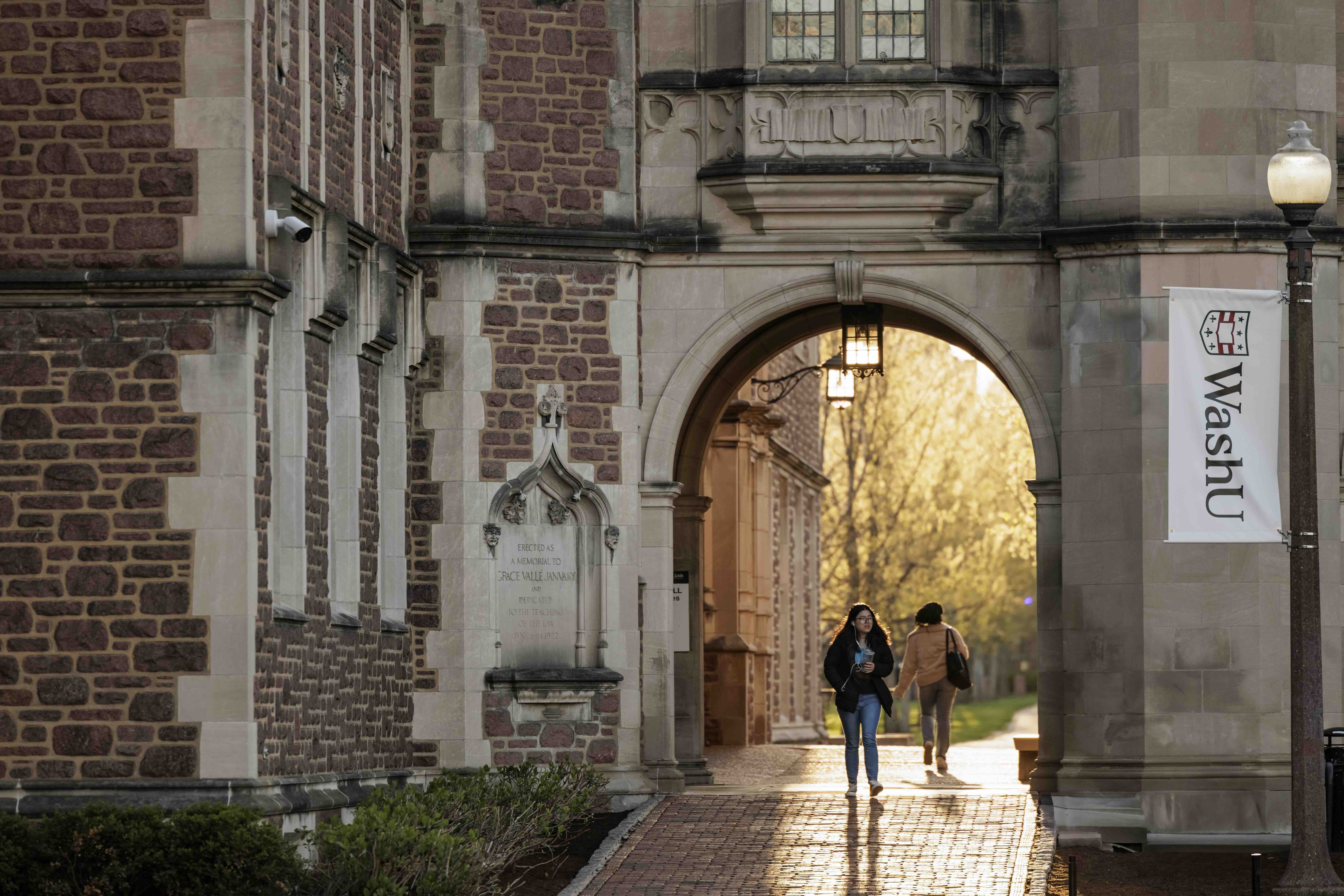
Two subject librarians, Rudolph Clay and Clara McLeod, were let go after decades at the library. (Rachel Benitez-Borrego | Staff Photographer)
Rudolph Clay and Clara McLeod, two longtime WashU subject librarians, were let go over the summer as part of WashU Libraries’ budget restructuring.
Clay’s research specialties were African & African American Studies (AFAS) and Urban Studies, and he was a Senior Lecturer in AFAS and the Head of Library Diversity Initiatives and Outreach. McLeod assisted students and faculty with research in Earth and Planetary Sciences. Both Clay and McLeod worked for WashU Libraries for over 30 years.
Mimi Calter, Vice Provost and University Librarian, confirmed in a statement to Student Life that University-wide budget cuts have impacted the library. Calter wrote that she “cannot comment on matters related to specific personnel.”
“The Libraries were asked by University administration to make budget cuts for fiscal year 2025-2026. That cut resulted in reductions to our library materials budget (i.e. collections) along with position eliminations and some administrative changes,” Calter wrote in an email comment to Student Life.
The Libraries’ website indicates that Clay and McLeod’s former subject librarian positions are filled in an interim capacity by other librarians. Calter declined to answer a list of questions including inquiries into new hires and the future of Clay and McLeod’s research specialties at the library.
“As we face the challenge of making the University more efficient, the libraries remain committed to our mission and to supporting all WashU’s academic departments,” Calter wrote.
McLeod was informed of her termination six days before her final day of employment, according to her statement to Student Life.
“I received an email late in the afternoon of June 24 requesting my availability for a meeting with the Vice Provost and University Librarian, Mimi Calter, on June 25 at 1:00 p.m. I was informed at that meeting that I was being terminated for financial exigency and that my last day of employment at WashU would be July 3, 2025,” McLeod wrote.
McLeod wrote that she felt the termination process did not reflect WashU’s values.
“I was saddened that I was being terminated from a community that I considered as family for the last 40 years. I felt that the termination process that occurred to me was not indicative of WashU[’s] commitment to treating its community with respect, dignity, and humanity.”
The chair of the Department of Earth, Environmental, and Planetary Sciences (EEPS), David Fike, agreed that the termination appeared to be sudden.
“We were surprised by the abrupt termination of Clara McLeod and saddened by the way in which it was handled,” Fike wrote in an email to Student life.
Similarly, Clay’s former colleagues in the AFAS Department said they felt shock and disappointment after learning that Clay’s position was terminated.
Shanti Parikh, chair of AFAS, said that she felt a personal “void” in the wake of his termination.
“He had his quiet strength behind him. … Very soft-spoken, but extremely organized and extremely reliable,” Parikh said. “If any of us ever needed to find something, we would send it to Rudy [Clay], and he would be able to dig and find it for us.”
Clay was considered to be a valued member of the AFAS department.
“He was part of our community, he came to our faculty meetings, … he promoted [library] events, he asked how the library could be of use,” Parikh said. “So he was a really good connector between an academic unit and just the library in general.”
Clay’s absence is not only felt by faculty but also current and former students.
Per Professor of History and AFAS Timothy Parsons, Clay helped one former WashU student write a book chapter about the history of the WashU AFAS department by setting up interviews with former students who advocated for the department’s creation in the 1960s.
Senior Halla Jones shared that Clay’s termination has affected her two-year research project on overlooked histories of African American art for the Merle Kling Undergraduate Honors Fellowship.
“I no longer have a person in WashU Libraries who fully understands the complexity and nuance of conducting research in Black studies, and the limited archive it has, and I am left to fend for myself in an institution that already prioritizes the dominant narrative of history,” Jones wrote in an email to Student Life.
McLeod’s colleagues in the EEPS department echoed many of the comments made by Clay’s colleagues in AFAS.
“Those of us that have been here a long time just really enjoyed always working with Clara [McLeod],” said Douglas Wiens, a professor in the EEPS department.
EEPS chair Fike praised McLeod’s depth of knowledge.
“She was always available to track down obscure references and brought ideas for how to bring her expertise to bear on any number of assignments and research projects,” Fike wrote in an email to Student Life.
Michael Wysession, an EEPS professor, said that McLeod clearly loved her job.
“She’s smart, competent, dedicated to her work. She loves the printed word,” he said.
McLeod’s expertise in her field was recognized by the Geoscience Information Society (GSIS).
An article published by The Source in 2019 celebrated McLeod’s receipt of an award from GSIS for “significant contributions to the field of geoscience information.” In the article, Denise Stephens, the former Vice Provost and University librarian, praised McLeod as a “trusted partner in faculty research” and “a respected member of the libraries and broader WashU community.”
When asked about what her next chapter will be, McLeod wrote, “I know that the University is facing challenging times and my hope is to continue a relationship with the University. … I am extremely thankful and humbled by the support I received from the community during this difficult time.”
Wysession said that McLeod continues to be important to the EEPS department.
“She’ll always be part of our department, whether or not the University is employing her,” Wysession said.
Even faculty and students who never met McLeod may have seen her last name on campus. Clara McLeod’s late husband, James McLeod, was Vice Chancellor for Students and Dean of the College of Arts & Sciences. According to Wysession, Clara and James McLeod “were very much a duo.”
Clay was also known throughout campus and even the greater St. Louis area. In 2016, Clay served as president of the Friends of Julia Davis Branch Library, a branch of the St. Louis Public Library.
Rafia Zafar — WashU Professor Emeritus in English and AFAS — noted that Clay once invited her to give a talk at the Julia Davis library which inspired Zafar to give public talks afterwards. Although Zafar is now retired and living in New York City, Clay has continued to influence her community involvement.
“If I’d encountered someone like Rudolph Clay as an undergraduate I might have become a university librarian instead of a professor — really. In fact, now that I’m retired I have joined the Schomburg Center for Research in Black Culture (New York Public Library) as an official volunteer, helping to process donations; Rudolph Clay … inspired me to do library work as a retiree,” Zafar wrote in a comment to Student Life.
Clay was involved with the Trailblazer Award for Black alumni and faculty and helped plan WashU’s annual Martin Luther King, Jr. Day commemoration for over 10 years.
Alongside his contributions to programming at WashU, Clay’s personal qualities left an impression. According to Parikh, Clay had a knack for connecting with students.
“One of our Mellon Mays [Undergraduate Fellowship] students from a while ago became interested in library sciences because she worked so closely with him,” she said.
William Maxwell, a professor in both the English and AFAS departments, described Clay as uniquely kind.
“He gave a lot of light. … [He was] an extremely kind man. People like to say that kind of thing about people, but Rudy [Clay] really was that. He still is, but he’s unfortunately not working for WashU any longer.”
Stay in Touch!
Get the latest and top news from StudentLife delivered to your inbox