News
ArtSci dissolves task force considering departmental reorganization after resignations of task force members
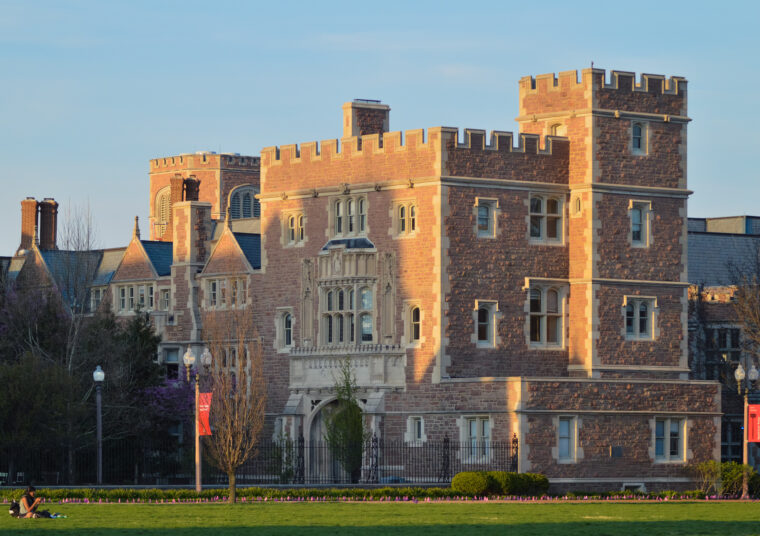
Four out of the six departments that were at risk of reorganization are based in McMillan Hall. (Lydia Nicholson | Student Life)
Dean of WashU’s College of Arts & Sciences Feng Sheng Hu announced the end of the task force created to explore the reorganization or consolidation of six separate academic departments and programs in the humanities at a Tuesday evening faculty meeting, Oct. 21. The dissolution of the task force means that Arts & Sciences is not moving forward with any restructuring of the six departments, although task force members said ArtSci may revisit its work as it looks to address inefficiencies in the departments in the future.
On Sept. 10, Student Life reported that Arts & Sciences created the “Social Transformation” task force to consider a departmental reorganization, including the possibility of a merger, of African & African American Studies (AFAS); American Culture Studies (AMCS); Education; Global Studies; Jewish, Islamic, and Middle Eastern Studies (JIMES); and Women, Gender, and Sexuality Studies (WGSS).
Over a month after the committee was initially formed, its members recommended to Hu that he dissolve the committee. Leaders of the task force said that the decision to end its work was due to student and faculty opposition and a lack of transparency from administrators, among other factors.
“Faculty, students, and alumni expressed serious concerns about the timing given the current political climate, the lack of a clear intellectual rationale, the absence of clarity about what specific problems the initiative was meant to address, and the lack of faculty involvement before the initiative was launched,” task force co-chair and chair of AFAS Shanti Parikh wrote in an email to Student Life.
“Ultimately, the dean accepted our recommendation to bring the task force to a close.”
In conversations with faculty and student stakeholders, the task force identified major skepticism towards a potential merger — skepticism that many members of the group held themselves, according to Parikh.
All but three members of the seven-member task force resigned from their roles Monday night. In a resignation email acquired by Student Life, one member of the committee wrote they felt that Hu was not taking into account the task force members’ recommendations and that the dean instead treated them as “obstructions.” According to Parikh, after the mass resignation, Hu responded quickly and decided to eliminate the task force.
“After some of us decided to step down from the committee, he understood the urgency of our recommendation, and he responded accordingly,” Parikh said. “And for that, I commend him, and I support his decision to suspend the task force’s work.”
In a statement provided to Student Life Wednesday evening, Hu wrote that the task force’s initial purpose was to explore ways to reorganize the departments to reduce organizational burdens on the six departments, and its closure was in part due to an unstable political climate.
“This decision was made after close consultation with the task force members and based on valuable feedback from a number of faculty and students, as well as a rapidly changing political landscape that made it difficult to focus on our overarching goals: reducing administrative burdens and exploring increased opportunities for operational and intellectual collaboration,” Hu wrote.
While there are no plans to restart the task force at the moment, Parikh noted that Hu reserves the right to reconvene the task force at any time. Hu still hopes to address issues that the task force was created to review, such as administrative burdens, but in different ways.
“I remain committed to addressing these critical issues, which have a direct impact on faculty members’ capacities for teaching and research,” Hu wrote. “I would like to thank the members of the task force, who worked in good faith under challenging circumstances to engage faculty, students, and staff.”
Stephanie Kirk, Director of the Center for the Humanities and the other task force co-chair, said that efforts to increase academic cooperation between the departments may continue.
“The idea in general is to see if the departments can address some of their administrative challenges through collaboration, as well as looking to see if there are some interesting and innovative intellectual initiatives that might emerge among some of these units,” Kirk wrote in an email to Student Life.
Parikh added that the political context complicated the committee’s work.
“The broader political climate, including national attacks on fields like Black Studies, Women’s Studies, and Education, made the timing of the initiative deeply concerning from the start,” Parikh wrote. “The political context added to the perception that this process was reactive rather than strategic.”
The creation of the task force prompted criticism from a number of faculty, staff, and students. One student, junior Ian Gomez, began speaking with students and faculty in the affected departments after learning of the task force’s creation. Gomez, a Germanic Languages and Global Studies double major with a concentration in International Affairs, described “extreme confusion” among those he spoke with both about the news of the potential merger, which came as a surprise, and the selection of the six departments specifically.
However, Gomez was impressed with the GS department’s efforts to organize listening sessions to gather feedback as well as the willingness of faculty and students to speak with him.
“I think that this experience has shown me just the strength of our community as a whole, and that’s a resource that really can’t be valued — you can’t put a number on that,” Gomez said.
Gomez said that he sees the decision to end the task force as the start of a conversation about the future of humanities education and administrative transparency.
“I think that this is the beginning of a much longer conversation about the future of Arts & Sciences … and how we are going to support our departments and students,” Gomez said. “It also invites a conversation about how to maintain lines of communication and ensure that people know the information they need to know when they need to know it.”
Parikh emphasized that the uncertainty surrounding the task force made it challenging for it to achieve its stated goals of reducing administrative burdens on the departments and strengthening their visibility.
“The level of confusion and anxiety surrounding the task force’s charge made it clear that the process needed to be stopped, and that the issues that the dean sought to address … should be approached in a different way,” Parikh wrote. “The decision demonstrates the value of student and faculty engagement.”
Additional reporting by Riley Herron
This article was initially published at 2:07 a.m. on Oct. 22. It was updated at 9:21 p.m. on Oct. 22 to include a statement from Dean Feng Sheng Hu.
Stay in Touch!
Get the latest and top news from StudentLife delivered to your inbox