News
New York University’s Helga Tawil-Souri reimagines infrastructure and mapping in Palestine
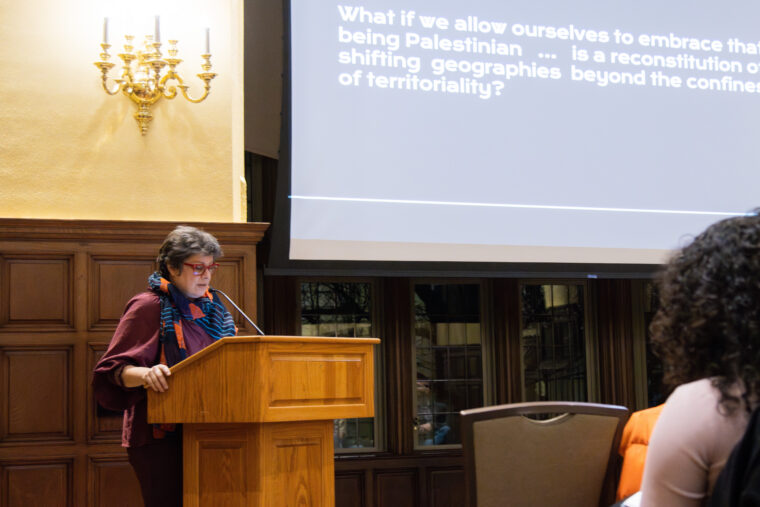
Helga Tawil-Souri talks about reimagining Palestinian infrastructure and mapping through the speculative International Pigeon Network (Max Silberg | Contributing Photographer)
Palestinian-American scholar Helga Tawil-Souri, co-editor of “Producing Palestine” (2024) and “Gaza as Metaphor” (2016), gave a lecture entitled “Spacing Palestine: Mapping and Speculative Infrastructures,” which examined how Palestinian identity should be understood beyond fixed territory and through shifting geographies, diaspora, and alternative technological systems, Feb. 12.
The event, hosted by WashU’s Department of Jewish, Islamic, and Middle Eastern Studies (JIMES), centered on what it means to be Palestinian.
“What if we allow ourselves to embrace that being Palestinian is a reconstitution of shifting geographies beyond the confines of territoriality?” Tawil-Souri said.
Tawil-Souri, who is also an associate professor of Middle East and Islamic Studies at New York University, argued that Palestinian life is defined by the ongoing negotiation between mobility and constraint and displacement and belonging rather than an attachment to a single fixed geography.
“Palestinians live with and in constant tension about space. There really is no one correct, central, or authentic departure point from the nominal geography of Palestine,” she said. “It is the disappeared places. It is the shrinking contemporary reality of the territories. It is the pan-territorial experience of exile. It is an uncertain future.”
From this framework, Tawil-Souri turned to mapping as a way for Palestinians to negotiate memory, loss, and presence beyond territorial confinement.
“Movement within, out of, and into Gaza is largely determined and constrained by Israel,” she said. “So too is communicative movement. All electronic communications are under the complete control of Israel.”
Tawil-Souri proposed the Internet Pigeon Network (IPN) as a potential communication infrastructure, utilizing homing pigeons to carry digital data between Gaza and external landing points in countries like Jordan and Egypt. The concept imagines locally built pigeon networks as alternative infrastructures of community-built connection, replacing centralized communication infrastructure.
“The pigeons would replace that last mile or middleman supplier, where Israel is constantly in control of that sort of infrastructure and that communication,” Tawil-Souri said. “By relying on pigeons rather than cables, the IPN decreases the network’s dependence and complexity, replacing agency in the community that it serves. It limits Israel’s surveillance capability and the profits that it extracts by the dependence that it enforces.”
Jonathan Judaken, professor of history and chair of the JIMES department at WashU, said his initial reaction to the lecture’s speculative infrastructure example was one of catastrophe since it suggested going back to ancient technologies as a means of communication. However, he said Tawil-Souri reframed his perception during the discussion, emphasizing the acceptance of new possibilities for communication rather than thinking of it as a catastrophe.
“Her response to my question about that felt really positive, like it’s not post-apocalyptic, because this is all about how we can think beyond catastrophe, before catastrophe, and open ourselves to new possibilities that don’t end up leading down that path,” he said.
Judaken added that the lecture’s themes extend beyond the Israel-Hamas war.
“It’s not only in the context of Israel-Palestine or of Gaza that we need to think about the kinds of issues that were discussed,” he said. “Whether that’s the question of rethinking our identities, rethinking the way we think about space and time, or rethinking the ways in which we communicate with other people, which were kind of three parts of her talk.”
An attendee, Dylan Zielonko, said the talk shifted his assumptions about how the region of the Middle East is typically discussed.
“The thing that was very surprising to me was, maybe, considering the state of Palestine from perhaps a stateless perspective,” Zielonko said. “A lot of conversation is very much based on rigid borders, and to hear one that was more post-border was interesting.”
Samira Saleh, a senior majoring in sociology and Spanish, explained that this talk recontextualized her Palestinian identity.
“I’m Palestinian. It seems something I’ve been definitely navigating at WashU amidst our political climate and tensions surrounding this issue,” Saleh said. “A lot of the discourse about this issue surrounds the importance [of] land, and that’s something that has always been really symbolic in the Palestinian identity. Learning how to possibly reach a point where an identity can be formed without land is really eye-opening.”
Tawil-Souri said part of the work of activism is to continue talking about Palestine even when it is hard to do so.
“It’s really important to keep talking about Palestine, particularly as more repression and suppression and silence seem to be happening,” Tawil-Souri said. “[Especially] in this moment where it has just kind of just fallen off the mainstream media.”
Stay in Touch!
Get the latest and top news from StudentLife delivered to your inbox