News
Digital device bans are on the rise in Arts & Sciences classes
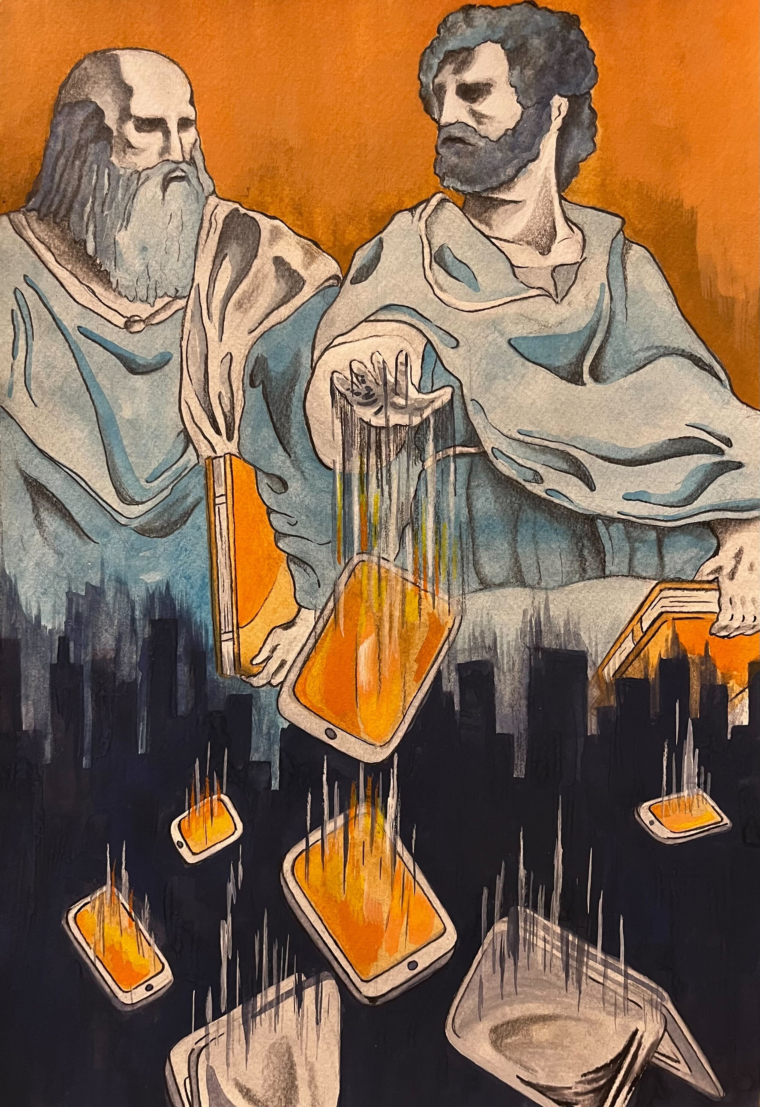
Liam Thomas McManaman | Staff Illustrator
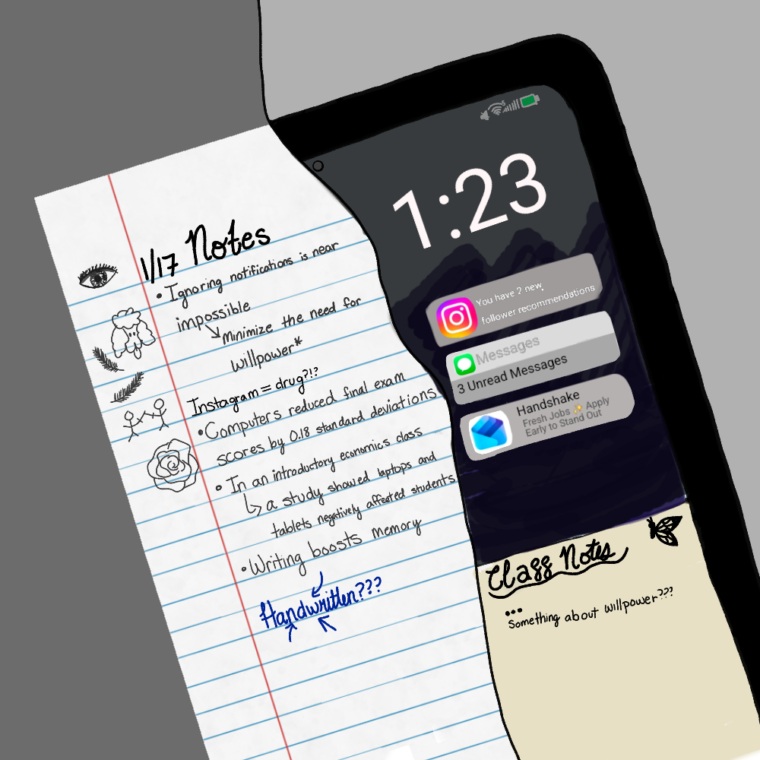
An increasing number of courses in WashU’s School of Arts & Sciences are heavily restricting or banning the use of digital devices in the classroom, according to Vice Dean of Undergraduate Affairs Erin McGlothlin and Associate Professor of Dance Joanna Dee Das.
Both faculty members participate in Arts & Sciences Curriculum Committee meetings and noticed this increase after reviewing the syllabi for every new course proposed by Arts & Sciences faculty as part of their committee responsibilities.
McGlothlin, who is also a professor in two Arts & Sciences humanities departments, has implemented a no-laptops policy in her class for the first time this semester because she is teaching a discussion-based Ampersand Program. Previously, she allowed technology in her classes, although she sometimes asked students to close their laptops when she saw a drop in students’ participation in class discussion. She said that when she has made this request, she has seen an immediate increase in engagement.
“Immediately the energy in the room would go up. Suddenly you have a group of students interacting with each other and with me,” McGlothlin said.
Senior Mia Powell, an English and history major, said that last semester, four of her five classes completely prohibited the use of laptops and iPads, and this semester, half of her classes ban digital devices. Powell studied abroad both semesters of her junior year, but said that only one of the courses she took as a sophomore fully banned digital devices.
Technology restriction policies in WashU classrooms include allowing iPads but not laptops for note-taking, requiring laptop users to sit separately from students who take handwritten notes, or banning technology use altogether — with exceptions for students with disability accommodations.
Das revised her digital device policy over the summer to ban laptops and only allow iPads, which can be utilized as textbooks or notebooks, for her discussion-based curriculum.
“I wanted to educate myself about the changes AI was bringing, and that led to a kind of slightly different but related question about attention in the classroom and how we have conversations that are not mediated by technology,” Das said. “I was going back and forth because I do know that many students these days do like to take notes on their laptops, but it’s not necessary for them to copy down every piece of information.”
Technology limitations are not new at WashU. Peter Kastor, a professor in the history and American Culture Studies departments, said that he prohibited the use of computers in the classroom over a decade ago. He found students were more attentive in lecture and more engaged in discussion when technology was banned. When he reintroduced computers in a seminar where students needed to see digital materials during the classroom meeting, he said he saw the quality of student interactions suddenly decline.
“I told everyone, bring your computers … and the quality of conversation plummeted. Fewer students spoke. They couldn’t engage each other as effectively,” he said. “They sounded more palpably nervous because the other students weren’t looking at them. They couldn’t [maintain] eye contact.”
Some professors are not outright banning technology but instead implementing policies to restrict it. Professor Molly Moore divides her classroom into a laptop and non-laptop section to limit the distraction of upright screens. Students with iPads are able to sit in the non-digital device section.
“I think of both the internal and external effects of using laptops,” Moore said. “Especially with laptops, you have the screen facing up. If you are sitting behind somebody that’s using a laptop, in particular, if that person is not on task … it’s almost impossible to focus.”
Michelle DeLair, a lecturer in American Culture Studies and the director of Curricular Innovation in Arts & Sciences, lets students set their own classroom technology policy at the beginning of the semester. She began to allow students to define their own policy about 10 years ago and incorporated student input because she felt that when students designed the policy themselves, they understood its purpose and were committed to following it throughout the entirety of the semester.
“I have had classes in the past decide, [say that] as a class, they don’t want laptops, or that they don’t want laptops during particular portions of the class,” she said.
McGlothlin noted that when she reads end-of-semester course evaluations for Arts & Sciences classes, students sometimes ask for restrictions on technology use.
“Some students will ask for a laptop policy because they find their learning is distracted when they look at another [student’s] screen,” she said.
Although an increasing number of humanities courses are restricting digital devices, many continue to permit their use in the classroom. Uluğ Kuzuoğlu, associate professor of history, who teaches “A History of Modern China” and a new seminar, “Artificial Intelligence: The Mind and the Machine,” has not changed his policy to accommodate any technology restriction.
“I think there is also some beauty in letting students get distracted when they want to be. Lectures are long,” Kuzuoğlu said. “Sometimes you just want [those] two minutes where you can get distracted and then come back to listen to whatever discussion is going on.”
Kuzuoğlu has also not placed restrictions on the use of artificial intelligence. He has even incorporated AI into some of his assignments, asking students to tell ChatGPT to pose as a historical figure, interview the figure, and write an essay about it.
“They can use it in whatever way they want. If they want to use it to summarize the readings, I can’t say don’t do it, because I don’t really have any way to monitor that,” he said. “Given that no one can really monitor that practice, I think we [have] to change our own practice of teaching and giving assignments.”
Das said that during her time on the Curriculum Committee, she has observed that the increase in technology bans is more prevalent in humanities and social sciences courses than in STEM courses. McGlothlin said she is not certain whether humanities courses are banning technology more than STEM classes.
Karl Schaefer, a lecturer in the mathematics department, said he does not restrict digital device use in his classes. He noted that the main goal of teaching is to help students learn content and develop skills, and classroom policies should support that goal.
He said that technology can become distracting and hinder learning for some students. At the same time, he emphasized that students are adults who can make their own decisions about how to spend their time and what they find valuable. He also noted that there are legitimate reasons for using devices in class, including situations in which students have disability accommodations.
Schaefer said a professor’s approach to technology can depend on the type of course being taught. He usually teaches large lecture classes.
“I don’t think this is a faculty versus faculty debate about whether or not device bans are good or bad. It’s not like I’m disagreeing with my humanities colleagues,” Schaefer said. “We have very different contexts in our classroom, different class sizes, different learning goals, and those different contexts require different policies.”
Schaefer added that if he was teaching a small humanities discussion-based course, he likely would have a policy restricting device use in some way. However, he emphasized that in the current classes he teaches, he feels it’s best not to prohibit digital devices.
“Thinking about the benefit to one student versus the entire class and weighing that against the enforcement of [a ban], that’s why I [don’t restrict it],” he said. “It’s not like a personal hatred for device bans. It’s just based on the context I teach in. I think it doesn’t really make as much sense.”
Several professors told Student Life that they are interested in students’ opinions about technology in the classroom and want to take them into consideration when drafting classroom policies.
“I’m going to survey the students at the end of the semester to see how they felt, because I do think, yes, technology is an inevitable part of our lives and our learning experience,” Das said. “But that doesn’t mean we can’t have guardrails.”
Powell said that professors banning technology doesn’t have a huge impact on her since she typically takes notes by hand. However, she has noticed that student participation and engagement, and the quality of class discussions, tend to improve in seminar courses when digital devices are banned.
Powell supports stricter limits on technology in humanities courses. However, she is less certain that more technology bans are necessary in STEM courses because they are often more lecture-heavy. She noted, though, that she has not taken many STEM courses in college.
“It’s your job to synthesize the information being tossed at you [in STEM classes],” Powell said. “It’s up to you whether or not you want to retain that. So if you’re texting, you’re only hurting yourself. But a seminar particularly requires the engagement of others for there to be any sort of pedagogical benefit to it for the entirety of the class.”
Senior Noah Gornstein, a political science and economics double major, said only one of his classes last semester had a policy banning the use of digital devices. Still, as the semester progressed, about half of the students in that class began taking out their computers to take notes.
Prior to last semester, Gornstein only had one other class during his time in college that banned the use of digital devices. He said that he had generally learned more in classes in which he took handwritten notes. However, for certain classes, he finds it helpful to have digitized notes so he can more easily study for exams and make flashcards.
Gornstein said the usefulness of digital devices can vary based on the course’s structure. In discussion-based classes, being able to pull up homework readings online can be helpful for reference. But in his lecture-heavy courses, device use can be distracting.
“When you see someone shopping online in the row in front of you, some of your attention is taken off what the professor is saying, and that can generally lead to a more disengaged class,” Gornstein said.
Gornstein told Student Life that although he feels the way technology is used in classrooms can make learning “less interesting,” he does not support professors banning digital devices altogether.
“I do believe that giving people the freedom is important. I think there [are] good reasons why some people might want to be able to use technology, [including] for learning disabilities,” he said.
Additional reporting by Aliza Lubitz.
Stay in Touch!
Get the latest and top news from StudentLife delivered to your inbox