Forum
The mirror doesn’t lie: AI exposes those who don’t think
Tillie Szwartz | Contributing Illustrator
A 2024 survey by the Digital Education Council, an educational artificial intelligence (AI) focused think tank, found that 86% of undergraduate and postgraduate students across 16 countries use AI tools in their studies. I apologize to the older generations who read that and had a heart attack. AI has permeated nearly every corner of the educational world to the point that you will hardly find any WashU student who has not used AI.
With individualized secretaries now at the disposal of anyone with a device and an internet connection, a paradigm shift in academia is doubtless on the horizon, if not already underway. This has, unsurprisingly, elicited much commotion among those who wish to herald in a new age of productivity and those staunchly opposed to the tool they think will “replace” thinking. Go home this Thanksgiving break, and you may have a grandparent patronizingly demand that you refrain from using the devilish ChatGPT.
However, the notion that AI will annihilate reason in the younger generations is, itself, an argument devoid of reason. AI alarmists have misconstrued the nature of this technological revolution. AI will not replace thinking. Rather, it will magnify the difference between those who think deeply and those who don’t.
Researchers at the University of Washington and the Allen Institute for AI coined the term “Generative AI Paradox” in their 2023 study on AI’s ability to produce novel information. They found that while AI consistently outperformed humans at generating information (e.g., summarizing a book), it could not hold a candle to humans’ ability to understand and synthesize information. Studies repeatedly show that AI has no capacity to replace human creativity, ingenuity, and imagination, so it is silly to ostracize it on these grounds.
AI has proven to be an immensely powerful tool for improving productivity; however, it should not be seen as a replacement for human skill, but instead as a complement to it. AI can scour the internet for sources, serve as an immediate tool to bounce ideas off of, and handle other menial tasks that would otherwise take a human much time. As with any tool, it can be abused, but those wise enough not to abuse it will reap the greatest benefits.
Opponents to AI, including disgruntled professors, argue that AI empowers students to cheat. But those who treat college as a means to an end and care little about learning beyond its practical benefits will find a way to circumvent the system with or without AI. Students who cheat their way through classes fool no one except themselves. They spend nearly $100,000 to learn absolutely nothing, and AI does nothing but make their intellectual laziness more efficient.
Nobody is a victim of AI or technology. If you are using AI as a factory to mass produce generic, wholesale assignments, then you are complicit in your own mental atrophy. Will some students, hooked on this opium that enables their academic sloth, never develop critical thinking skills? Absolutely. But who is to say that they ever would? These are the same people who, before AI, copied SparkNotes and Chegg verbatim. This is not a new development. Turn on any ’80s or ’90s movie set in high school or college, and you are bound to see the trope of the jock paying off or bullying the nerd into writing his papers. AI doesn’t create this problem; it merely exacerbates it.
All of these points signal a more sinister cultural development: people treat college as a checkpoint to be reached rather than a real opportunity for intellectual growth. I am glad that AI is shaking the foundations of the educational world because it forces us to confront this problem. I heard a story of a class where students left AI to do their assignments, and the TAs graded said assignments with AI. What are we doing? Frankly, if a class is an “easy A” because of AI, then it shouldn’t be offered. We’ve reached the point where some classes are just chatbots interacting with each other. What has higher education become?
Just as calculators didn’t end mathematics but exposed those who didn’t understand it, AI won’t end thinking. It will merely expose those who already don’t think much, and perhaps more importantly, expose the cultural rot that has disfigured the university system into profit-greedy corporations rife with administrative bloat. Universities have spent decades curating a pitch-perfect academic profile to optimize enrollment and maximize profit while hollowing out academic rigor. For many, it seems registration has become a precarious balancing act between grade-inflationary and weed-out classes, both of which are antithetical to the goal of education, but this is a topic worthy of its own article.
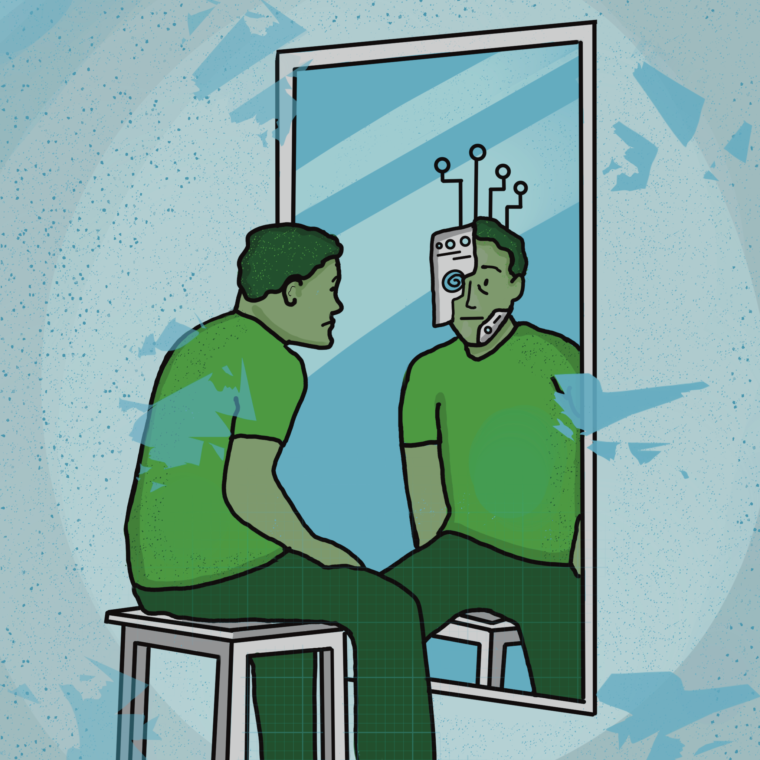
AI is a mirror, and it is uncomfortable to see what it reflects: students who never cared about learning, classes that never required thinking to pass, and institutions that forgot their original mission. Right now, many people are looking in the mirror, and it’s not making them happy. They think they hate the mirror, but really, they hate the reflection.
Stay in Touch!
Get the latest and top news from StudentLife delivered to your inbox