Forum
Addicted to scrolling? Try fiction instead.
Mimi Milord | Contributing Illustrator
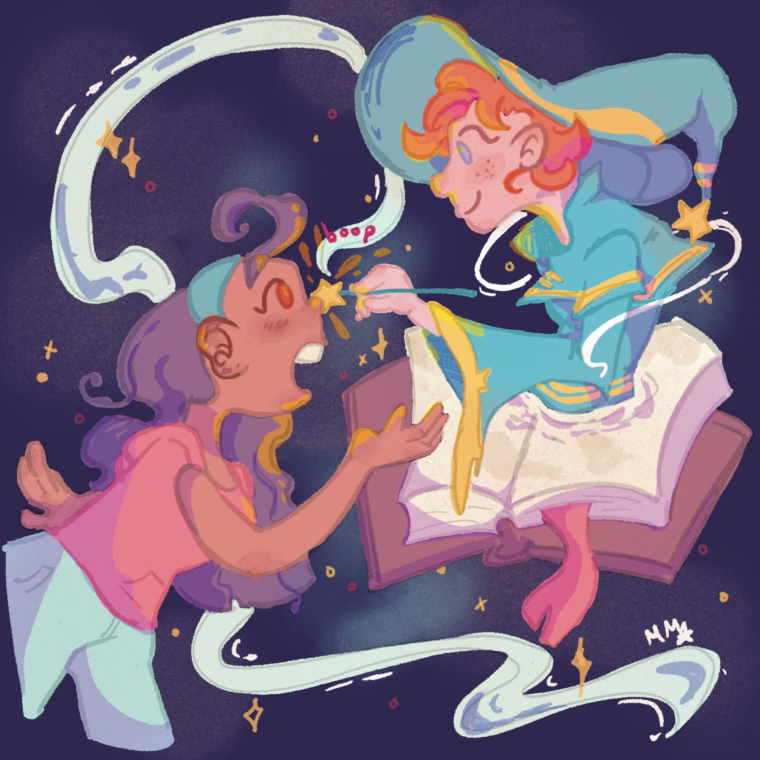
I’m sure that many of us social media users share the experience of scrolling for an extended period of time and remembering… nothing.
One of the most troubling aspects of doomscrolling is how time seems to just disappear. Not only can hours feel like mere minutes on TikTok, but after scrolling, it is incredibly difficult to recall the content of the posts you just consumed. This content is diverse; from dancing clips to political commentary to niche humor, we are exposed to ideas from around the world while scrolling. But the true paradox of the internet is that in the process of connecting us, it has also left us isolated.
Our generation reports feeling more lonely than older ones. We are less likely to have close friendships and feel like we belong in communities. These shortcomings can be attributed to the decreasing presence of stories and growing prevalence of mindless scrolling as the way we entertain ourselves. When we don’t consume fiction for fun, we forget how to create meaningful narratives in our lives, and narratives teach us how to build connections and community. Today, we are missing stories.
The average college student spends upwards of four hours per day on social media. I would guess that at most, 30 minutes of this time is spent interacting with actual friends and family, while the remaining hours are dedicated to scrolling for pure entertainment — entertainment that derives from content with no plot, characters, or greater meaning.
This paradigm is problematic because engaging with fiction, whether through reading a novel or even watching a movie or TV show, is connective. Studies have shown that reading fiction enhances empathy, and watching movies also exposes us to new perspectives. Writing a book or producing a fictional story requires composition; that is to say, authors and directors intentionally craft narratives to have deeper meanings and lessons.
Even “trashy” fictional content, such as surface-level romance books or low-budget sitcoms, has intentionality. If anything, these fictions inspire great meaning in our lives because they are about things that we can all relate to, like love, family, and relationships. The underlying theme of most stories — connection — is what we miss when entertaining ourselves through social media for hours per day. No wonder young people are missing community these days: our scrolling has eroded the inspiration that arises from fiction.
To clarify, the problem with our scrolling epidemic is not necessarily its lack of intellectual merit; typical criticisms of social media are often based on general denouncements of “trashy” content, even though people have always engaged with the “trashy.” For instance, in early modern Europe, “chapbooks” were short-form, fictional novellas that were popular but held little literary value. Even many of our parents grew up watching unserious content, yet they were generally less lonely than Generation Z. At the very least, previous forms of “trashy” content were fictional. They may have been an escape from reality, but they transported the viewer into another reality through storytelling. In contrast, doomscrolling diminishes the presence of narrative in entertainment; it’s media that we struggle to remember, much less extract meaning and life inspiration from.
When you consume a piece of fiction, you may begin to understand another’s perspective. You learn to incline toward empathy and away from cynicism. It’s as easy as watching your typical rom-com TV show, where alongside the temporary break from critical thinking, you actually observe how characters maintain long-term, meaningful relationships and grow to see the value in fighting for those we love. Perhaps the first step for reconnecting Generation Z is simply re-engaging with stories once again.
I don’t want to shame anyone for doing what brings them joy. I’m asking us to consider a return to storytelling as our default mode of entertainment. Next time you get back to your dorm from class, instead of scrolling, try reading a trashy romance or start a new show, and see if you remember more than what your scrolling showed you yesterday. Enjoying a story may inspire a story in your own life.
Stay in Touch!
Get the latest and top news from StudentLife delivered to your inbox