News
WashU to acquire the University of Health Sciences and Pharmacy and create new pharmacy school

WashU is acquiring the University of Health Sciences and Pharmacy, which is located next to WashU’s medical campus. (Sydney Tran | Editor in Chief)
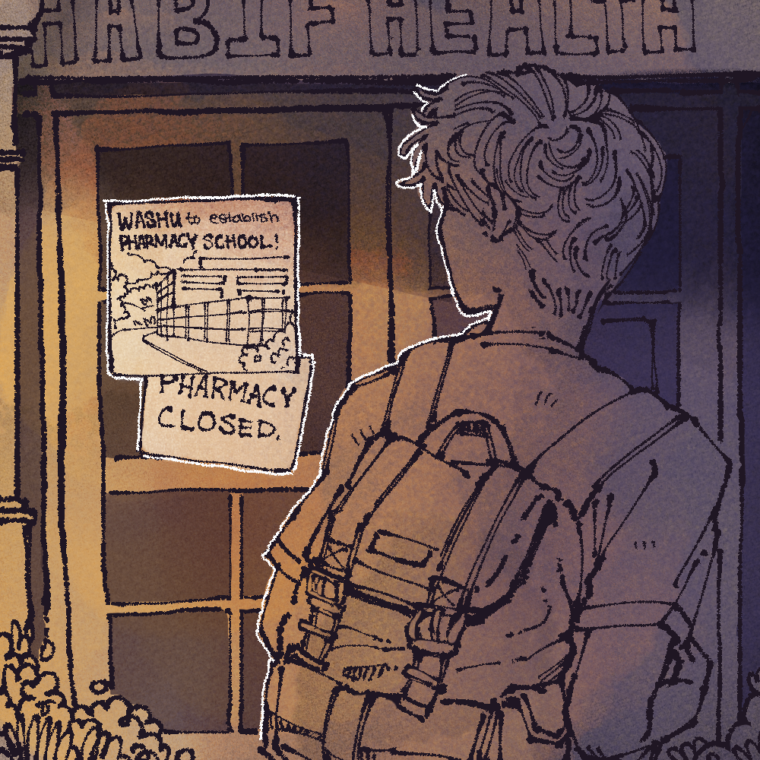
WashU is creating a new pharmacy school after entering into an agreement to integrate the University of Health Sciences and Pharmacy (UHSP) into the University, according to an email sent by WashU Chancellor Andrew D. Martin on Feb. 24.
UHSP’s Doctor of Pharmacy (PharmD) program will become WashU’s new school, still operating at its current location on the UHSP campus, which is next to WashU’s medical campus. According to the UHSP press release, programs other than the PharmD will be phased out after the 2026-2027 academic year. WashU’s press release in The Source states that “some” programs UHSP has besides the PharmD program will transition to WashU.
UHSP and WashU have reached an agreement about this merger, but are still awaiting regulatory approvals over the next year and a half. UHSP’s press release states that they are still working with WashU on a “transition plan.”
Some students expressed frustration with the timing of the UHSP announcement shortly after the armed person alert earlier in the day.
Julie Flory, vice chancellor for marketing and communications, said the timing was due to logistical communication factors.
“We would have preferred not to have to make this announcement today given other events, but UHSP was informing its community this morning and we needed to coordinate the timing with them to support their communications,” she wrote.
While UHSP’s announcement states that there will be “minimal disruption” for current PharmD students, its undergraduate students who don’t graduate in time will be required to relocate following the 2026-2027 academic year. UHSP currently has 372 undergraduate students.
Options for undergraduate students will include a teach-out agreement offering limited spots with WashU’s School of Continuing & Professional Studies (CAPS), pending agreements with other institutions that will not be finalized until March of this year, and a traditional transfer.
Some undergraduates are former Fontbonne University students who moved to UHSP after Fontbonne closed in 2025 under a teach-out agreement. For UHSP students opting for the teach-out agreement, they will be offered automatic admission to a partnered school, matched tuition and fees, matched transfer credit, and facilitated graduation on their original timeline.
There is no stated mention of similar programs for part-time Masters of Public Health students, as UHSP suggests that these students may be required to take on a full-time schedule in order to finish their degree before the integration.
UHSP is offering students the opportunity to meet with faculty and staff to plan for the future. The university has not publicly released information regarding the impact on faculty.
Neal Sample, chair of UHSP’s Board of Trustees, cited challenges facing higher education, including decreasing enrollments and high costs nationwide, as factors in the decision.
“Over the last decade, UHSP has made several difficult but strategic decisions to adapt to these changes,” Sample wrote in a press release. “Despite these efforts, the realities of the higher education landscape and long-term financial projections made it clear that we needed a sustainable solution that would secure our mission, students and legacy.”
As of Nov. 17, 2025, the S&P Global projected a negative outlook for UHSP as the university projected above-policy annual endowment draws for the 2025 fiscal year and extending onwards to the 2028 fiscal year. Although these draws maintain sufficient financial resources, they could minimize the financial flexibility of the institution going forward.
The addition of a pharmacy school is the second new school WashU has added in three years, following the formation of the School of Public Health in January of 2025, and the University’s 10th school overall. Before that, WashU had not added a new school division in a century.
In his email, Martin assured the community that the decision was not made as a result of any short-term financial considerations.
“This integration is not a response to short-term actions,” he wrote. “It is a strategic decision grounded in our long-term academic priorities and made possible in part by the university’s strong foundation and our longstanding affiliation with BJC HealthCare.”
Stay in Touch!
Get the latest and top news from StudentLife delivered to your inbox