Scene | Uncategorized
‘An inherent inequality’: Law School report highlights environmental racism in St. Louis
Within conversations about climate change, little focus is placed on how marginalized communities are disproportionately affected by its negative environmental impacts. Alarming statistics published in a new report by the Interdisciplinary Environmental Clinic (IEC) at the Washington University School of Law shed light on environmental disparities that affect the lower-income and/or Black communities of St. Louis.
The IEC report, “Environmental Racism in St. Louis,” which was published Aug. 31, contains sections about health hazards and issues such as lead poisoning, asthma, mold, air pollution, home energy costs, healthy food limitations, vacancies and illegal dumping, and how these issues have historically hurt the Black communities of St. Louis.
This data exemplifies that discussions surrounding environmentalism must include the socioeconomic disparities that St. Louis’s low-income communities of color have, as well as the health inequities that put these fellow St. Louisans’ lives in danger.
The IEC is a pro bono law practice clinic that engages with the environment and community. The IEC, as well as Action St. Louis, ArchCity Defenders, Dutchtown South Community Corporation and the Sierra Club, contributed to the findings and research.
According to the report, “Black St. Louisans are exposed to considerably greater environmental risks than white residents, contributing to stark racial disparities regarding health, economic and quality of life burdens.”
Some health disparities include: “Black children in the City of St. Louis are 2.4 times more likely than white children to test positive for lead in their blood”; “Black children in St. Louis make roughly 10 times more emergency room visits for asthma each year than white children”; and the air pollution sources of St. Louis “which create harmful dust that may contain asbestos and lead occur in majority-Black neighborhoods.”
These statistics only showcase a small number of the entire institutionalized effects of inaccessible and unhealthy environments on St. Louis’s marginalized communities.
“It’s a shame to pursue any environmental goal without trying to address the racial and socioeconomic inequalities that exist here [in St. Louis] and that are blaringly obvious,” Sophie Watterson, a senior who participated in the Environmental Law Clinic in St. Louis, said. “So, my research and my contributions to the project focused on food access in the city.”
Watterson notes that marginalized communities often live in “food deserts,” meaning that they are far from full-service grocery stores that offers healthy options.
“It’s about the quality, and there’s an inherent inequality that some people don’t have the choice to eat an apple,” she said. “Like Funyuns are the only option, and, while that is a fun indulgence sometimes for some people, the fact that you can’t make better choices for your health is unjust.”
Not only are marginalized communities affected by food deserts, but the physical environment is also impacted, as increased transportation can have negative effects.
“The communities [have] a lack of access to healthy foods and that normally ties into the lack of infrastructure to get to the stores,” Sean McManus, a third-year student at Washington University School of Law who helped with editing and publicizing the report, said. “The combination of all that then increases the more transportation that may lead to further air pollution.”
The report also highlights that Black communities face high vacancy rates. 90 percent of vacant properties in St. Louis are in Black neighborhoods, according to Tara Rocque, assistant director of the Interdisciplinary Environmental Clinic. This lack of occupancy leads to worsening environmental conditions, causing more people to leave neighborhoods.
“…People don’t want to live in an area with high vacancy,” she said. “So, the people who can afford to move, move. And the people who cannot afford to move are stuck in a neighborhood that gets worse and worse. And that is compounded by illegal dumping: People who don’t want to pay 50 dollars to go to a dump, [will just] dump a trunk load…of tires or construction waste in a neighborhood that has empty lots.”
While social and governmental institutions are at fault for exploitative environmental and socioeconomic disparities, the Wash. U. community may wonder if Wash. U. has negatively contributed to the environmental marginalization of St. Louis’s most vulnerable communities.
Freshman Brianna Chandler, a student associate at the Office of Sustainability who grew up in St. Louis, believes that Wash. U. is partially responsible for gentrifying St. Louis and worsening the Delmar Divide.
“Students move into areas of the city that are mostly populated by people of color [and live] there for four years…and then they leave,” Chandler said. “[It is] like a cycle [that] residents living there have to deal with. This [is] not so much on the environmental side…but just in general.”
She also believes that because Wash. U. is in St. Louis, “[the University] has a responsibility to be respectful to the region that they’re inhabiting [and] engage in best practices with regions in all areas, including environmental.”
To Chandler, this includes divesting from fossil fuel companies: “They’re giving the school money, which convolutes the school’s interest. That’s [a] conflict of interest in my opinion.”
While Wash. U. as an institution has work that it must do, the Wash. U. student community can get involved in advocating against the intersection of injustice that lies between environmental, racial and socioeconomic disparities.
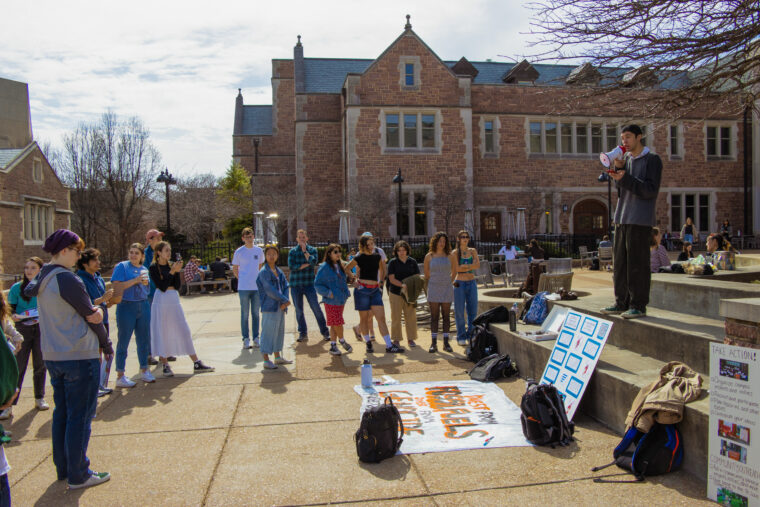
“Get involved with Green Action,” Chandler said. “They are doing a lot of work to engage with [the] St. Louis community. To the people of color who want to get involved [but] don’t know how, don’t be afraid to join environmentally-centered groups, because [these] groups have just historically not been spaces where there were [many] people of color and…we are needed there.”
Stay in Touch!
Get the latest and top news from StudentLife delivered to your inbox