Scene
An analysis of ‘Digger’: A satire on the audience
Holle Ritter | Contributing Illustrator
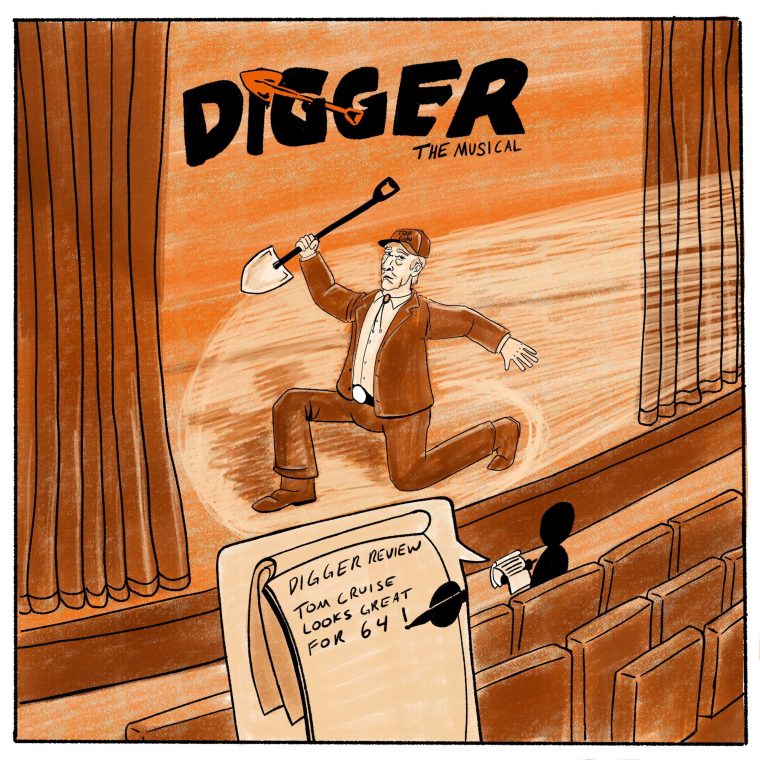
“Digger,” the new film directed by Alejandro González Iñárritu and starring Tom Cruise, is likely to be the most divisive movie of the year, if not the decade. It goes beyond the typical political commentary you’d expect from a satire of its nature and instead utilizes a unique narrative structure to transform itself into a commentary on modern audiences of art.
Beware, spoilers abound throughout the rest of this piece.
If you watched the trailers, “Digger” seems to be a climate satire featuring a larger-than-life oil baron named Digger Rockwell (Tom Cruise), cataclysmic collapsing ice slabs, and politicians too idiotic and self-serving to act.
However, roughly 30 minutes in, it is revealed that the story following Rockwell is actually just part of a historical farce play named “Fossil Fools.” It turns out that Digger Rockwell and the events of the movie thus far were true, if not a little exaggerated, past events and have been scenes in the play. Cruise is actually playing an actor named Curtis Markson who is truly portraying Rockwell. “Fossil Fools” is being produced in the near post-climate-disaster future by an entire team of backstage and onstage talent.
Seemingly, everyone who watched this movie has a different opinion on what it’s really about. But as for me, I saw it as an exploration of the power or powerlessness of art.
Nonetheless, twists of this manner can often backfire. It can often be seen as a cheap way to surprise the audience or add artificial thematic weight to a story by introducing superficial meta elements rather than exploring a story’s real thematic ramifications. However, I think “Digger” uses this narrative framework to go beyond the limitations of a traditional political satire to explore how art functions in a society where the worst catastrophes have become reality.
This tension is addressed in the film when Curtis Markson (Tom Cruise) breaks down mid-scene on a U.S. plane that is about to bomb a massive ice slab. Standing on a theatrical set that depicts a beautifully falsified version of the night before doomsday, Markson points out how his character, Digger, is so absurdly comical that he’s barely reminiscent of the true Digger Rockwell. Furthermore, by reducing Rockwell to a boisterous caricature, the play hides the truly charismatic and appealing nature that led him to gain power to begin with.
Markson eventually confronts Hannah (Sophie Wilde), the play’s director, and her answer to his dichotomy is simple: the inaccuracies exist so the audience can laugh. In the play, every character is a bumbling buffoon, and every event is blown comically out of proportion. This surrealization of reality allows the audience to feel relief through the absurd depictions of Rockwell and other hated public figures while avoiding coming to terms with their own truly malicious nature as bystanders.
That feeling is exactly what the film questions. Can satire, and art as a whole, create genuine change? Or does it only let people feel better about doing nothing? The play’s audience points toward the second answer. They laugh, cry, cheer, and still walk out with only the catharsis they came for, not concrete change. “Fossil Fools” gave them what they desired, but catharsis without action is just comfort. “Digger” never claims that art is useless, only that its power lies in the hands of those who experience it.
This question “Digger” poses is then further explored through the character of Kenny Rockwell (Jesse Plemons), Digger’s now-grown-up nephew, who financed this production of “Fossil Fools.” It’s shown how the same family being ridiculed in the play is the one funding it and profiting from the disasters it caused, down to the Rockwell-manufactured air filtration masks the audience puts on at the end of the play when they leave the theater for their disastrous, flooded world.
Whether Kenny Rockwell funded the play as a genuine attempt at atonement, as a way to redirect public rage, or something in between is left for us to decide. But the only thing for certain is that he has the influence to do any of these things. That influence exposes how art and narratives can be put to work for the rich and powerful.
A play that ridicules the Rockwells to such an absurd degree lets the audience spend its anger inside the theater, where it threatens no one, and the fact that everyone uses the Rockwell family masks at the end shows who still profits when it’s over. In this way, “Digger” shows how the meaning we take from a work is ours, but this meaning is often constructed by someone else for their own benefit.
Yet the film is just as interested in the crowd watching it as it is in the Rockwell family. At one point in the film, Digger is asked to testify before the European Council, a group of European political elites, after a climate disaster. In the extended sequence, Rockwell bombastically calls out their hypocrisy, expressing that the very people who condemn his oil drilling are the ones who demand two-day delivery and use gas-guzzling cars and planes to journey across the world.
However, this speech goes beyond indicting the European Council and instead splits it in half. By exposing how the world depends on the oil he sells, Digger forces his audience to either be with him or against him and makes the delegates redirect their anger at each other rather than towards him. In this way, Digger can take control of the narrative and pit people against one another rather than bearing the totality of the backlash himself.
As the camera moves around during this scene, it becomes more apparent that there are actual mannequins seated in between the human council members. Could these mannequins represent how slow and static modern political structures are, to the point where they can’t initiate quick, effective change? I think so.
However, they might also represent the neutrality that is often mistaken for independence. And they are the figures we, the audience, resemble most. They are present in history and silent through it. That is how “Digger” reaches past the European Council to get to us. It exposes how we live the same unsustainable lives and watch from the same quiet seats.
The ending of the play then makes that point visual. As Digger drowns in the depths of the ocean, the camera pans to the packed audience watching “Fossil Fools” as they erupt into a standing ovation. By cutting to them, the film also cuts to us, the viewers. We are asked to look at our own role as spectators not only to art but to the history we live in and actively shape.
Of course, the film is at risk of stepping into the same trap it diagnoses. A movie that tells its audience they are complicit can become its own form of comfort, where a dose of guilt feels like real moral work. But unlike “Fossil Fools,” “Digger” gives us no easy exit. Through its meta structure, we are always aware of the play’s fabricated nature and thus can’t resign ourselves to its absurdity. Its jokes alienate us, its societal commentary implicates us, and its final cut turns an ovation into an accusation.
We recognize ourselves in the mannequins who stood by and let history happen without saying anything. “Digger” can’t force us to act, but it refuses to equate passivity with innocence. In this way, “Digger” is an exceptionally nihilistic film. It shows how art wasn’t able to change anything and that the people being satirized are the ones still in control.
But I reject this interpretation. There is some strangely optimistic feeling within me that this movie isn’t a depressing display of a future reality. I think the one major reason for this is that “Fossil Fools” happens after their climate disaster, but “Digger” happens before ours. This simple difference shows how we still have a chance to reverse course. The world of “Digger” created “Fossil Fools” as a reaction to its suffering, but we can create art in anticipation of it and, because of that, have a chance to prevent it.
Although art doesn’t have the power to change the world on its own, it can give purpose to the people who can. And so whether “Digger” ends up being a warning or a resignation will depend on what we, the audience, do after the credits roll.
Stay in Touch!
Get the latest and top news from StudentLife delivered to your inbox