Forum
College content creators are unrecognized advocates
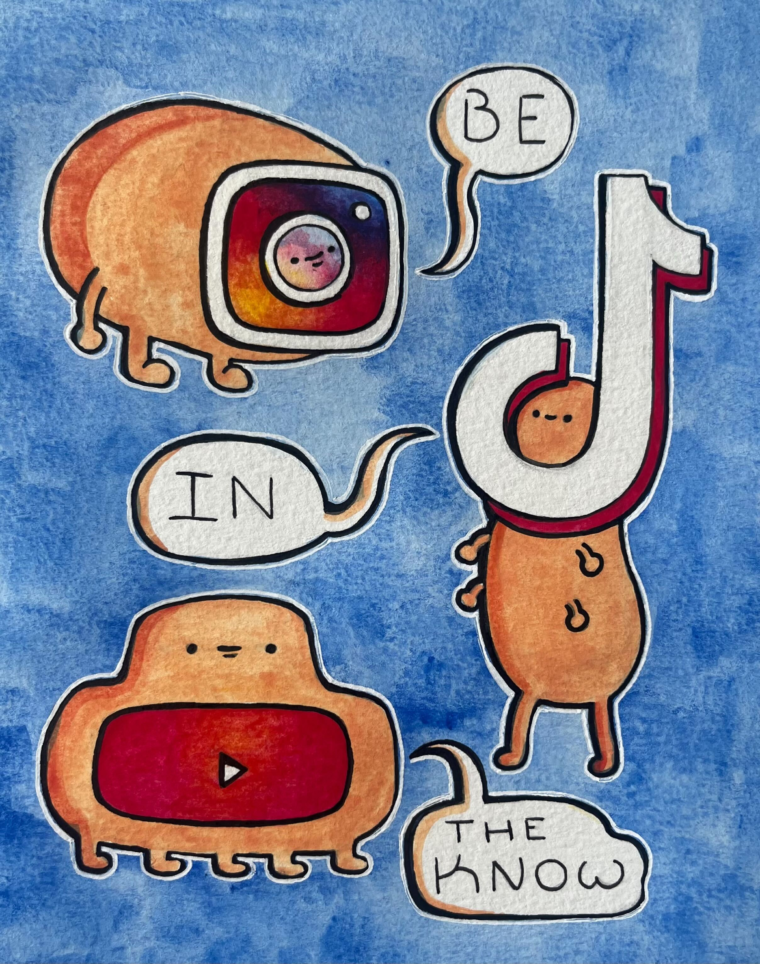
Liam Thomas McManaman | Contributing Illustrator
I love spotting WashU’s campus creator celebrities in the wild — on the way to class, walking into BD, or in the library. Yet I used to be a distant consumer of their content. Engaging and supporting their work would’ve caused me to be too closely associated with the “cringe” that people often associate with being a college content creator.
I didn’t understand that most college content creators fall into two categories: those who want to be social media stars and those who use social media to express their ideas and thoughts. The aspiring social media star’s content often features viral trends and is enjoyed by a wide audience, while the second group of college content creators post the things they care about, their feelings, and have a targeted college audience.
After coming to WashU, I realized that the image I had in my head of the University was different from its actual environment. It was then when I began to see the content of creators sharing their experience in college, I realized their importance. Their videos allowed me not to feel lost in the unexpected WashU culture.
In general, the idea of college is too romanticized. When I first moved into my dorm, I was caught up in the excitement of a new city and being around smart people. I didn’t even consider that my dream school, whose aesthetically pleasing Instagram I thoroughly stalked before moving, could have imperfections.
That’s because WashU doesn’t advertise its blemishes to incoming students. But why would they? It’s not the administration’s job to advertise the areas in which the University is lacking; their job is to get students to apply by showcasing the good it does with things like research and diversity. However, they cannot turn a blind eye to what the students want to be improved — that’s where college content creators step in.
Take, for example, WashU content creator Bell Riley, who talked in one of his videos about a SideChat poll that asked if WashU students consider themselves transphobic (of which 192 people out of 883 selected yes). His caption reads: “hey @washu ! your diversity brochures don’t really match the campus culture. i’m really excited to come back to a campus where i’m scared to use the bathroom. being a queer student isn’t just a debate for me, it’s my life.
Riley’s post highlights the importance of student perspectives on university life. As Bell wrote, WashU isn’t showing the reality that exists on campus, which in this case, is transphobia among the student body. He speaks the message to trans students considering WashU, but also to the student body. By tagging the University in his caption, his video calls to action towards the University to better acknowledge (and ideally combat) transphobia on campus.
Tiffany Blue, a former WashU student, also used her platform to speak on life at WashU. She posted a video on the “PROS and CONS of WASHU in ST. LOUIS” which many students watched before committing. Her comment section under the video is full of students saying how helpful the video was and asking questions which Blue responded to.
Blue remains a voice to WashU students, new and old, with her discussion on transferring from WashU to USC. She explains her choice in her video “why i transferred from washu.” Although some of her reasons seem superficial, they are still validating for students at WashU who feel the same. She offers reasons like weather and party life, but also talks about issues such as safety, the WashU bubble, and the intense work grind. She expressed to her viewers that if they want to transfer from WashU, they should not feel alone in their experience.
As a student body, we need to support those documenting their authentic experiences and perspectives on WashU, especially since the University doesn’t publicize all aspects of student life. Many college content creators use their platforms to share parts of WashU that need to be changed. These perspectives are important for prospective students to know, current students who may relate, and to advocate for change from the WashU administration and students.
They teach us the importance of using our voices for activism, giving advice, and fostering community. If you see something on campus that is harmful to the well-being of students, take after these creators and say something. What we need to realize, as people and a student body, is that if we want to see change, we have to start by being brave enough to take action.
Stay in Touch!
Get the latest and top news from StudentLife delivered to your inbox