Forum
Return to demonstrated interest threatens accessibility

Marceline Lee | Illustration Editor
Half a decade ago, WashU’s personal media team, The Source, interviewed Vice Provost for Enrollment Management Ronné Turner. It was a moment of celebration and progress. In the name of equity, WashU adopted a need-blind policy. They even scrapped demonstrated interest within the admissions process.
“All of this together makes us much more accessible to students from a diversity of socioeconomic backgrounds, students who are going to make an impact on our community and the world,” Turner said.
Now, just a few years later, WashU has gone back on its word. For high school students applying for first-year admission in fall 2027, demonstrated interest is back on the table. While the Office of Undergraduate Admissions plans to track applicants’ website searches and who signed onto their email list, the University cheerfully admits, “On the top of our list (and hopefully yours!) is a campus visit.”
Despite the University’s sentiment, demonstrated interest is, and continues to be, an inequitable policy. Though WashU’s decision to reinstate the policy comes with nuance, the decision must be critically examined.
WashU’s reestablishment of demonstrated interest comes in the wake of financial struggle and uncertainty. Earlier this year, the University predicted a $7.4 million deficit for Fiscal Year 2026 (FY26). Furthermore, potential shifts in federal research funding models and changes to Medicaid funding implicate an uncertain financial future. Money is short and might get shorter. For WashU, a return to demonstrated interest may ease the burden.
It’s a well-documented move in the higher education playbook. Demonstrated interest favors applicants who are more likely to enroll. That means institutions can deal out fewer admittance letters while ensuring dorms are filled. Additionally, admissions rates drop, and finances become more predictable. The return to demonstrated interest is a decision that prioritizes selectivity and financial stability while sidelining equity in the process.
In a 2017 study, researchers found that a mid-sized selective university placed more emphasis on costly contact with the university (campus visits) than others (attending school information sessions) in the admissions process. Those who had the means to make costly contact with the university had a higher chance of getting in. WashU appears to be no different with their largest emphasis on campus visits, a trip that can take a day, weekend, or more. Add on the costs of three meals a day, a place to sleep, and a means of transportation, and it becomes obvious that this policy favors affluent students.
It would be one thing if WashU was unaware of the inequitable implications of demonstrated interest. In her 2021 interview with The Source, however, Turner succinctly encapsulated the policy’s largest drawback, stating, “We know that demonstrated interest puts students from rural communities, first-generation families, and high schools with low college-going rates at a disadvantage.”
Turner, speaking for WashU admissions, clearly recognizes the inequitable impact of demonstrated interest. WashU decided to reinstate the policy despite their knowledge of how it may alter campus demographics.
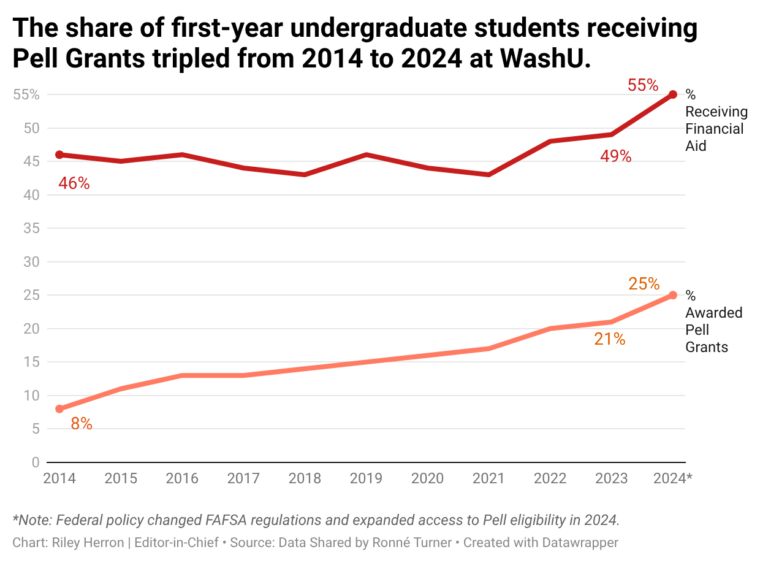
The decision comes with an alarming shift in WashU’s student body for the Class of 2029. The percentage of Pell-eligible students, those receiving financial aid, and first-generation students each dropped. As demonstrated interest factors into the Class of 2030’s admissions, these “blips” could very well become trends — curating a space that favors affluent students while discarding those with lesser means.
Famously, WashU has fallen short of supporting socioeconomic diversity in the past. Since then, the University has implemented successful policies (such as the WashU Pledge and need-blind admissions) to increase its accessibility. In 2024, Chancellor Andrew D. Martin told the Missouri Independent that he prioritized education accessibility as “one of the three pillars of [his] leadership.”
WashU is in a sticky situation. While on one hand, the University has repeatedly emphasized supporting lower-income students, it is also struggling to make ends meet. The return to demonstrated interest may buoy the University, but it comes at the cost of WashU’s commitment to socioeconomic diversity.
I don’t argue that WashU should return to its old admissions policy. But it is our responsibility as students to pay attention to the tension between the University’s supposed values versus the real-life impact of its policies, all while keeping finances in mind. For now, I will continue watching to see who WashU favors, and by proxy, what WashU becomes.
Stay in Touch!
Get the latest and top news from StudentLife delivered to your inbox