Forum
In defense of the performative intellectual
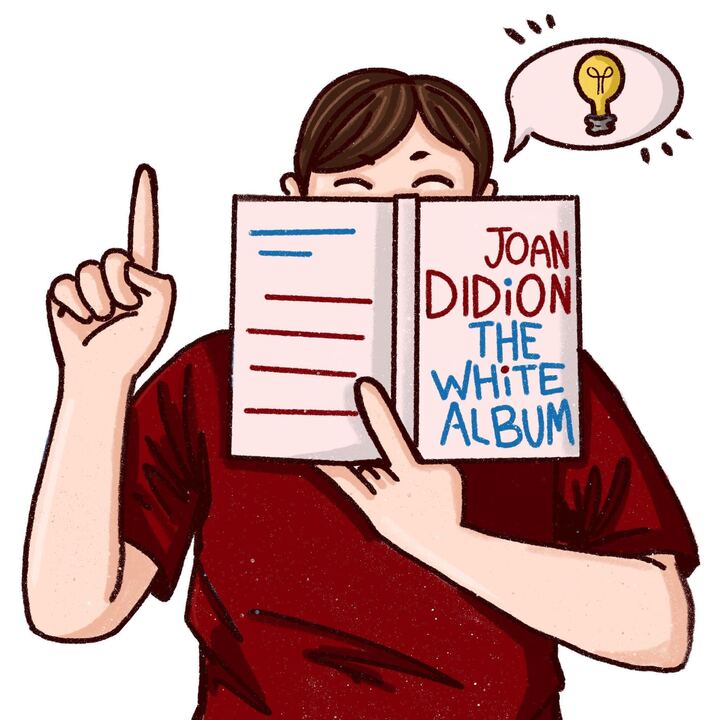
Lauren Ciudad | Contributing Illustrator
For seven months in my sophomore year of high school, I kept Joan Didion’s “The White Album” in my backpack at all times. While I loved her philosophical insights and careful choice of words, I wasn’t even close to fully understanding the dense cultural references to 1960s California. Complete comprehension, however, was never my goal.
The importance lay in little pieces of free time — the minutes before class started, or before I saw friends at lunch — when I could proudly take the book out, read through a page or two, and more importantly, hold up the book in various obvious ways (in front of my face, over my head lying down, standing on the desk) in hopes that someone would see it and make a comment. I desperately sought approval from my peers, but more so my teachers, wanting to be recognized by people I deemed smarter than me. I might as well have held a flashing neon sign: “Look at me! Look how smart I am!”
In retrospect, the performance was flimsy and fruitless. No one really cared that I was reading Didion, save for a few comments from an English teacher, but my act of reading something almost purely for looks didn’t completely go away. Although I’ve never gone back to that extent, I still catch myself, at times, holding something in a more pronounced way in hopes that someone might comment.
The performative intellectual is an archetype many students are familiar with, considering that it thrives most strongly when dropped in an environment teeming with other intellectuals. In other words, a university is the perfect breeding ground. As a student at WashU, I’m constantly inundated with conversation snippets that seem like performative intellectualism.
It goes beyond sharing simple news — it wouldn’t be “I’m doing an internship at such-and-such place over the summer,” but “I’m applying for five internships at these extremely prestigious institutions over the summer,” which has the same vibes as telling your high school friends how many colleges you’re applying to. There’s a bragging about something that isn’t there — an internship that hasn’t been secured, a course that hasn’t been taken, or, in my case, a book that hadn’t really been read.
And, on the surface, it’s incredibly annoying. Even if it stems from a deep insecurity about intelligence or some manifestation of imposter syndrome, it’s hard to see anything other than someone bragging about their not-really-accomplishments. But I want to propose a flipside. I didn’t arbitrarily choose Didion’s works as the face of my act; if I simply wanted to fake a level of intelligence I didn’t possess, I would have used “War and Peace,” or maybe a scientific journal. I chose, instead, something I had a genuine interest in that simply went a bit over my head.
Part of my hope wasn’t just that I’d be acknowledged for having some impressive level of reading comprehension, but that someone might say to me, “I love that book,” and I’d find someone with similar tastes to myself. I didn’t simply want recognition, I wanted community and shared interest. This rings especially true in the first few months of college, when it can be difficult to find those communities or people that enjoy similar things to you.
So then, I propose we all flaunt our genuine interests in a more public way. No more talking about soon-to-be internships in the Collins Farms line — I’d rather hear about books that haven’t really been read or movies that haven’t really been watched but that people have a genuine interest in. Plus, even though there is often a performative aspect when one might flaunt something above their level of understanding, it doesn’t always have to be like that. While I read Emma Cline’s “Daddy” just a few weeks ago, I’m not ashamed to admit that I purposefully carried it cover-up so people might ask me what I was reading. Not because I didn’t understand it, but because I was hoping someone might ask me about it, and I could give them a recommendation for something they might enjoy. If we all exhibited our interests more publicly, we would naturally meet people with similar interests and therefore learn from each other’s interpretations, views, and understandings.
Although I’ve since devoured other books in Didion’s catalog, I have yet to return to “The White Album.” But, when I do, I’m sure I will hold it up proudly — which I no longer view as an act of “performative intellectualism” — but as a beacon of possible togetherness, of potential friends and shared interest.
Stay in Touch!
Get the latest and top news from StudentLife delivered to your inbox