Forum
Stop making reading ‘efficient’
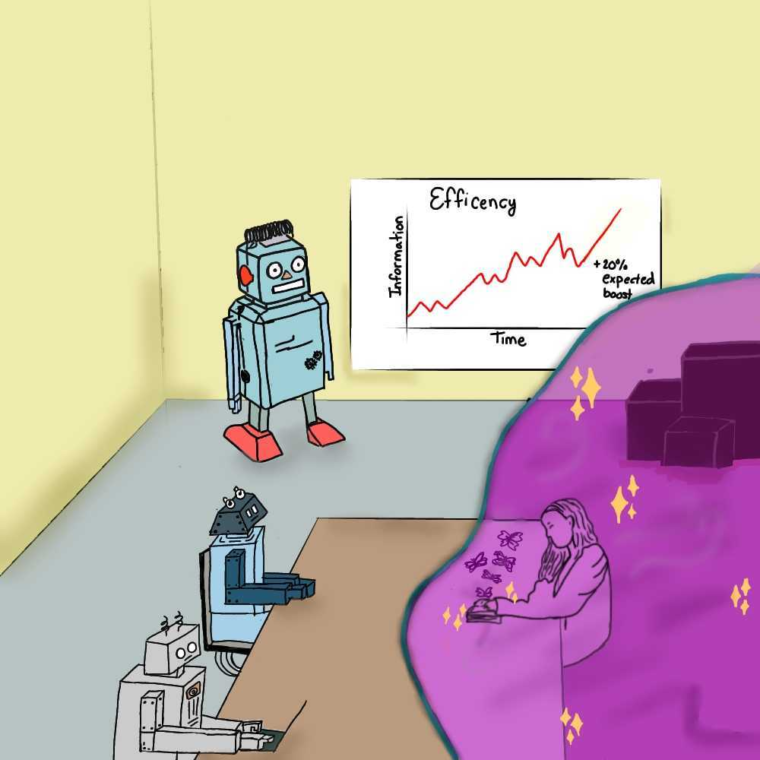
Diya Gupta | Staff Illustrator
The market economy may be right: Reading has a terrible return on investment. It’s not scalable. It’s easily outsourced to artificial intelligence. It offers no networking upside, doesn’t increase shareholder value, and (probably) doesn’t pair well with an afternoon Zyn. In the modern efficiency-focused economy, reading doesn’t seem to be a worthwhile investment. Humanity is divesting accordingly.
For many students, the practice of reading assigned texts has become a vestige of the outdated education system. WashU, like most universities, reports a large proportion of students who regularly use AI to summarize or explain readings. Students and teachers alike are bombarded with studies that claim literacy is declining in America, while being reminded by scholars that democracy relies on a literate population. Yet, the protocol remains the same: Our professors continue to assign readings, we engage with them less, and our reading muscles slowly atrophy.
The problem isn’t that students dismiss the benefits of reading, but that they have been taught to view it as a mechanism for extracting information. Reading supplies the content needed to pass tests, write essays, and get participation points. When students discover a more efficient pathway to information, like AI summaries, our natural response is to adopt it.
But reading isn’t just a channel for relaying information. It drastically improves attention spans, cultivates empathy, feeds creativity, and allows you to digest and wrestle with complex information. At the societal level, our country cannot function without well-informed, literate voters. We know all this — we have been warned for years. Yet, readership still declines.
Herein lies the contradiction. What dissuades students from reading is entirely utilitarian: Reading is both more involved and less efficient than relying on summaries. Yet when academics adopt a similar pragmatism to encourage reading, it’s ineffective. Academics don’t recognize that lofty petitions to save democracy or promises to increase productivity will never persuade non-readers to read.
I’m convinced the solution stems from the same giddy intoxication shared by BookTok romantasy girlies and seventh-grade Harry Potter superfans. They don’t read with an altruistic motive to preserve humanity, but a genuine love of the game. Educators and academics can’t cultivate readership through civic obligation, but they might inspire civic responsibility through enjoyment.
To do so, we need to change the conversation that surrounds reading. Nonfiction isn’t the only valuable form of reading; “To Kill a Mockingbird” teaches us more about power dynamics than “How to Win Friends and Influence People” and “48 Laws of Power” ever could. Moreover, reading doesn’t always need to challenge you or prepare you for your KPMG interview. Classics aren’t the inherently superior form of literature. Enjoying “easy books” doesn’t contribute to the rise of anti-intellectualism; picking up a Colleen Hoover novel likely won’t kill any brain cells.
The material people start out reading is largely unimportant; the priority should be reading for enjoyment, because enjoyment is what builds a lasting habit. Once this habit has formed, it can carry readers towards more challenging material that deepens their understanding of the world.
A reversal of downward-sloping readership and literacy rates would require many to abandon their current notion of what it means to read. If reading’s only purpose is to convey information, then students supplementing it with AI are simply increasing their efficiency. By treating reading as a means to an end, professors encourage students to outsource it. But if an educator’s goal for their students is true intellectual growth, they need to encourage them to linger, to wrestle, and — yes — to read what has no discernible “value.”
WashU should be built for this type of unoptimized reading; it should be an example for the larger education landscape. That could mean funding one-credit reading seminars with no exams or creating classes that allow students to read what interests them instead of adhering to a rigid syllabus. Reading cannot remain inseparable from performance metrics. WashU needs to signal that reading exists for more than a numerical grade.
Reading for enjoyment, not for a return on investment, is a return to reading in its purest form. And that is why it should be defended and celebrated. Some things that drive value can’t be quantified, scaled, or automated. When we prioritize enjoyment in reading, it becomes a habit — and this habit is what truly creates the most capable citizens.
Stay in Touch!
Get the latest and top news from StudentLife delivered to your inbox