Scene
‘Yes, and’: The three student troupes of WashU’s improv scene

SPISH improv member Uma Simhan takes the stage in McDonnell 162 (Jun Ru Chen | Contributing Photographer)
“Everything you see tonight will be made up on the spot: every scene, every line, and every character will be for tonight and tonight only,” the groups announced to their excited audience.
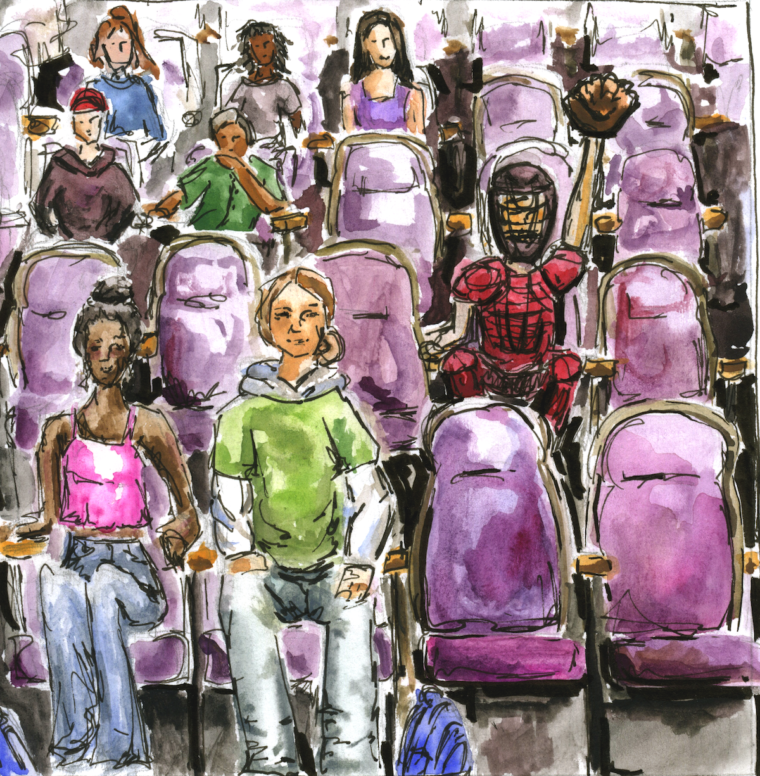
Nine times a semester, McDonnell Hall 162 is transformed from a lecture hall into a stage. The room is packed with students filling every seat, staircase, and open aisle to watch their peers create characters and stories, bits and scenes, all in front of their very eyes. They have come to see improv.
There are three improvisational comedy groups on campus: K.A.R.L. (no one knows what it stands for), Mama’s Pot Roast (MPR), and Suspicious of Whistlers (SPISH). They have carved out a comedic niche for themselves and, along the way, have amassed a cult following of supportive peers. Performances are heavily anticipated and marveled at by fellow students. These three troupes have significant overlap socially and regarding performance; however, each group has a unique, standalone history and energy, which draws different types of student improvisers to them.
Each show is roughly an hour long, in which the improv groups play a variety of rotating games. On campus, there are two types of improv performed at shows: long-form and short-form. Long-form skits are around 15 to 20 minutes and have a more fleshed-out narrative arc and character development. Short form skits are three to seven minutes long and tend to be punchy and sharp.
The composition of each show varies by group.
“You go to K.A.R.L. to see dialogue, you go to SPISH to see narrative, and you also hopefully go to Pot Roast for those,” junior and musical chair of MPR, Eli Litman, joked.
MPR is the only group on campus that performs both long- and short-form improv, while K.A.R.L. performs strictly short-form and SPISH performs strictly long-form.
The groups’ individual ethos and histories impact their style of improv. The oldest group on campus is MPR. Co-founded in 1991 by Peter Sarsgaard — a well-known actor and producer — MPR emerged from an “improv renaissance” in the ‘90s and 2010s, as described by sophomore Winston Mattson, MPR’s president. SPISH was created in the fall of 2003 by two sophomores and a first-year who wanted to create a long-form improv troupe, so they contacted their friends and held two rounds of open auditions.
K.A.R.L. — which was created in 2003 by students who had auditioned for Mama’s Pot Roast and not gotten in — draws heavily from sketch comedy group Upright Citizens Brigade (UCB), which developed in Chicago in the ‘90s and included notable comedians like Amy Poehler and Adam McKay. UCB prioritizes the repetition and callback of a joke or a bit, which is something junior Ella Rodriguez claims inspires the group. Rodriguez is co-PR chair, social chair, and Pandamonium chair for K.A.R.L.
MPR stands out from the other comedy groups at WashU by embracing both long- and short-form comedy, and Litman and Mattson describe it as the most outlandish of the three groups.
“Pot Roast is out there. It’s weird. We do lean the most absurdist these days out of the groups,” Litman said.
The way MPR leans so much into whimsy speaks to how distinct each improv group’s focus is.
“[SPISH] talks a lot about how we are storytellers. … We really get to sit with the characters we create. And sometimes that’s terrifying. But it’s also really rewarding,” sophomore and co-PR chair of SPISH, Elliana Lilling, said.
Across the board, improvisers expressed a strong loyalty to and intimacy with their specific troupe, and many also described feeling drawn to performing improv. For Litman and Mattson, connection with the audience is partially what makes improv so compelling; the obstacle of winning attendees over keeps them coming back for more.
“[College improv is] like the uncool younger cousin of stand-up; we kind of have to win the audience over a little bit, and I think that adds to the challenge. And so when you do get that laugh, it means more,” Mattson said.
He continued to explain how creating an environment where people can come together in joy and humor is a way to give back.
“To me, there is almost a virtue to it. I’m here to bring people joy and lighten their semesters a little bit. If I can make you laugh, that is a win. Having people come to shows and laugh at us and laugh with us, it’s a real joy,” Mattson said.
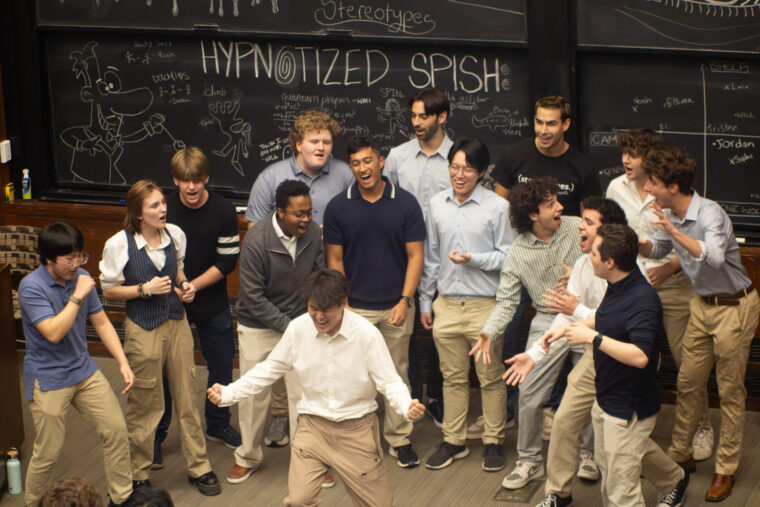
The Stereotypes perform an acapella opening performance at a SPISH show (Jun Ru Chen | Contributing Photographer)
K.A.R.L. captain and senior Ben Faden emphasized the importance of the audience members enjoying themselves.
“Laughter in a show, for me, at least, is like breath. Like you can feel when the audience is laughing because you just know it and everything feels good … and that’s how you know a show is good; it just comes out, and it just feels good.” Faden said.
It is palpable for everyone in the room when the air at an improv show is charged with the magnetism of a rapt audience anxiously anticipating the unexpected.
“It’s more fun when the room is packed. Laughter bounces off people around you.” Rodriguez said.
“And the hotter and sweatier the room gets, the funnier we get,” junior and co-PR and social chair of K.A.R.L., Ari Schlanger, said.
Litman echoed how powerful it feels to sense the audience’s enjoyment. Although he initially was not planning on doing improv in college, Litman was sucked into it via other comedy channels on campus, and he found that the creativity and quick thinking of MPR members stood out to him.
“I feel like improv is just like jazz for millennials, where you’re just making stuff up … It’s a skill and … it’s really rewarding to get positive feedback from other people, people you know and people you don’t,” Litman said.
Sophomore Kennedy Hack-Juman, the co-president of SPISH, seconded that improv requires expertise and finesse, with long-form having its unique set of difficulties. She explained how long-form requires remembering a lot of information at once about the character while infusing the story with an intro, climax, conclusion, and conflict.
“[Long-form is] a different beast. I think SPISH prides itself on attacking that challenge even though none of us come in with long-form practice,” Hack-Juman said.
While the newbies frequently do not have a background in long-form, the group’s expertise is bolstered by six hours of practice a week and the deep trust that helps support scenes. This closeness is something Lilling echoed as one of the newer members of SPISH, explaining that when she was admitted into the group, she was immediately asked if she would be joining them on their annual trip to Chicago. Despite their lack of familiarity, the decision to go was an easy one to make.
Hack-Juman has been doing improv since age six and describes it as “the most free space I’d ever come into contact with.”
“Having unconditional support from your scene partners is not something that happens in day-to-day life. It kind of only happens in this space where you’re told to stop thinking about yourself. … The focus is the scene, it’s not you,” Hack-Juman said.
Junior and co-president of SPISH, Noah Zelin, also mentioned the consuming and selfless nature of improv.
“Everybody comes from different places, but the one thing we have in common is that we’re willing to buy into this thing that is improv, where you kind of give up yourself, and you’re vulnerable,” Zelin said.
This strong community has been deliberately rebuilt post-pandemic, both within the individual improv groups and across campus, according to Rodriguez. She also spoke specifically to how they are still working on bringing back some traditions. This year, on March 28, they are hosting Pandamonium, which was once one of the largest college improv festivals in the Midwest. For this festival, K.A.R.L. invites improv teams from across the region for a one-day event, during which they practice with random teammates, receive coaching from professionals, and then perform at night.
Zelin echoed Rodriguez’s point about the value of an extensive and rich comedy community, expressing how improv is inherently a social effort.
“It’s not about being clever. It’s more about building something larger than yourself, supporting your scene partners. You are not trying to be funny; the funny kind of just happens when you follow the rules of improv,” Zelin said.
This was evident at the last K.A.R.L. show, where the group was told to take inspiration from the word “soda” to tell us how they like their romantic or sexual partners. In between the quips of her teammates, Rodriguez bounced forward, already grinning.
“I like my partners how I like my soda: Mount and Dew.” And the room erupted.
Stay in Touch!
Get the latest and top news from StudentLife delivered to your inbox