News
WashU’s School of Public Health Dean discusses state of public health at Gephardt’s Civic Café
 jun ru chen
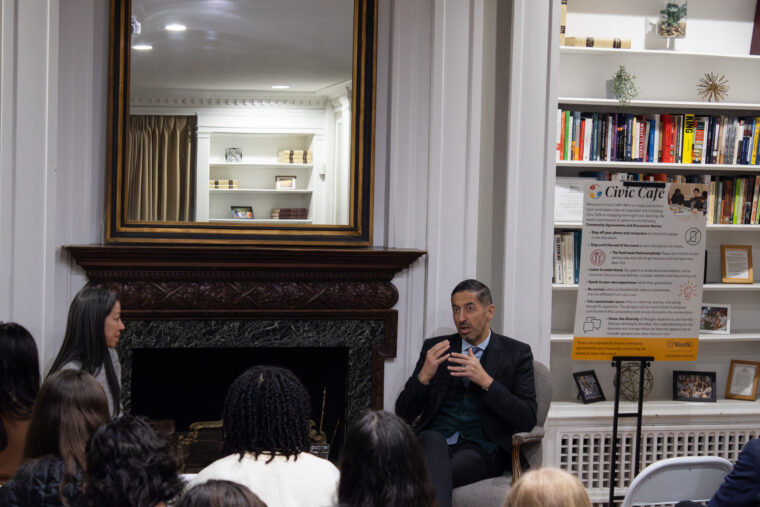
Dean of the WashU School of Public Health Dr. Sandro Galea speaks to community members about the politicization of public health. (Jun Ru Chen | Staff Photographer)
Dean of WashU’s School of Public Health Dr. Sandro Galea spoke about the broadening scope of public health in the midst of increasing politicization during a Civic Café event hosted by the Gephardt Institute on Jan. 14.
In the discussion moderated by Engage Democracy Fellow Dana Chapnick, Galea said it is time for health to no longer be a divisive matter.
“Health can be a unifier, it can bring us together. It’s heartbreaking to see the aftermath of the pandemic and the extraordinary entanglement of health with partisan politics,” Galea said. “It’s important to get back to a place where health pulls us together.”
Despite the current climate surrounding public health, Galea identified thoughtful language as one of the main combatants.
“I think our language should be one that creates … a shared vision of a world where we all have a place to treat each other with dignity and respect, to the end of creating space for us all to live rich, fulfilling lives. And that is inseparable from the art of generating health,” Galea said.
Galea discussed the importance of an interdisciplinary approach to public health, which he defines as creating a world that generates health. Improving this sector not only falls on hospitals, but also on lawyers, urban planners, and economists who can play critical roles in shaping everyday health.
According to Galea, the United States’ current policy tactics have disproportionately invested in treating medical conditions instead of preventing their onset.
“It’s easier to see cure; it’s harder to see prevention,” Galea said. “It is part of how we understand the generation of health, and it is on us to shift that understanding.”
WashU senior Margo Ogrosky, a civic fellow with the Gephardt Institute who attended the event, found Galea’s talk reassuring in a time of perceived stagnation in health.
“I think one of the biggest problems, or biggest issues I have right now within the health field is how to have hope — how to feel successful when things don’t happen so quickly in the context of health and policy,” Ogrosky said. “It was nice to hear him say that these are the times where change can be made.”
Executive Director of the Gephardt Institute Stephanie Kurtzman views the Civic Café dinner series as a way to build civic skills and knowledge in the WashU community. The Civic Café is one of several forms of programming at Gephardt geared towards inspiring community members to engage in civic pursuits. Galea said student willingness to take on roles as civic citizens will help lead us into a brighter future.
“Tomorrow is better than today because of the students.”
Stay in Touch!
Get the latest and top news from StudentLife delivered to your inbox