News
Mayor Cara Spencer urges a unified approach to city issues
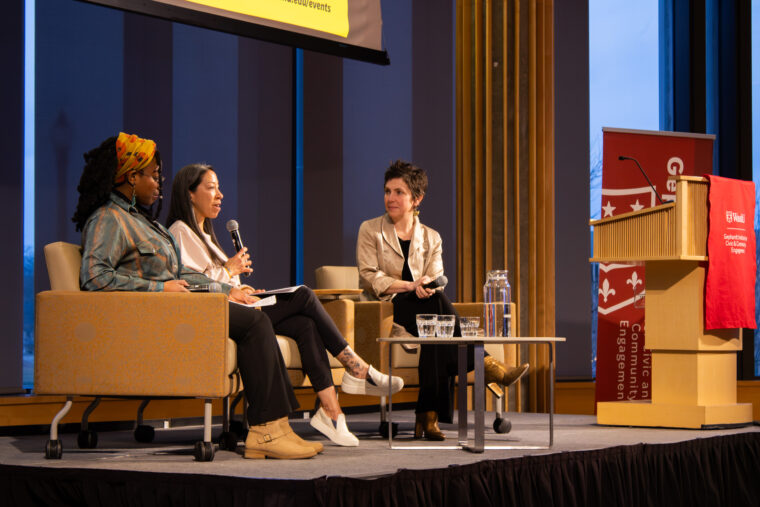
Mayor Spencer speaks with Engage Democracy Fellows Dana Chapnick and Aliyah Wilcox at Wednesday’s event (Rachel Benitez-Borrego | Staff Photographer)
St. Louis City Mayor Cara Spencer discussed the city’s struggles with isolated governance in a fragmented region amid issues with funding and disaster response in Hillman Hall’s Clark-Fox Forum on Wednesday, Feb. 18.
Spencer left considerable time to answer audience questions, which touched on divisive topics like the recent tornado, the presence of Immigration and Customs Enforcement (ICE) in St. Louis, and data centers coming to the city. The event was part of the Gephardt Institute’s Civic Café series, where community leaders are invited to share their stories of civic engagement.
Spencer repeatedly returned to the difficulties facing St. Louis and the idea of connecting with neighbors. She pointed to fragmentation between the city and county of St. Louis as a factor that weakens the city’s ability to address issues like poverty, disaster response, and racial divisions.
“We are missing that civic infrastructure, in my view, and it’s not as strong, as woven together, and as collaborative as it should be,” Spencer said. “Some of those challenges that we all face don’t know borders.”
Spencer said that this fragmentation can worsen the issues the city is already facing.
“The city carries the region’s poverty,” Spencer said. “The city carries the region’s homeless population in general, and we have the lowest tax base in the region. It’s an impossible task to be taxing some of the lowest-income residents in the region to be able to meet the highest needs, and we have to be thinking as a region.”
Spencer said rebuilding from the tornado on May 16, 2025, has been a particularly difficult task for the city, given a lack of funding, especially as federal money promised to the city for disaster relief hasn’t yet been disbursed.
“We don’t have a long-term funding source,” Spencer said. “We don’t have the funds right now to rebuild, but we are pushing for them.”
She added that the tornado response has brought together the city, county, and state, something she said feels like a turning point.
“I am very hopeful because the region is coming together and is willing to have dialogue in ways that I haven’t seen,” Spencer said. “The state is working with the city; St. Charles County is picking up the phone when I call, and vice versa.”
Spencer said that the response has required considerable effort and continued communication.
“We’re having to build relationships where they didn’t exist before, and being willing to really come to the table over and over again … to understand where our goals overlap and to be able to be willing to work past differences,” Spencer said.
Spencer said that this communication is paramount, both on a governmental and interpersonal level. She added that it has informed her approach to governance.
“The answer really is just to listen to your neighbors,” she said. “Being informed by your community [and] willing to change your mind is so important.”
While the evening began with pre-written questions from the Gephardt moderators, most of the event was filled with questions from the audience. Spencer’s willingness to answer over a dozen audience questions impressed some in attendance, including Erika Porter, a Master of Social Work student at the Brown School.
“I didn’t expect her to be able to answer every question because we hit her with questions from different areas, but she was approachable, friendly, and she appeared transparent,” Porter said.
One of the areas the audience asked about was Spencer’s response to the continued debate over the new data center located near the Armory building. Spencer said that her job as mayor is to find as much utility for the city in a situation where her hands are somewhat tied.
“I know that rates will increase for [those that live in St. Louis] when data centers go in, whether they go in the city of St. Louis or they go in St. Charles or beyond. The question is, will the city benefit, from a tax perspective, or in some other meaningful way, by having [a data center] in the City of St Louis?” Spencer said. “To some extent, we know they’re coming. We know they’re here.”
Another audience member asked whether Spencer had any desire to run for state or federal-level office.
“I don’t have any ambitions to go beyond [mayor], particularly because I love the nuts and bolts of municipal government,” Spencer said. “When you get into bigger systems, it becomes much more ideologically based, and I’m more focused on how to make government work better on the local level. I love my job.”
Spencer spoke directly to the WashU community, offering a call to action to engage directly with the city of St. Louis and to choose to live permanently in St. Louis.
“It’s really important to leave campus on a regular basis and participate in the economy, where you can support local businesses and to get to know the surrounding municipalities,” Spencer said. “You’re getting world-class education here in St. Louis, some of the best in the world. We would love to root you here and to keep you here and to build an economy that is not only nurtured by your presence, but furthered by your perspective.”
Nicholas Demba contributed reporting.
Stay in Touch!
Get the latest and top news from StudentLife delivered to your inbox