News
Gephardt Institute’s Longest Table sees 538 attendees
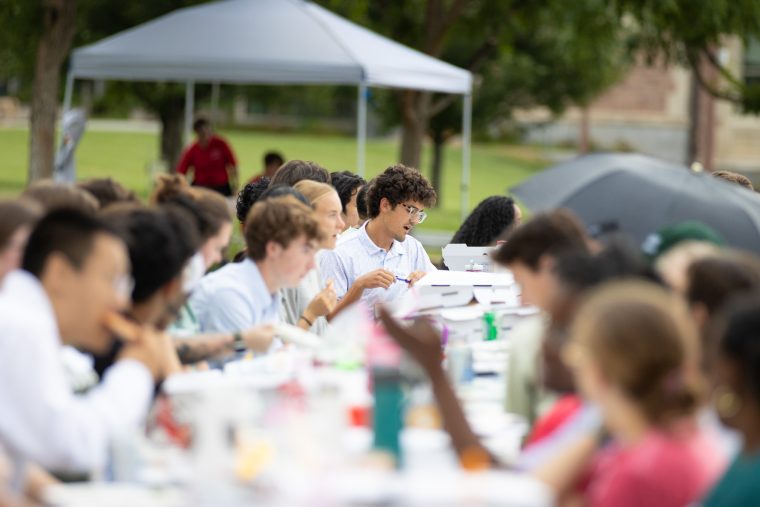
On Sept. 10, WashU community members came together for Gephardt’s annual Longest Table, an annual tradition encouraging political dialogue (Hannah Dorval | Contributing photographer)
Five hundred and thirty eight members of the WashU community gathered in Tisch Park to engage in civic dialogue at the Longest Table, an annual tradition hosted by the Gephardt Institute for Civic and Community Engagement, on Sept. 10.
The Longest Table seeks to expand the idea of political dining table discussion to a larger scale, inviting participants to share a meal and discuss the current civic climate with a small group of participants and a facilitator at a series of picnic tables surrounding Tisch Park. What sets the Longest Table apart from similar civic dialogue events is its ability to bring this discussion to a large number of participants from various backgrounds, civic experiences, and areas of the University.
“One of the benefits is you have McKelvey students sitting with MBA students from Olin, sitting with ArtSci undergrads, all at the same table, and maybe they’re being facilitated by a faculty from the med school, and so I think that the Longest Table really touches all the corners of WashU,” said Sarah Nash, Gephardt community engagement manager.
First-year Frankie Webster felt surprised at first by the age range at her table, but throughout the event she gained an appreciation for the fruitful discussion created by those differences.
“It was interesting getting an older person’s perspective who didn’t come to WashU as an undergrad, so it was just different people than who I’d been around for the past couple weeks,” Webster said.
At each table of around six students, a WashU faculty member served as a facilitator, guiding participants to connect over their civic history, recognize current events bringing them concern or hope, and finally to identify how to take action towards civic involvement. Although the discussion was structured around these specific topics, participants at each table were able to allow conversations to flow freely into various relevant topics.
With music playing, a slight drizzle, and good food, each group dove into conversation. During the hour-long event, one table spent a large amount of time focusing on the hope brought by events such as the World Cup, the impact of recent Supreme Court decisions, the influence of privilege on civic involvement, and the various sources individuals receive information from.
Another table spoke on fashion differences between Korea and Thailand, the perils of AI and how different generations view said issue, and the day-to-day interactions that create faith in other people.
Senior William Meyer has been able to attend the Longest Table all four years of his time at WashU and found himself surprised by the way conversations have evolved over time.
“People’s opinions have changed, and what they care about has changed over time. I’ve heard people talk about the election in previous longest tables, or talk about war in certain regions, and now people are talking about AI, talking about different federal policies,” Meyer said.
At its core, the purpose of the event is to challenge participants to “exercise the muscle of civic dialogue,” Anna “Dr. G” Gonzalez, Vice Chancellor of Student Success, said in her opening statement.
The Gephardt Institute hosts events year-round, allowing students to continue exercising that muscle.
“This campus community is hungry for dialogue, hungry for honest, thoughtful conversation, hungry for spaces where we can talk about the things that matter to us,” Gephardt Institute Executive Director Stephanie Kurtzman said.
Editor’s note: This article was updated at 8:47 am on Sept, 23 to reflect that one of the authors of this article is Brayden Weigelt and not Brayden Wang. Additionally, Gephardt’s community engagement manager Sarah Nash was originally misspelled and now corrected.
Stay in Touch!
Get the latest and top news from StudentLife delivered to your inbox