News
New study pods headline updates to Olin Library
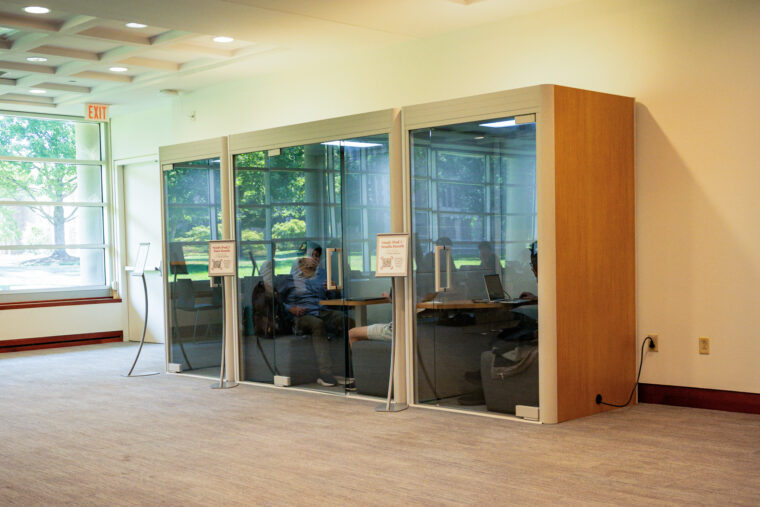
Students use the new study pods on the first floor of Olin Library. (Justin Rosenblatt | Contributing Photographer)
In addition to other changes at Olin Library this semester, three glass-enclosed study “pods” have been installed on the first floor to provide soundproof environments for students working individually or in pairs.
According to WashU Libraries’ 2024 impact report, of the total visitors counted in library public spaces, around one-third studied in collaborative spaces and nearly two-thirds studied in quiet spaces. The new, quiet pods reflect an overall trend in the libraries’ usage.
Paul McArthur, Director of Space Planning & Projects for the University libraries, led the installation of the new spaces in collaboration with campus architects and WashU Furniture & Design Services.
McArthur rearranged the furniture on Olin’s first floor to take advantage of “dead” space in front of the help desk and accommodate the pods. The new pods are equipped with ventilation, lights, outlets, and motion sensors. One pod is a standing desk and the other two have seating.
According to McArthur, the pods were purposefully sourced from a local business.
“The pods are made by a company called Oasis Berco. They’re in St. Louis on the south side,” McArthur said.
McArthur added that he wanted to install multiple models in order to gauge student reactions to each type of pod.
First-year Flora Lu said she usually goes to the East Asian Library but anticipates using the pods in Olin because they’re soundproof.
“I think it will be pretty helpful, like if I have some classes online, and I also like watching some videos. I won’t interrupt others, and I also won’t be interrupted by others,” Lu said.
Lydia Golitz, a graduate student, said she appreciated that the booths are private and conveniently located on campus.
“My schedule this term is sort of all over the place, so having a place I can go for special appointments, like therapy or things that wouldn’t otherwise be good to do in a shared space or outside, has been super helpful,” she said.
Golitz used the two-person pod and plans to try out the other models.
“I would use the standing one,” Golitz said. “It reminds me of a phone booth … but I think that’s kind of cool.”
If the pods prove to be popular, McArthur said he is “very open” to adding more in the future.
Olin Library staff is measuring the success of the pods. Once an hour every hour for the duration of their shift, students on staff count the number of people in each library space, McArthur said.
McArthur shared internal data that puts this task in perspective: last semester, all of Olin’s hourly headcounts added together exceeded 480,000 people.
The decision to install the pods stemmed partly from staff members’ observations that study rooms with six seats were often being used by a single person at a time. If people working alone choose to use the pods instead, group study spaces will free up.
Kimberly Singer — Director of Communications for WashU Libraries — also cited student feedback from the Libraries Student Advisory Group (LSAG) as a significant reason for the change.
Meetings with LSAG have resulted in other ongoing changes to the library.
“One of the big things we heard at the end of last year and from this last group was more wellness-based activities, or … a study break or brain break,” Singer said.
In response to the advisory group’s comments, Olin Library added a community puzzle to the help desk, and Singer is working on expanding the availability of popular literature, not just academic texts. The library has recently granted students access to Libby, an e-book and audiobook lending service for popular books.
Additional changes to Olin include expanded hours on Fridays and Saturdays and new two-person seating on the second and third floors.
Singer emphasized that student needs are the library team’s priority.
“We really want to try to accommodate the students the best that we can.”
Stay in Touch!
Get the latest and top news from StudentLife delivered to your inbox