News
Civic Cafe Hosts Community Organizer and Affordable Housing Advocate Kaveh Razani
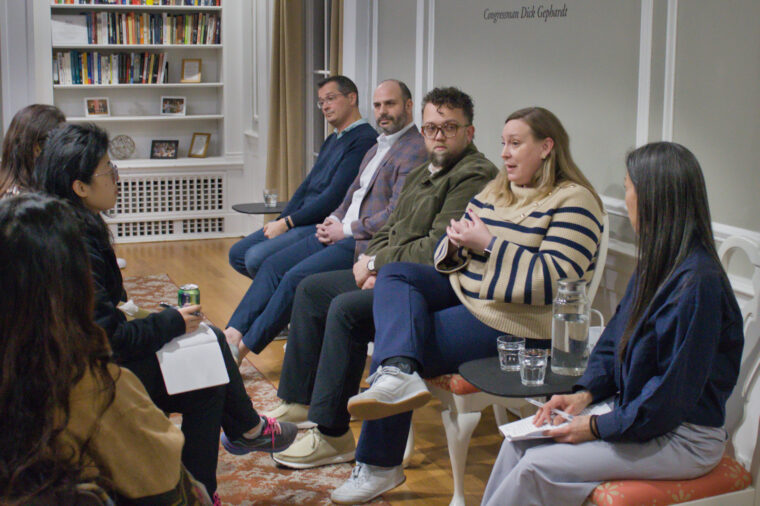
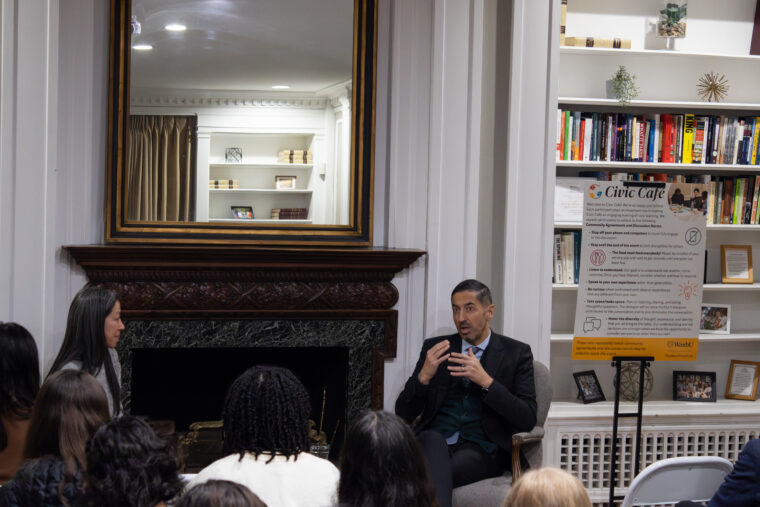
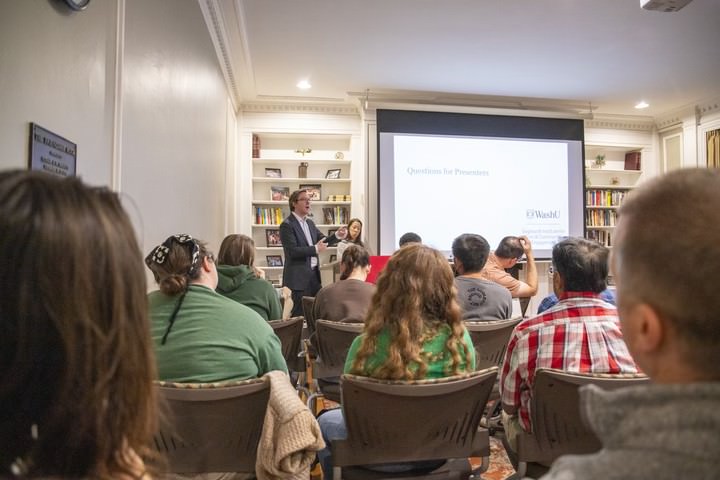
The Gephardt Institute hosted St. Louis civic leader Kaveh Razani to participate in its Civic Cafe series at the Stix House, Jan. 30. Around 20 undergraduate students, graduate students, and Washington University community members sat down to hear Razani discuss his experiences with community engagement and helping local artists to access affordable housing.
Gephardt’s weekly Civic Cafe discussion series aims to connect students with local civic leaders, motivating them to get involved with social justice issues they care about and form deeper connections with the St. Louis community. In the past, it has hosted a variety of local speakers with themes for the cafes including Skill Building, Democracy Dinner, and Civic Storytelling.
Razani is a Co-Director of the St. Louis Art Place Initiative, an organization that strives to build wealth and equity for local artists by helping them purchase homes. He also has co-founded many businesses in South City, including his now-closed event venue, Blank Space St. Louis on Cherokee Street.
Razani was the first member of his Iranian family to be born in the United States. His family is extremely liberal, he said, often getting into technical debates about left-leaning fringe theories.
His journey to community organizing began back in high school when he created an alternative newspaper, and later when he spent time at the University of Missouri studying broadcast journalism. Razani said that he had originally wanted to write about social change but quickly realized his passion for campaign politics. He shifted career paths, left Mizzou, and started a variety of small businesses.
Razani described his approach towards igniting change by focusing on local communities.
“[Community engagement] happens as a side effect of caring about where you are and the people that you are with,” he said. “It’s not something you go out and seek to do externally… and it’s not on some fantastical scale, but on a local and personal level, and it’s about finding folks that share that vision of change.”
Razani said that he and his friends were always throwing parties and hosting concerts growing up. This organizational experience provided him with the necessary background to go into community organizing.
He said that the first property he rented out was the Blank Space property on Cherokee Street, choosing to utilize the venue by polling the locals about what they hoped to see in the space. According to Razani, the space was used for everything from art shows to weddings.
Razani said he believes in the power of art, choosing it as a medium to enact social change. He also described artists’ role in connecting individuals and bridging the gap between communities.
“[Artists] are people who share this identity of translating true human experience into this format that others perceive, interact with, and experience differently,” he said. “And there is this element of challenging one’s thought process inherently built into it.”
In his childhood, Razani was exposed to multifamily housing and the struggles of achieving home ownership, he said. While he emphasized the absurdity of the concept of land ownership in the first place, he also said that he has a first-hand understanding of why home ownership is necessary in order to build generational wealth and thrive in a capitalist society.
“How do you get people to be more autonomous and participative in their own lives, gain control, and have a voice?” he said. “[The answer is that] there is a lot of power associated with you and your home. [Owning a home] means you’re really a part of the community.”
Razani said he focuses on providing housing to artists because of their lack of a steady income.
“Artists are on the most compromised end of the socio-economic spectrum,” he said. “They’re not really bankable, and most artists don’t even think about what it would be like to actually own a home.”
He described the role that WashU plays in developing affordable housing in the city.
“WashU owns a bunch of real estate, and they do not pay a dime of property taxes —10s of millions of dollars a year,” he said. “In comparison, the Affordable Housing Commission of St. Louis has an annual budget of $5 million.”
He also said that WashU has impacted the surrounding neighborhoods through the expansion of off-campus student housing.
“I have friends who grew up in [the] Skinker-Debaliviere [neighborhood]. That’s not even a real neighborhood anymore. It’s just student housing,” Razani said.
After the event, first-year master’s student, Tom Van Denburgh, said that he came to the Civic Cafe discussion with Razani to enhance his connection to the St. Louis community.
“I’m interested in hearing the perspectives of different thought leaders especially because I often feel cut off from the greater St. Louis even though I have a car and am able to travel around,” he said.
Another attendee, first-year William Meyer, said he thought Razani’s talk could inspire students to engage with their community.
“I think we need to learn how to have more of an activism culture here,” he said. “I think we should start engaging more with St. Louis and get out of the WashU bubble.”
Speaking to Student Life, Razani said that WashU students should use the power and resources that come with the institution to create change from the inside and also past graduation.
“It’s important for folks to recognize that they are already a part of the conversation and can affect that conversation more so than the average person,” he said.
Stay in Touch!
Get the latest and top news from StudentLife delivered to your inbox