News
Professors join DxD and Civic Café to discuss redistricting in Missouri
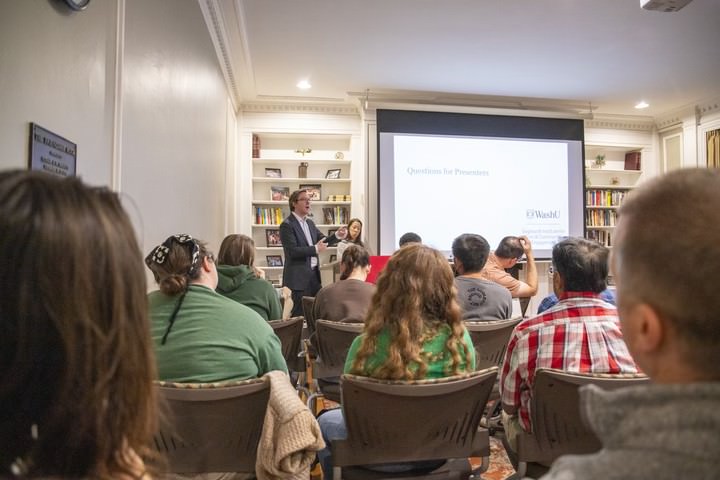
Panelists speak at last Wednesday’s event. (Courtesy of Brenna Metts)
Four WashU professors joined together last Wednesday to stress the importance of drawing political maps and the implications of redistricting. They explained that a number of states in the U.S. are moving toward redistricting and how new district maps change party representation in Congress while also often disadvantaging minority voters.
Missouri Governor Mike Kehoe recently approved a new district map, which would remove a Democratic congressional seat. The panelists spoke to a packed room, each contributing a perspective through the lens of their own discipline. Political Science Professors Dan Butler, Michael Olson, and Michael Strawbridge, as well as Law Professor Travis Crum, spoke. The event was hosted by the Gephardt Institute as part of their Civic Café program. For the event, they partnered with Dialogue Across Difference (DxD) with the goal of promoting civic engagement and open-minded thinking.
Following the presentations, students were encouraged to stay for small-group discussions to share their perspectives on redistricting and its impacts on Missouri. These discussions were led by moderators who encouraged receptive listening and individual participation.
The event began with opening remarks from WashU Votes Co-Chairs Hannah Pignataro and Marcellus Thorsen, who stressed the importance of the event and acknowledged that many of the audience members were not Missouri residents.
“The truth is, the way our districts are drawn impacts the way we make our voices heard here at WashU,” Pignataro said.
Butler was the first speaker. He argued that redistricting has become a political tool by highlighting that only 17 congressional districts nationwide are considered “toss-ups” while 362 districts are solidly for one party. He continued by sharing that Missouri’s new redistricting measure will likely be put on the ballot for Missouri residents to vote on, but warned that doing so may help the majority party. He explained how putting redistricting initiatives on the ballot then often causes previously conflicted voters to vote for the majority party candidate and vote against the referendum, ultimately putting the majority party in office.
“I don’t think we always think about how actually having things on the ballot can help the majority party not be cross-pressured to vote, they can comfortably vote against a referendum while voting for the majority party candidate. Without it being on the ballot, they may vote against the majority party candidate, knowing that voting for them would support that bill,” he said.
Crum spoke next. He walked the audience through the history of redistricting laws through Supreme Court cases. He continued by discussing the legal battles that will likely ensue from Missouri’s new redistricting plan.
“There are a fair number of state constitutional claims that are being brought right now, one of which is that the Missouri state constitution prohibits mid-decade redistricting,” Crum said. “There’s also language in the Missouri Constitution that requires districts to be compact.”
Crum explained that the new map’s districts would not be compact. He warned, however, that although there may be cases over the new map, it ultimately is up to the Missouri Supreme Court to rule on the constitutionality of this new map.
Olson spoke third. He said that redistricting has been a useful tool in the past to ensure that political representation is equal, but today its role is to disadvantage minority voters.
“Gerrymandering has always been a part of the political toolkit,” Olson said. “But the sort of more pernicious use of redistricting to sort of dilute minority voting power is more prominent today.”
The presentation concluded with Strawbridge, who focused on how redistricting affects Black voters. He said that much of Black political participation is rooted in trust in the political system and that if trust degrades, civic participation often follows.
“Our political institutions rely on trust and perceptions of legitimacy, and when those perceptions of the trust and legitimacy erode, they lose their influence and power,” Strawbridge said. “It also leads to lower engagement, lower turnout, lower likelihood of being involved in turning out to vote.”
After Strawbridge spoke, audience members and speakers broke into groups to share their thoughts on the presentation. The students in attendance, generally, shared concern for Missouri’s new plan and worried about how it may impact minority voters.
Participants also broadened the conversation to redistricting nationwide, questioning its morality. Some said that redistricting has become harsh gerrymandering, leaving many people disadvantaged. They also spoke about the importance of civic engagement as college students.
“It’s really important to know what is going on around you in politics, especially during such turbulent times right now,” said first-year Aubree Herzog.
First-year Alden St. John highlighted a heightened importance for young people to be politically active, pointing out their low rates of civic participation.
“It is necessary to make sure that we know more about how our political system works and what impacts us, especially among young people. We vote at the lowest rates and are often the least civically engaged,” St. John said.
When asked about student civic engagement after the discussion, Strawbridge said that the more constituents participate in politics, the more likely their representative is to be receptive to their requests.
“The more engaged citizens are, the more responsive elected officials will be,” Strawbridge said.
Discussion members also shared their appreciation for Civic Café events. Many students said that they find it a beneficial resource to better understand the world. They also remarked that it has expanded their understanding of Missourian politics.
“I have really enjoyed coming to Civic Café events and learning new things about being in Missouri, being from New Hampshire myself,” Herzog said. “I feel like it is a whole new world of politics here and learning about the issues that affect the people of St. Louis and different marginalized communities that are being directly impacted by new policies have been enlightening to hear about. Civic Café events are just so important.”
Editor’s note: an earlier version of the article stated that the event was hosted by Civic Café. The event was hosted by the Gephardt Institute, which runs the Civic Café program.
Stay in Touch!
Get the latest and top news from StudentLife delivered to your inbox