Scene
The Enemies Project: WashU father-daughter duo fight against political extremism
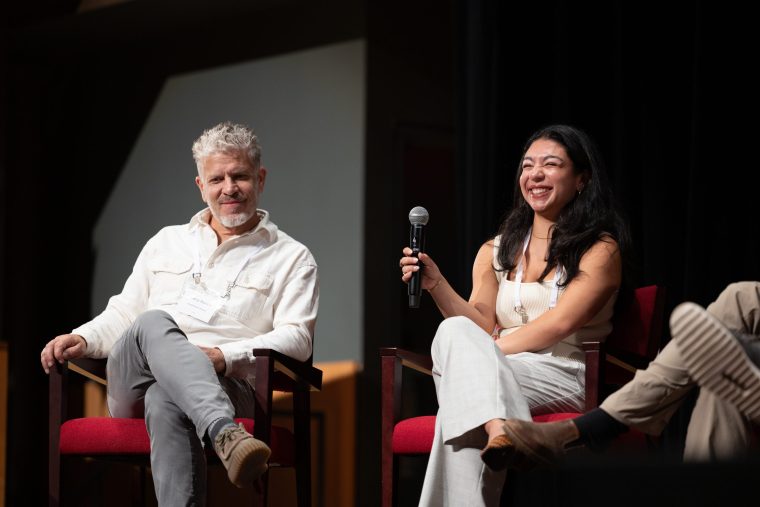
With over 90000 subscribers on YouTube, senior Sadie Rosen and her father Larry Rosen (B.A. ‘88) reveal the power of empathy through their channel, The Enemies Project. The pair bring together strangers with fundamentally opposed political beliefs for a sit-down conversation. Their docuseries aims to break online echo chambers through vulnerability. It’s working, as across their 16 uploaded episodes, all the enemies have left connected.
“If you disagree with someone, understand why. It can even strengthen your own beliefs,” Sadie Rosen said.
Since the channel launched last May, such pairings have included a transgender woman and a MAGA woman, a Palestinian man and a Zionist Jewish man, and a progressive man and a member of the Proud Boys, a far-right, ultra-nationalist organization.
As polarization cleaves the political climate, Sadie and her father noticed increasing unproductivity and conflict. To combat these divisions, Larry Rosen first pitched The Enemies Project to his family in 2025. Before the show, he worked in mediation law for 20 years, handling ugly divorces and business breakups. His mediation style, “bridging,” has given Larry Rosen the foundation to navigate these conversations in politics.
“[Bridging] is a term we use to talk about bringing people together,” Sadie Rosen said. “[It] is specific to understanding other people and getting to the ‘why’ behind their beliefs.”
While other political bridging organizations exist at the local level, their channel pioneers a national forum. In 8-hour-long shoots, Larry Rosen sits as the peacekeeper between the two opposing parties. He aims for the heart and digs out the reasoning behind the participants’ ironclad beliefs. Once exposed, the overarching goal can be achieved: understanding one another.
Often, the parties’ opposing views stem from similar personal tragedies. Whether violence, death, or inequality, these people’s hardships shape their character and their politics. Sadie Rosen gave an example from their episode on gun violence, where both women suffered a tragic loss from guns yet emerged from the experience with polarizing positions.
“I’ve seen [trauma] lead to multiple paths. Toward anger and frustration or toward empathy, and I don’t blame people either way,” Sadie Rosen said.
Their videos embrace the interpersonal side of politics. Uncovering these experiences lays the groundwork for connection that Larry Rosen then fosters, and the two enemies find mirrors in each other.
Though Larry Rosen could guide these conversations, he needed another, younger person to amplify their message online.
Sadie Rosen handles the digital side of “The Enemies Project,” managing the editing, advertising, and social media accounts. Though her father unites “enemies,” she reconciles connection and virality, another set of opponents. Algorithms value shock and dramatics, which Sadie Rosen balances delicately with their project’s mission.
“Sometimes I start the video with debate, or a hook to get people in, but [the videos] always end in understanding,” Sadie Rosen said.
Condensing this nuanced content into 15-second clips remains a struggle. Sadie Rosen provided an example of an early video that reached three million views on Instagram: a contentious moment between a transgender woman and a MAGA woman. It was a successful video at a glance, but the overwhelming amount of divisive comments pushed Sadie Rosen to pivot her approach.
“I realized the one-sidedness drives people to feel fulfilled [that] their opinion is right, but it’s not doing anything productive,” she said.
Sadie Rosen walks a tightrope online. Still, the emphasis on understanding underlines all their short-form content, and users now flood their comments with encouraging, heartfelt responses. Though hate comments remain, they’ve cultivated a dedicated following of over 190000 on Instagram. Their massive digital reach directly challenges those who need to hear these conversations.
“It’s a mass humanization moment we want,” Sadie Rosen said. “We really ensure that our content, in the end, is positive.”
Alongside social media, Sadie Rosen scouts the show candidates. She messages hundreds of people on Instagram and other platforms and often faces rejections from those she asks. Though she “sometimes really disagrees” with their opinions, she ensures each participant has a genuine rationale for their beliefs, rather than flaming political tensions.
Preparing to graduate from WashU in the spring, Sadie Rosen aspires to work full-time on the channel. Her and her father’s ambitions stem from past online commentary. They’ve been workshopping a curriculum around this style of meditation, which they hope to extend into the college space. Only two years in, the series’ future remains filled with possibilities.
For now, two more episodes have wrapped. One tackles a relevant topic for WashU: artificial intelligence. Rosen juxtaposes an anti-AI artist and a 20-year-old millionaire who acquired his wealth by starting an AI company. Their conversation touches on the extent to which AI helps or harms humanity. Next, a tearful conversation between a Jan. 6 rioter, who spent a year in solitary confinement for it, and a veteran who served tours in Iraq and Afghanistan. The pair will discuss how they both believed themselves to be protecting the United States. In the next few months, these dialogues will be shared on their YouTube channel.
In a tense, divided midterm election season, Sadie Rosen has a front-row seat to individuals overcoming political opposition. This position drives her hope for the national climate. As these show participants, seemingly foes, shake hands, hug, and cry together, this docuseries stands as a testament to compassion. With The Enemies Project, Sadie Rosen and her father cut through the current chaos.
“If we lead with fear, that is the future,” Sadie Rosen said. “We are not as divided as we think we are.”
Stay in Touch!
Get the latest and top news from StudentLife delivered to your inbox