Forum
Regaining our sensitivity: Reflections on the armed threat alert
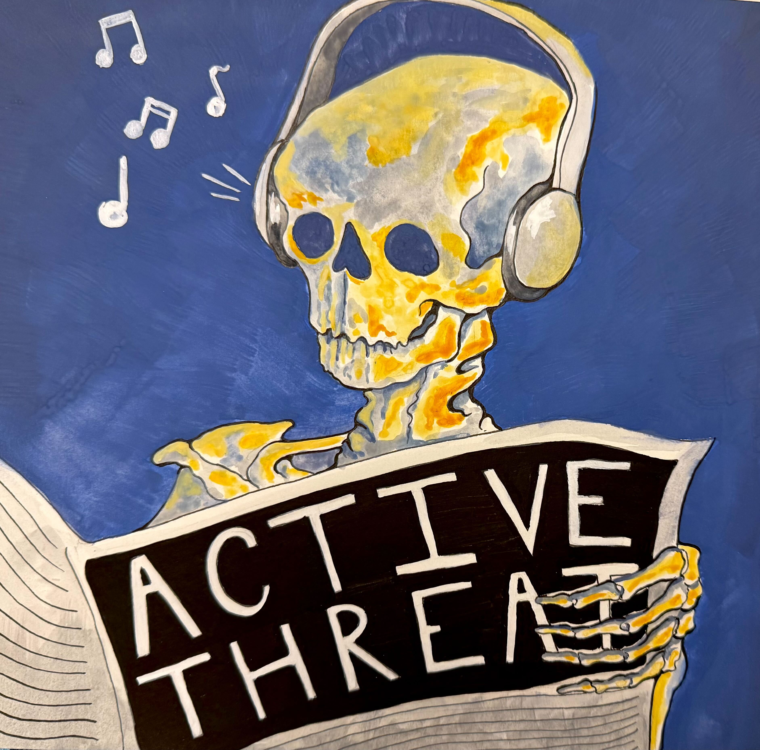
Liam Thomas McManaman | Staff Illustrator
Just one month ago, WashU students were scared for their lives. They were huddled in classrooms, hidden in closets, and barricaded in bathrooms. Some of us frantically sent texts to people we knew were on campus, hoping that they were safe. To our relief, the threat of an armed person on campus on Feb. 24 was declared a false alarm, and no one was actually hurt.
Within just a couple of days, it seemed as if we had all moved on. Campus activities resumed as normal, and now, the event is barely a topic of conversation. Ultimately, we so quickly forgot the trauma of the alert because we are troublingly desensitized to violence. This desensitization doesn’t just impact how we process campus threats but also how we view President Trump’s recent actions that in isolation would have caused more public outrage. Regaining our sensitivity is step one of fighting against the erosion of democratic ideals.
Desensitization stems from abundance. The information age has flooded us with never-ending waves of headlines, news, opinions, and more, to the point where this overexposure fosters indifference. At WashU, this means that the threat of violence on our campus didn’t end up feeling major or surprising in its aftermath. School shootings have become, quite frankly, a recurrent piece of the national news cycle, and that abundance has desensitized us to the idea that schools might not be safe.
From a broader perspective, the fact that many of us seem to have forgotten the very real emotions from the Feb. 24 alert reflects how our excessive media consumption dulls our sensitivity. This desensitization is exemplified in the practice of scrolling on social media, which is now a major source of entertainment and information for Americans. Your feed can give you a video of a puppy playing piano, then immediately after, spit out actual war footage. By equating the news with entertainment, scrolling allows us to ignore atrocities with the simple swipe of a finger. That is desensitization.
The decline in local news engagement has also meant that Americans are often removed from the media and information they are exposed to, leading to more indifference regarding current events. Usually, local avenues for change, such as city or regional government, provide everyday citizens with tangible outlets for channeling their political concerns. When people only see major geopolitical events in their news brief, it is easy to mentally discard — and become desensitized to — troubling information. Questions like “What can I do to stop the violence in the Middle East?” make us feel helpless.
In short, excessive exposure to non-local news has led to the desensitization epidemic of our time. This dynamic helps explain our current political moment in which President Trump is using this ethic of abundance to desensitize Americans to his policies. We are now less sensitive when President Trump initiates the American military without consent from the American people, because, well, he keeps doing it. We are less sensitive when that militaristic mindset is turned against actual Americans, as in ICE, because we just add it to the list of outrageous policies the administration has enacted. This is exactly the idea behind Trump’s “flood the zone” strategy — a tactic used by his administration to overwhelm the public and policymakers at the beginning of his second term.
Whether it’s our community’s ability to quickly bounce back from the threat of violence on our campus or the increasing lethargy with which we view or talk about the Trump administration’s actions, we are facing a crisis of desensitization.
Although the alert was just a false alarm, those feelings of fear during the event were real. We were afraid, because we knew that school shooting threats need to be taken seriously. Similarly, we must recognize that the Trump administration’s undemocratic actions are deeply troubling to the ideals of our nation.
The paradigm that normalizes moving on from our fear during the alert is also what allows Trump to remain unaccountable for fascist policies. We must resist the urge to forget the shooter threat.
Let’s re-sensitize ourselves to gun violence and to encroachments on American democracy. This could look like engaging more with local news outlets like the St. Louis Post-Dispatch and St. Louis Public Radio and spending time processing each piece of media we engage with instead of doomscrolling. If we don’t act now, we can only hope that the next threat is another false alarm.
Stay in Touch!
Get the latest and top news from StudentLife delivered to your inbox