News
New federal labor regulations and growing membership generate optimism among WUGWU members for formal unionization
The Washington University Undergraduate and Graduate Students Workers Union is undergoing a new surge of energy to be recognized as an official union by the University. This movement has been spurred by updated National Labor Relations Board (NLRB) regulations, an influx of undergraduates among its ranks and labor concerns heightened by pandemic conditions.
 Grace Bruton
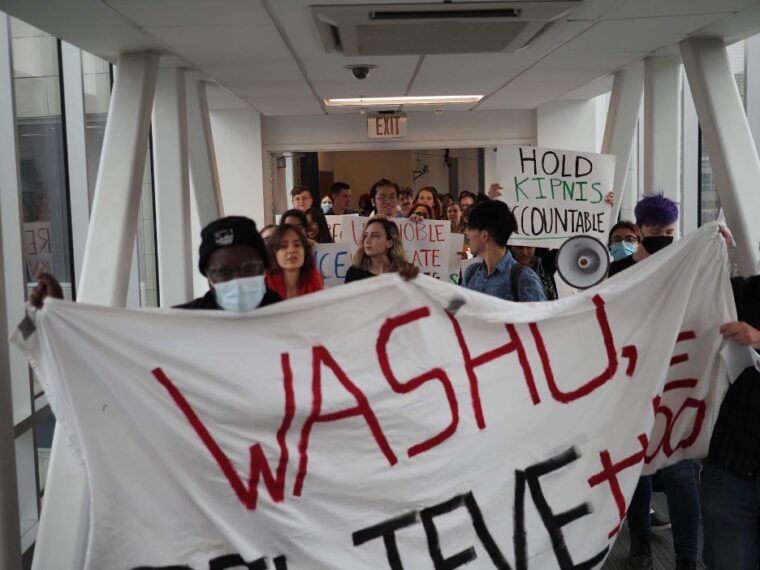
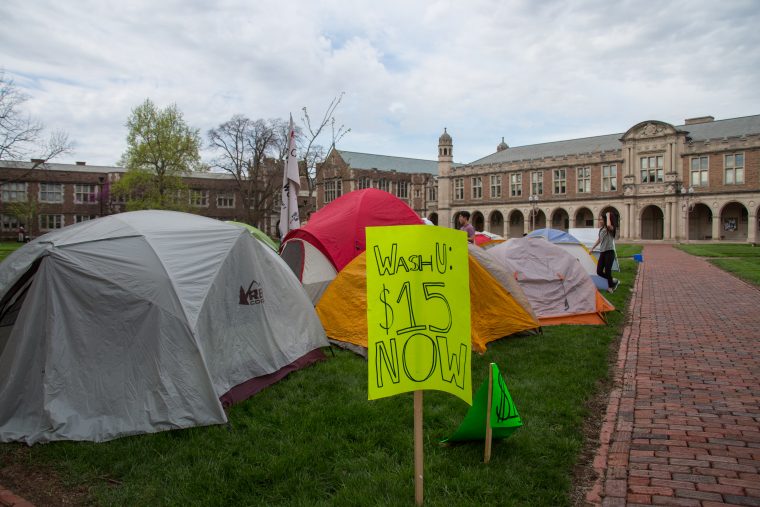
While WUGWU has been leading labor organizing efforts on Washington University’s campus since 2016, it has never been officially recognized as a union. Because of its inability to engage in formal collective bargaining with the University, WUGWU instead carries out direct action advocacy which has taken the form of petitions, marches and setting up an encampment on campus.
Although the union has been successful in pushing the University to meet some of their demands, including a $15 minimum wage for around 1,200 campus workers starting in July 2021, members of WUGWU said they could make more progress with collective bargaining rights.
Grace Ward, the chair of the Campaign Committee for WUGWU, explained that without formal union status, it is significantly harder for the organization to have leverage in decision-making. She said that unionizing WUGWU would give the organization the legal means to strike and hold the administration accountable for certain working conditions.
Executive Chair of WUGWU Trent McDonald further explained that unionization would give the University a legal duty to bargain in good faith with their employees.
“Bargaining in bad faith breaks the law,” McDonald said. He added that the laws backing unions provide more support for workers than the laws protecting social organizers. “The National Labor Relations Board theoretically, not always practically, but theoretically, does have to enforce [unfair labor practice charges].”
Unionization would also guarantee more financial transparency from the administration, according to McDonald. Namely, if the administration says they are unable to afford one of WUGWU’s demands, the union would be able to demand budgetary proof of the claim from the University.
While many members of WUGWU, including McDonald and Ward, see tremendous value in unionizing, some members are reluctant or opposed to unionization.
McDonald noted two main reasons why one would oppose unionization: a sense of individualism and a fear of losing one’s job.
Concerns over being fired stem from the fact that in one fifth of union drives, someone is fired illegally, McDonald said. “So the fear is well rooted in a sense that people don’t want to lose their job. This of course makes a strong argument for why unions should exist, to prevent that kind of thing from happening.”
While some workers join WUGWU with anti-union ideology, Ward said a lot of that sentiment is “conditioned by the University’s messaging campaign.” The last time that WUGWU took steps to vote to unionize in 2017, anti-union sentiment from the administration partially bogged down the movement’s momentum.
Ward said that there were likely graduate students opposing unionization who revealed WUGWU’s organization for union status to faculty and administrators, leading to pushback from the University.
Heads of departments told graduate workers they risked losing their assistantships and the provost posted a webpage suggesting that international graduate workers might be deported if WUGWU gained union status, Ward said.
“After the provost posted and circulated that idea of international students getting deported in the instance of the strike, there was a massive chilling effect,” Ward said. “Many international students didn’t even want to talk to their peers about unionizing.”
Amidst this period of anti-union messaging from the school, WUGWU went through a “soft election process” where they saw what percentage of the organization would vote in favor of unionization, Ward said.
In the fall of 2017, after the group felt they had garnered enough support within their ranks, WUGWU held an election where its members were able to vote whether they wanted the organization to be recognized as an official union.
WUGWU did not reach the majority of votes needed to win the election and has not held an election since. Ward said that the votes from the election were split roughly equally into 3 categories: ‘no’ ballots, ‘yes’ ballots and ‘objected’ ballots.
These contested ballots stemmed from a process by which both parties involved in the dispute—University administration and WUGWU—had the opportunity to object to who could legally cast a ballot.
McDonald said that while both sides can fight over who can be part of the official bargaining unit, employers are more likely than workers to challenge the legitimacy of who can cast a ballot.
“Wash. U. set really stringent categories of who would be eligible to be considered potentially part of this graduate workers union,” Ward said. “They had to be actively TA-ing that semester, they had to be on certain forms of funding, etc.”
Ward said that WUGWU’s internal counting showed that the election would have gone in favor of unionization if it weren’t for the contested ballots.
“We, as an entire body, understand that as soon as such a process were to be initiated there would be open suppression and anti-union messaging that would come from the administration,” Ward said. In the future, Ward said that WUGWU plans to keep the process by which they will be moving towards certification private so as not to spur anti-union sentiment from the administration.
While they have not announced any concrete plans to make another formal push for unionization, the recent posts on their Instagram page surrounding the topic of unionizing, in addition to changes to the NLRB, indicate that another formal push is now a real possibility.
“Big news for the student workers; bad news for the bosses,” reads the beginning of WUGWU’s latest Instagram post. “The federal agency that sets and adjudicates most private sector labor law, the National Labor Relations Board [NLRB], has withdrawn a proposed rule excluding student workers from its protections, making union recognition drives much simpler. Time to get down to work!”
The aforementioned “proposed rule” set by the Trump Administration attempted to repeal a precedent set by a 2016 court case involving Columbia University that gave graduate and undergraduate students the right to be considered workers.
Since Nov. 6, 2017, the NLRB has held a Republican majority, except for a four month stint at the beginning of 2018 when the Board was split due to an unfilled seat. McDonald said that WUGWU did not attempt to unionize through the NLRB during this time period because their case could have been used to repeal the precedent set forth in the 2016 court decision.
“I don’t think there’s been one example of a grad or undergrad union filing post-Republican majority for an election,” McDonald said. “Everybody said you’re not going to win, you will lose the right of everyone else, including the 1000s of people that already have recognized unions.”
The board still has a Republican majority at the moment, but as soon as Aug. 2021, this could technically change to a Democratic majority. While there is no guarantee that a majority of WUGWU members would support a union if an election was held, members would not be concerned about upending the collective bargaining rights of other workers around the country by filing a petition.
If WUGWU chooses to petition to hold another election, the new makeup of their organization could affect their odds at winning the vote.
Undergraduates were only allowed to join the union starting in 2019, which was two years after the organization made its first formal push for unionization. McDonald sees the influx of undergraduate members as a boon to any potential future push for unionization.
“In some ways, our only real strength is numbers,” McDonald said, noting that new undergraduate members will give the union significantly more leverage.
“The only real way that wealth and power gets redistributed downward comes from large class-based movements, making demands upon ruling elites, decision makers and creating a sense of crisis, that the only way that that crisis will be resolved is by giving the people what they want,” McDonald said.
Junior Luke Ehrenstrom, an undergraduate worker, noted some of the reasons that undergraduate students in particular might want to unionize. They said that undergraduates often aren’t sure what a “good salary” for their job is and a union would give them greater support in demanding higher pay.
“It’s not like, ‘Oh, I’ve got a bachelor’s degree, I should be getting this amount of money’—it’s like, some jobs require some amount of training, other jobs don’t require some amount of training,” Ehrenstrom said. “A union would allow us to say, ‘Okay, here’s what these wages are, here’s what we’re going to negotiate for, here’s how much we think they should be, here’s what benefits should be attached.’”
Along with adding undergraduates to the organization, the issues that the COVID-19 pandemic has brought to light will be a factor in any future drive to unionize.
“People’s sense of precarity is definitely increased,” Ward said, speaking to the negative employment conditions wrought internationally by the pandemic. She said that many graduate students especially are concerned about the protection and financial stability attached to pursuing a Ph.D. or master’s degree.
Ward said that the increased motivation to unionize, in light of these conditions, is two-fold. For one, some workers want the tangible result of a higher salary and better benefits now in order to have a stronger safety net when exiting graduate school. Secondly, graduate students want to strengthen the democratization of the national workforce that they will be entering post-graduation.
“There’s more this idea that we’re part of a movement that’s working to democratize higher education across the board,” Ward said. Members of WUGWU who end up working in academia later on in life will be part of the “same labor system that we are now,” she said, which is part of their motivation to change the system as graduate students.
When asked about the possibility of WUGWU’s formal unionization, Vice Chancellor for Public Affairs Julie Hail Flory wrote in a statement to Student Life that the University does not recognize WUGWU as a union with collective bargaining rights, citing the fact that WUGWU has not been elected by the student body.
There is no legal requirement that the administration can only recognize WUGWU as a union if the student body elects them as such.
“We continue to believe strongly that graduate students are students, and not employees,” Flory wrote. “We are committed to providing an exceptional graduate environment where all of our students can succeed and we value our interaction with student governing bodies, like the Graduate Professional Council and Graduate Student Senate, as we work together to address issues of concern.”
Stay in Touch!
Get the latest and top news from StudentLife delivered to your inbox