News
‘Labor of Love’: WUGWU Valentine’s Day cards to chancellor highlight student concerns
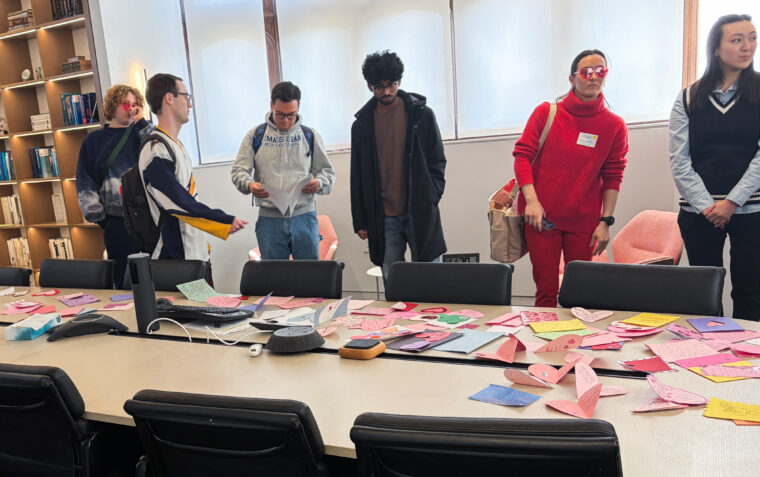
Members of WUGWU presented 150 Valentine’s cards to the chancellor’s suite last Friday (Sonal Churiwal | Staff Writer)
Approximately 20 members of the Washington University Graduate Workers Union (WUGWU) delivered 150 handmade Valentine’s Day cards to the chancellor’s suite in Brookings Hall on Friday, Feb. 13.
WUGWU collected the cards from graduate students, many of which describe improvements they would like to see at WashU.
Holly Rosewood, a Ph.D. student in the history department, said that even though many of the cards detailed policies that WashU could improve, she ultimately described the efforts as a “labor of love.”
“We all want to be here, and we want to be creating educational spaces,” Rosewood said. “We all want the University to do better. That’s why we’re taking the time.”
Because Chancellor Andrew D. Martin was out of town due to travel, Joshua Walehwa, associate vice chancellor and chief of staff, received the cards and listened to student statements, which focused on areas to improve University support for graduate students. Walehwa said he planned to read the cards and later share them with Martin.
“The timing is off in terms of the chancellor not being here, but I just appreciate your thoughtfulness,” Walehwa said to the students who delivered the cards.
Since its founding in 2016, WUGWU has advocated for WashU to recognize graduate students as workers for their labor as researchers and instructors and to provide employee benefits.
“I study labor history, so I know without a doubt that what we do is work, even though we may not be classified as workers,” Rosewood said. “[We] want to be treated as real employees, and have benefits that reflect that, whether that’s better healthcare, vision care, childcare. [Just] reciprocating care that we give to the University,” Rosewood said.
Sherlyn Contreras, a Ph.D. student in Plant & Microbial Biosciences, said they believe WashU does not extend enough support to first-generation students.
“I’m a child of immigrants,” Contreras said. “I’m first-gen, in all ways. … As we move up in education, we feel the most impact of not being supported. I was displaced during May, in the tornado, and the one [housing option] WashU kept pushing out was a $60 per night stay. That’s more than Airbnb.”
The cards also raised concerns introduced by the current political climate, particularly about threats to immigrant students from Immigration and Customs Enforcement (ICE). Jackie Freed, a Master of Social Work student, expressed a greater need for emergency preparedness for possible interactions with ICE.
“The University should be providing clear guidelines on what to do if ICE does enter campus because we have seen that [at] other universities. They are now apparently allowed to go into churches and schools,” she said.
Walehwa acknowledged that several participating students wanted greater clarity on WashU’s level of commitment to immigrant students so they can set realistic expectations about the University’s response.
“What I’ve heard from this conversation is ‘If there is an approach [to ICE], we’d like to know,’” Walehwa said.

WUGWU’s cards outlined desired changes at the University (Sonal Churiwal | Staff Writer).
Students also expressed concerns about funding cuts in the College of Arts & Sciences. John Naughton, a Ph.D. student in the math department, pointed to the elimination of 6th-year funding for Ph.D. students across disciplines.
“[It] is really going to reduce the ability of students currently here to finish their research programs and to be competitive in an increasingly difficult job market,” Naughton said. “It’s also going to affect [the] ability to attract more excellent graduate students in the future.”
According to Naughton, the University also cut stipend lines, contributing to a smaller cohort for math Ph.D. students, from 11 in 2022 to four in incoming classes. He added that this reduction has had a trickle-down effect on undergraduate students taught by Ph.D. students.
“The caps on our smallest discussion sections have increased from [21] students to 32 students,” he said. “It really affects the ability of the students to participate and to learn to the fullest extent, and to the extent that they deserve.”
Walehwa said he believes that the University’s actions reflect a commitment to long-term planning.
“I cannot speak on behalf of the chancellor, but what I do know is that leadership is committed to WashU now and WashU in the future,” Walehwa said. “[Leadership considers] how we can be good stewards and make sure that folks in the future get the privilege of doing what you are doing right now,” he said.
The WashU Investment Management Company describes its commitment to longevity as “willing to take calculated risks and innovate in the long-term best interests of the University.”
Ty Easley, a Ph.D. student in the math department, questioned whether continued dialogue with the Trump administration truly supports longevity.
“The administration’s public actions give the impression that it believes capitulating to fascism is a good thing for its long-term longevity,” Easley said. “And that is a wildly ahistorical belief.”
Bobby Huggins, a Ph.D. student in computer science and engineering, said that long-term planning should extend beyond finances.
“[Financial security] is not sufficient. The important thing is that we protect our academic values, our commitment to academic freedom, [and] to creating a welcoming environment for all students,” he said.
Huggins hopes that the conversation with University leadership will extend beyond the Valentine’s Day demonstration.
“We appreciate that someone was there to hear out our concerns, but it was important to us to speak with someone who was able to give concrete answers,” Huggins said. “We hope to hear back from the chancellor’s office publicly.”
Stay in Touch!
Get the latest and top news from StudentLife delivered to your inbox