Forum | Staff Editorials
Staff Editorial: We must fund EST

Lucia Thomas, Staff Illustrator
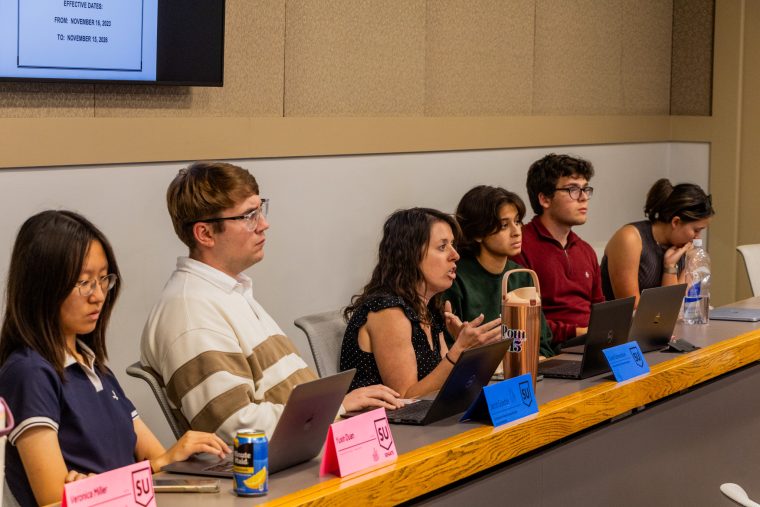
The WashU Emergency Support Team (EST) is an essential service on our campus. Yet, on March 26, they lost their block funding after falling short of the two-thirds majority required in the spring 2026 Student Union (SU) election.
EST responds to all emergency calls on campus, answering over 600 calls per year. It leads crucial public health organizing — including classes for CPR, Stop the Bleed, and Active Bystander Training — and hosts COVID-19 and flu vaccination clinics. The organization is run by student volunteers who go through extensive EMT-B and internal training (roughly 100-200 hours) to provide “first aid care for any medical emergency (e.g. cardiac, respiratory, intoxication, drug abuse, orthopedic, diabetic, severe bleeding, head injury, and any major trauma),” according to its website.
EST is funded by an SU block grant approved by a student body vote each year, giving them a fixed budget upwards of $70,000 for the full academic year to fund training and operations. Uncle Joe’s and Campus Y also applied for block grants and received them this election cycle. In contrast, SU Treasury sorts other student groups into categories I-III, granting them either limited flat funding or an annual budget and appeals through the school year.
Last week, the student body voted against EST’s funding by a margin of seven votes under the two-thirds threshold. This vote is unprecedented, as EST has consistently secured its block grant in recent history.
SU, the University, and EST are in the process of planning their next steps, whether that be defunding the organization or finding an alternative method, such as becoming a category student group, receiving direct University funding, or using a constitutional pathway to a recall vote.
While there are many options and considerations, we urge the University and SU to find a solution that preserves the imperative role that EST plays on campus for student health and safety. Students can make this demand, too, by messaging their administrators and SU representatives.
The sudden shift against EST among students this year is likely due to a recent wave of criticism against the organization, most visibly evident on the WashU channel of Sidechat (an anonymous social media platform). After EST lost its funding, posts included, “Let’s f*cking go EST did not get their block funding #PowerOfSidechat,” “EST mad af downvoting all these posts. We won you lost,” and “War is over.” These Sidechat posts and beliefs reveal a fundamental misunderstanding of EST’s role on campus and students’ disrespect and cruelty towards their peers.
Another reason for this vote is the lack of overall voter turnout in this election, which was below historical averages. Only 376 students voted against EST’s block funding, but their decision impacts the lives of thousands of students. Students must take responsibility to educate themselves on SU elections and each ballot item and vote accordingly.
Some students believe that EST does not provide enough services and is an unnecessary middleman before the hospital, as EST must call an ambulance for more serious medical interventions. Their critiques about EST’s quality of care are important, but it cannot improve services without the funding to operate. Students who do not wish to be treated by EST still have the option of calling 911.
If EST does not get funded, students experiencing a medical emergency will have to rely on Clayton Emergency Services. EST saves some students time and money for lower-stakes medical calls and determines whether they need to go to the hospital. The city’s response times may be much longer than EST, which is located on campus and knows how to navigate it. Additionally, students who call Clayton EMS and do not need an ambulance pay for Treat No Transport fees, depending on their insurance, but do not need to pay for EST’s services. Moreover, the Washington University Police Department often offers to transport students to the hospital, rather than incurring the costs of an ambulance, which can be hundreds of dollars. Many of EST’s calls are also related to alcohol and drug intoxication, a situation where receiving medical care from a peer can be more comfortable and familiar.
EST also eases Clayton EMS’ workload. According to Student Life reporting in Spring 2025, Clayton EMS received 900 calls per year from WashU students before EST existed, and they now get around 300.
Students will pay the same $712 student activity fee, which SU distributes to student groups, regardless of whether EST is funded. This money will thus not necessarily go toward organizations that students value more than EST. A portion of EST’s block grant goes toward training future members for the following year, meaning that this loss in funding also has implications for the future of its organization.
EST performs an invaluable free service on campus. SU and the University must find a sustainable and consistent way to secure their funding, or students will suffer the consequences, including lost money and time and a lack of important medical initiatives on campus.
In the following days, students should message their University administrators, such as Dean of Students Rob Wild ([email protected]), and SU Executive Officers, such as President Ashton Lee ([email protected]) and Vice President of Finance Meris Damjanovic ([email protected]), to ask them to fund EST in any way possible. Student voices are the most crucial at these crossroads.
Staff editorials reflect the opinion of the majority of our editorial board members. The editorial board operates independently of our newsroom and includes members of the senior staff.
Sylvie Richards, Managing Forum Editor
Sydney Tran, Editor-in-Chief
David Ciorba, Senior Forum Editor
Riley Herron, Editor-in-Chief
River Alsalihi, Senior Forum Editor
Kate Theerman Rodriguez, Senior Forum Editor
Lyn Wilkins, Junior Forum Editor
Will Rosenblum, Managing Scene Editor
Laurel Wang, Senior Scene Editor
Elizabeth Grieve, Senior Scene Editor
Matt Eisner, Managing Sports Editor
Hannah Much, Junior Sports Editor
Anna Crook, Junior Sports Editor
Isabella Diaz-Mira, Managing Photo Editor
Zoe Rhodes, DEI Editor
Bea Augustine, Managing Design Editor
Grayce Cooper, Managing Social Media Editor
Mason Sutton, Managing Special Issues Editor
Editor’s Note: This article was updated on March 30 to replace an SU senator’s contact with one more relevant to the case.
Stay in Touch!
Get the latest and top news from StudentLife delivered to your inbox