Forum
Bad Bunny’s halftime show was political
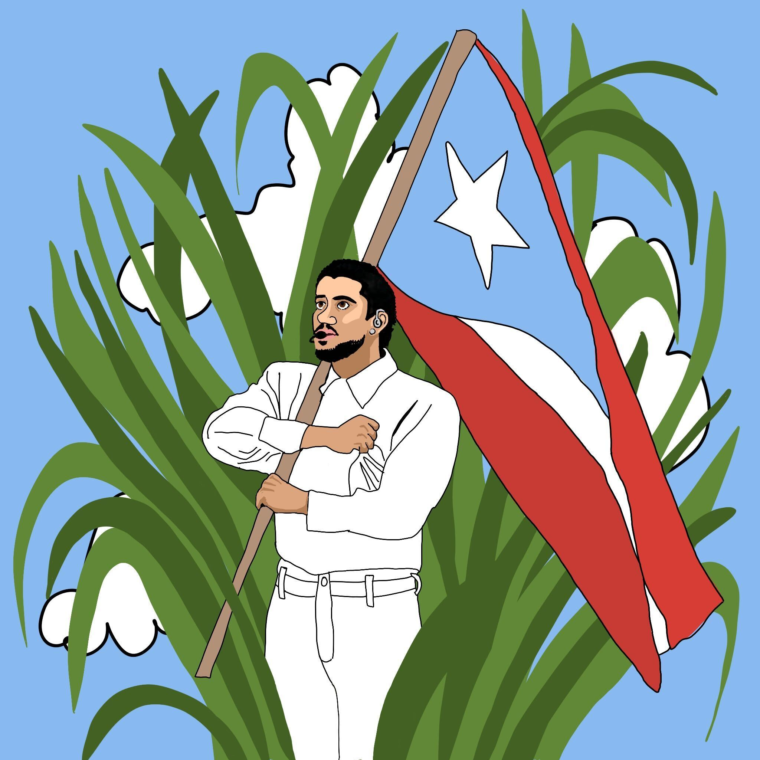
Janae Crespo | Contributing Illustrator
As I watched Bad Bunny remove his earpiece and walk off the field, I smiled. His performance was one full of lively music, beautiful choreography, and wonderful sights. I couldn’t help but feel proud and impressed. After all, he delivered a beautiful message. It wasn’t until my screen lit up with a text from a friend, “I wish Bad Bunny’s performance was more political,” that confusion clouded my thoughts. My friend, whom I had just talked to about the politics behind Bad Bunny’s Grammy acceptance speech, thought his performance wasn’t political enough.
It occurred to me that several aspects of Bad Bunny’s performance might be overlooked without prior knowledge of Puerto Rican history. As a Puerto Rican, I thought the performance was lovely, but the best part was the history, storytelling, and parallels drawn between past resilience and current struggle. Bad Bunny’s halftime performance at the Super Bowl was not only a beautiful display of culture and pride but also one of political resistance from past to present.
The performance opened as Bad Bunny emerged from a sugarcane field. To many, this design seemed random, possibly because sugarcane is tropical, but it is much more profound. Sugarcane has been a central part of Puerto Rico’s history for centuries. Introduced to the island in 1523, sugar immediately became a huge industry in Puerto Rico. For centuries, it was at the center of Puerto Rico’s economy. By the 1600s, it was more profitable than gold. This crop, integral to Puerto Rico’s economy, was founded on exploitation and oppression. In the 1940’s, Puerto Rico’s government ruled against sugarcane holdings that were larger than 500 acres, and since a majority of sugarcane plantations were this size, the Puerto Rican government bought a large amount of these holdings with the intention of redistributing the land. Though the redistribution varied in success, the industry began to fade soon after.
Bad Bunny’s choice for the set to be surrounded by sugarcane showcases its historical importance to Puerto Rico’s economy. The actors in the opening scene, cutting the sugarcane and seemingly working in the fields, are a reminder of how this industry came along.
Throughout the show, Bad Bunny carries the Puerto Rican flag various times. This isn’t shocking — anyone who knows Puerto Ricans knows we display our flags at every given opportunity.
The version he carries, however, is different from the standard flag. Bad Bunny carries a flag with a shade of blue significantly lighter than its usual navy. This isn’t a malfunction but a purposeful statement.
After becoming a U.S. territory in 1898, Puerto Ricans responded by starting an independence movement. By the 1930s, the movement gained momentum, and people flew the Puerto Rican flag as a sign of resistance and national identity. In 1948, Law 53, “La Ley de la Mordaza,” made engaging in expressions of Puerto Rican nationalism illegal. Owning the flag could result in up to 10 years in prison or a $10,000 fine. Police and the National Guard could even enter homes without a warrant if they suspected a flag was being displayed. In 1952, the navy blue version of the flag was adopted to match the flag of the U.S. and established as the island’s official flag. Law 53 was repealed in 1957 after nine years, but not before many were arrested and suffered a loss of freedom and representation.
Today, flying the original version of the flag is still associated with Puerto Rican independence, and it remains a prideful display of national identity. Bad Bunny choosing to display this version throughout the halftime show is a rebellious act of resilience and a display of history.
In a later segment, Bad Bunny takes a shot from a woman. This woman is the owner of Toñita’s Caribbean Social Club in Williamsburg, Brooklyn. Toñita opened her club in 1974 as a meeting place for local baseball players and families, and over time, it became a safe space for Puerto Ricans and Latinos in the community. Over the years, Williamsburg has felt the effects of gentrification, and Toñita has said that she’s been offered money to shut down the club and sell. However, she has no intentions of doing so. Toñita’s act of refusing to leave her neighborhood in Brooklyn is a politically charged act of resistance against the effects of gentrification, and her social club remains one of the last Latino social clubs in New York. Bad Bunny’s decision to include Toñita in his performance of the song “NUEVAYoL” is one that highlights the presence of Latinos in gentrified areas and the importance of resistance and continued presence.
While climbing a powerline, Bad Bunny later performs his song “El Apagón,” which directly translates to “The Blackout.” The song is about dealing with consistent blackouts and having a good time regardless. Puerto Rico has been facing frequent blackouts and a power crisis for decades due to consistent hurricanes and storms. Even without hurricanes, Puerto Rican residents lose an estimated 27 hours of power a year due to blackouts. The visual of climbing the power lines, combined with the song, was a beautifully paired homage to the perseverance of Puerto Ricans, even when dealing with the effects of terrible natural disasters.
Throughout his performance, Bad Bunny presented parts of Puerto Rican history when communities persevered through resistance. In a time when Latino communities are struggling, this performance feels especially meaningful. Though the majority of the history displayed and provided is specific to Puerto Ricans, his message was greater than just us; it was as big as all the Americas. Bad Bunny’s performance was political; it was a reminder to communities everywhere that in times of struggle, unity is needed when fighting for justice.
Stay in Touch!
Get the latest and top news from StudentLife delivered to your inbox