Forum
Charlie Kirk and the fragility of free speech
In the wake of Charlie Kirk’s murder, our country has been tormented, not only by the death itself, but by the disquieting reality that ideas can make you a target in America. However, beyond politics, beyond his assassination in broad daylight, Kirk was foremost a husband and a father. Kirk was not an online caricature designed to prompt sarcastic laughs and eye-rolls. He was a human — an American citizen — murdered in cold blood.
Indeed, Kirk was not a moderate in any respect; many found his ideas offensive. Yet, he built his career on the inextricably American principle of open dialogue. His death prompts Americans to respond to something larger than fractional politics and highly publicized political violence: We must resist the attempts to exterminate the very freedom Kirk was assassinated for exercising.
Free speech has become fragile — we know this. Mainstream news prescribes a steady diet of this existential, yet entirely tangible, script. We are aware that a moderate political climate was jettisoned from the grasp of U.S. politics long ago. We know that the arc of history is tilting further from freedom: Each time an individual is censored or a book is banned, we are left to swallow this reality. Still, we neglect it, unsure if we can stop it and complacent in our comfort. We parade our thoughts and prayers on Instagram stories, yet cower from sharing our convictions aloud. After all, we don’t want to be made an example. We don’t want to end up like Kirk.
“He subscribed to fascist ideology,” we insist, while erasing his history of championing democratic debate. Crucially, his views may have been divisive, but that alone can never justify the taking of his life. Let me be clear: Kirk’s assassination was a direct attack on democratic values and open debate, not a stance against fascist ideology.
As a nation, it is crucial that we stop artificially molding our ideological opponents into communists and fascists. Erroneous name tags serve as a cowardly proxy for honest dialogue across the ideological spectrum. Reductive labels turn those who bear them into subhuman opponents, which allows the dismissal of their beliefs and justification of violence against them.
Quickly, Kirk’s assassination amplified partisan extremism and political scorekeeping. Both parties eagerly awaited the headlines that confirmed the killer could be linked to the other side. Critically, we ignore that this degenerate activity only propagates the killer’s quest for divisiveness. As a nation, we obsess over the political stance of Kirk’s killer instead of seeking ways to promote the ideas of free expression they wish to silence.
Those who see political violence of any kind as a partisan attack brutally distort American values. Every citizen is endowed with the rights — like free speech — that we cherish as Americans. As we continue to stray from this fundamental, we not only move toward social anarchy and a collapse in our humanity, but also corrupt what it means to be a unique American citizen. There will never be a single candidate, election, or debate that delivers unity to the American people. The battle is, as it has always been, in the mind of the individual. As long as we continue to brew this noxious mixture of violence and fear, we will keep yielding anguish and bloodshed.
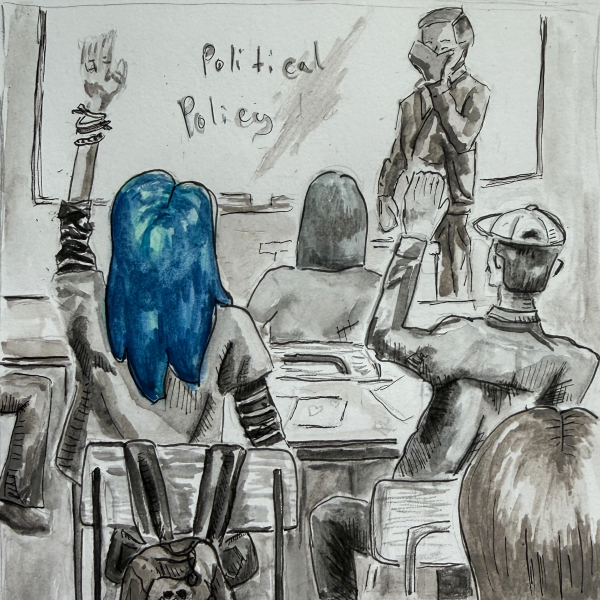
Ultimately, as Kirk’s death proved, political violence doesn’t stay within the confines of D.C. and presidential rallies; it infects classrooms and college campuses. As students, we have a duty to replace the violent culture of politics we’ve inherited from previous generations with unapologetic debate. We should not flinch at inviting a political speaker to campus or sharing personal beliefs in class.
Speak passionately, debate vehemently, but never resort to silencing with blood what can be discussed with words. WashU students don’t need more echo chambers. We need experience conducting dignified conversations. If any one of us, when adorned in a WashU cap and gown, recalls never debating an ideological opponent, this university has critically failed us — and we have, in turn, sabotaged ourselves. This proficiency in conducting debate is a prerequisite to meaningfully contributing to a pluralistic democracy.
We must decide if we will live in a country where children become fatherless because someone decided an idea was too offensive to speak. When a society polices speech and ideas with bullets, it only hastens its own demise.
Stay in Touch!
Get the latest and top news from StudentLife delivered to your inbox