Freshman Press
Seeing sculptures: An Introduction to Campus Art
Every student at Washington University has the opportunity to see the sculptures located around campus daily, but not every student knows the stories behind the pieces. Freshmen walking to class may pause to wonder why a lanky bunny sits in the center of campus or what the symbols composing the statue in front of Bauer Hall symbolize. Digging deeper into the stories behind how and why the art is on campus reveals a history not only about the art, but about the University itself.
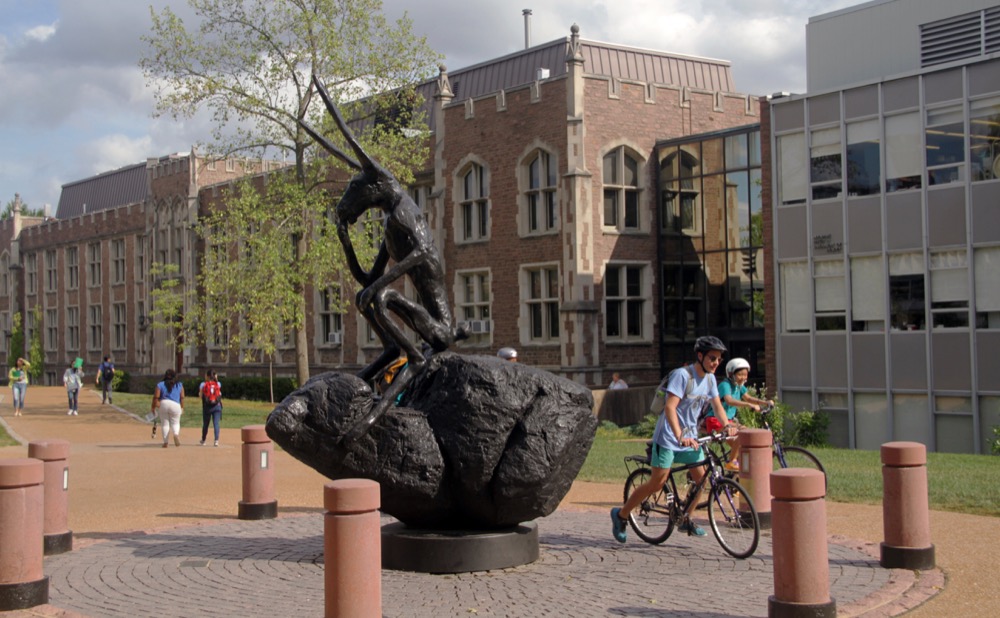
Thinker on Rock (“The Bunny”)
The iconic cast bronze statue, situated in the center of campus near Olin Library and Graham Chapel, depicts a bunny resting on a large rock. Constructed by British artist Barry Flanagan, Thinker on a Rock is a humorous allusion to Auguste Rodin’s Thinker. The statue, installed in 2001 with a loan from the Gateway Foundation, is often decorated by students, though a plaque nearby warns against it. Other statues depicting the bunny can be found in Des Moines, Iowa, Utrecht, Netherlands and Washington, D.C.
Places
Places is an outdoor installation belonging to the Kemper Art Museum that was created by Ayse Erkmen in 2015. Located behind Olin Library, these green tiled rock-like formations can be used as anything from chairs to stepping stones. Erkmen has been sculpting since 1969, and her works can be found in countries such as Denmark, Turkey, the United Kingdom, Japan, Austria and the United Arab Emirates. Places is Erkmen’s first project completed in the United States.
Swamp Creature Friends
The newest art addition to campus, this neon green sculpture catches eyes as students enter into the Swamp on the South 40. The artist, Tom Friedman, is a St. Louis native who is known for reusing common materials in innovative ways.
Ainsa I
Students entering Bauer Hall from Mudd Field are greeted by a seated figure made of stainless steel, whose silhouette is made up of letters from a variety of alphabets. Ainsa I was created by Jaume Plensa and arrived on campus in 2014. Students are encouraged to walk and even climb inside the sculpture.
Olin Ceremonial Ding
Located just a few steps from Bauer is another important landmark: an enormous bronze vessel, called a Ding. The five feet tall, 1,500 pound bowl was gift to the Olin Business School from alumni from the Washington University-Fudan University MBA Program, located in Shanghai. Ceremonial Dings were a common indication of power and authority during China’s Shang Dynasty, and indicated the social status of the owner. The Ding may be better known by its “Poke-stop” name, Wash. U. Asian Pot Sculpture.
Bears
This giant statue of the university’s mascot, found in front of the newly renovated Athletic Complex, is dedicated to George H. Capps, an alumnus both as an undergraduate and in the law school. Capps went on to work for the FBI, was the head of Capitol Coal in the 1950s and 1960s, and served on Washington University’s Board of Trustees from 1979 to 1982. While these two bears are a noble addition to the statues on campus, there is a less noticeable animal also featured on the statue for students who take a closer look.
Works of art on campus may function as landmarks around campus or as ways to visually liven up brick and stone buildings, but they also have the ability to bring personality, history and Poke-stops to campus.
Stay in Touch!
Get the latest and top news from StudentLife delivered to your inbox