Scene
From safe rooms to strength: Kibbutz Nahal Oz carries on
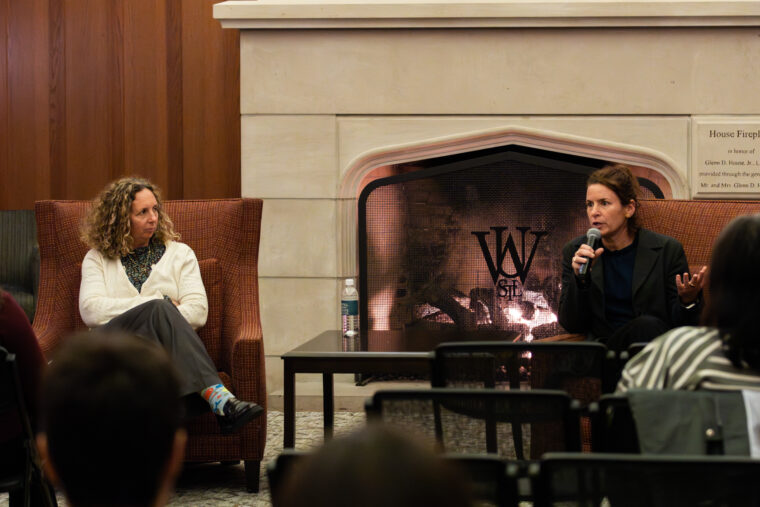
In addition to speaking about their experiences in Israel on Oct. 7, Michal Magen (left) and Yael Raz Lachyani (right) work on recovery and social initiatives to restore their Kibbutz community. (Max Silberg | Staff Photographer)
For the past two and a half years since Oct. 7, Michal Magen and Yael Raz Lachyani have held on to one dream: to return to their home, Kibbutz Nahal Oz, in Israel and begin the process of rebuilding their lives. Now, they’re sharing that dream with others to honor the stories of those whose lives were cut short as a result of Oct. 7.
This past Wednesday, students and community members came together in the Goldberg Formal Lounge to listen to the testimonies of Magen and Raz Lachyani, members of the Kibbutz Nahal Oz community who endured and survived the horrors of Oct. 7 and are coping in its aftermath. The event was organized in partnership with the Jewish Federation of St. Louis and WashU Hillel.
Both Magen and Raz Lachyuni grew up on Kibbutz Nahal Oz and returned to raise their families. A kibbutz is a communal living situation where members work together, sharing income and property tax. Magen and Raz Lachyuni have been integral members of the kibbutz throughout the years, and their connection to their community has only strengthened in the time since Oct. 7. Magen now serves as the community manager, leading the kibbutz’s recovery and strengthening process. Raz Lachyani works in community process facilitation and social initiatives and has spent time serving as the spokeswoman of Nahal Oz, accompanying the families of hostages as their loved ones returned to Israel.
Kibbutz Nahal Oz is situated in the northwest Negev desert near the Israel-Gaza border in southern Israel and was the first kibbutz attacked on Oct. 7. It was founded on Simchat Torah, a Jewish holiday that marks the completion of that year’s cycle of Torah readings, in 1953. Oct. 7, 2023, would have marked the 70-year anniversary since its establishment, but instead, 15 people were killed and eight taken hostage to the Gaza Strip by members of Hamas.
“From the beginning, it wasn’t easy to be in Nahal Oz. But again, the founders were Zionists, and they had a vision that they wanted to build a big community together,” Raz Lachyani said.
On the morning of Oct. 7, Magen and her family woke up around 6:29 a.m. to the sounds of red alerts, Israel’s emergency alert system consisting of sirens and mobile app notifications, and missiles overhead. No strangers to these spontaneous attacks, the Magens headed over to their neighbor’s house for some Saturday morning coffee. Everything changed in an instant.
“My daughter was looking out the window, and she told me, ‘Mommy, there are some people near the fence. They look like terrorists,’” Magen said. “So we went home, and from this moment, our day looked like hell.”
The Magens immediately retreated to their safe room, closing all the windows, pulling down the shutters, and locking the doors. Risking revealing her location, Magen called the head of security on the kibbutz to ensure he knew of the severity of the situation and could alert others.
“He didn’t answer me the first time, but the second time, it was a little bit after 7 o’clock in the morning, and I could hear him fighting already with the terrorists. He said, ‘Michal, I know, I know, I can’t talk with you.’ And I think it was the one of the last calls that he took, because he was killed about 20 minutes after,” Magen said.
About an hour later, the Magens decide to head upstairs and lock themselves in the safe room on the second floor, hopeful that if the militants were to enter their home and break open the first floor safe room door, they would see it vacant and leave the home. They stayed up there as the militants raided their home until they were rescued by the Israel Defense Forces 12 hours later.
“All we could hear was gunfire, grenades, bombs, and shouting in Arabic all day,” Magen said.
Raz Lachyani’s day looked similar. After receiving alerts from her phone and the kibbutz group chat where other people were begging for help after seeing dead bodies, she and her family headed to the second floor for their upper safe room.
“My memory is gone from that day. I do not remember much about being in the safe room, so you are not going to get a story about what we were doing there, but I can promise you, it wasn’t pleasant,” Raz Lachyani said.
As the hours in the day crept by, Raz Lachyani and her family slowly lost contact with the outside world. Their phone batteries began to die one by one, and with the power out, they were left sitting alone in the darkness.
“We didn’t know we were going to be in the safe room for so many hours, so we did not take food, water, or anything. There was no choice if we wanted to use the restroom,” Raz Lachyani said. “Usually when we go into a safe home in Nahal Oz, it’s only 10, 15, or 20 minutes.”
Hamas militants eventually entered the area next to Raz Lachyani home as the family sat in terrified silence above. An electricity lock on the front door stopped them, and the Raz Lachyani family survived that day.
“We heard the noises from our home, we kept hearing more and more, and we didn’t know what was going on,” Raz Lachyani said.
The family and others living on Nahal Oz were transported to an army base and then took refuge in a boarding school on a nearby kibbutz. Community members had stocked the school’s building in advance of their arrival.
“We all try to help each other out,” Raz Lachyani said. “They knew we were coming with nothing, so they brought over sheets, brushes, and shampoo. Of course, what any Jewish family does when there is a disaster.”
From there, Magen and Raz Lachyani began their new lives. Yet, they weren’t alone, sharing in the pain with thousands across Israel.
“We were very together during this time. We were seeking a lot of power together, crying together, and laughing together,” Magen said.
As mothers, these two years for Raz Lachyani and Magen have been an especially difficult journey in finding ways to give their children a sense of normalcy while dealing with the hurt they carry beneath the surface.
“You can imagine my young boy who was 15 years old. All his life he played soccer, and one day, it was gone. He didn’t go join another group; he gave up his hobby. He changed schools twice in two years and got separated from all of his friends. All of his life was taken from him beyond the trauma he endured and loss of strength,” Magen said.
Since Oct. 7, Nahal Oz has erected various memorials around the kibbutz honoring those whose lives were taken and those who carry invisible scars.
“The trauma is not going away, whether it be after two years, 10 years or 20 years. We all need to learn to live with it,” Magen said.
In time, the community is prepared to rebuild and keep the legacy of the kibbutz alive.
The event concluded in a show of strength with Raz Lachyani encouraging the audience to remember the horrors of the day and be a driving force for change.
“Learn, listen to stories like mine and Michal’s and bring it out to the world,” Raz Lachyani said.
During a day when so much life was stripped away, Magen reminded the community to never take for granted the time we are given.
“Life itself is powerful and stronger than anything,” Magen said.
Stay in Touch!
Get the latest and top news from StudentLife delivered to your inbox