News
Religious leaders discuss Catholic-Jewish relations for 60th year of Nostra Aetate

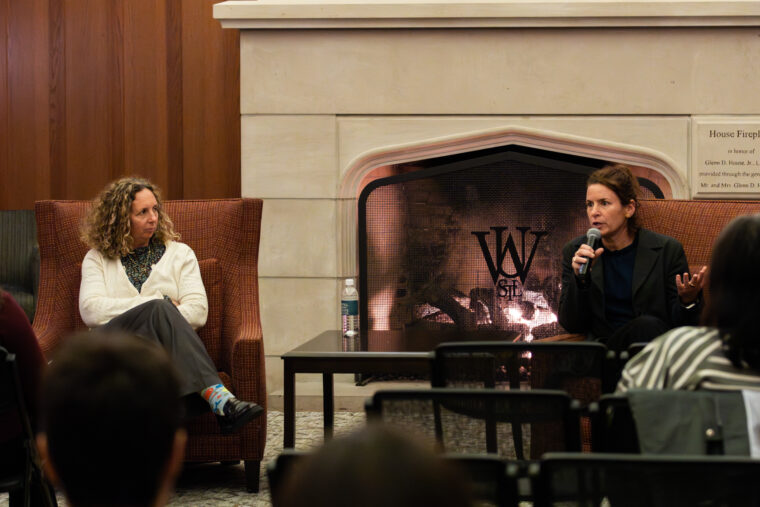
The John C. Danforth Center on Religion and Politics hosts 60th Nostra Aetate celebration (Tanvi Gorre | Student Life)
St. Louis’ Most Rev. Archbishop Mitchell T. Rozanski and Rabbi Noam Marans emphasized the power of Catholic-Jewish dialogue and relationships in a conversation moderated by Friar David J. Suwalsky for the 60th year of Nostra Aetate, Feb. 5.
Aetate is a declaration issued by the Second Vatican Council on Oct. 28, 1965, to affirm the Catholic Church’s respect for non-Christian religions in a post-World War II world. According to Marans, this document notably affirms Catholic respect for Judaism two decades after the Holocaust, in which Catholics contributed to the genocide of the Jewish people.
Marans and Rozanski believe the aspirations of this document are best practiced in Catholic-Jewish relationships. During the talk, Marans said that interreligious relationships can demonstrate that people from different perspectives can not only co-exist but also converse.
“I truly believe [in] this: the power of the visibility of our relationships,” Marans said. “There is nothing more positive than when people see that I have relationships with bishops and cardinals.”
Marans and Rosanski are an example of friends across religious lines. Rozanski finds that such relationships are at the crux of Nostra Aetate.
“The work of Nostra Aetate continues each and every day in the Jewish and Catholic community, and it has to continue with our commitments to one another,” Rozanski said.
However, to Rozanski, interreligious relationships can face challenges. While these theologies share perspectives when it comes to immigration and capital punishments, there are some points of disagreement. In particular, Catholics have distinct relationships with the Jewish people and the State of Israel, which Marans said have not always worked for the Jewish people.
“It’s going to take a lot of talking about what it means to be an identifying Jew, how Israel plays a role in that, and what is possible from the Catholic Church in terms of a new or revised theology of the land,” Marans said.
Approximately 250 attendees went to the event in Emerson Hall. Lillian Murphy, a project coordinator for the Office of the Provost and a member of the Catholic Student Center, came to the event to learn more about how to reach across theological boundaries.
“We came here because I think a really important part of our faith community is interfaith relations and the dignity of human life,” Murphy said. “I think that we, as young adults and as people who care about the world, want to know how we can reach out across the aisle and talk to people who are different from us.”
Professor of theology Lawrence Feingold, who teaches Catholic theology at Kendrick-Glennon Seminary, said he resonated with the panelists’ focus on one-on-one relationships.
“It was beautiful to be at this event tonight,” Feingold said. “What they emphasized tonight, both the rabbi and the archbishop, was the importance of personal friendships, right? Of coming together [and] speaking together … so that when incidents of antisemitism happen there’s an immediate tie.”
Feingold said that he has close ties to people of the Jewish faith, as his mother-in-law is a Holocaust survivor. She came to the U.S. through St. Louis Jewish Family Services, an organization that supports the Jewish community in St. Louis. Marans, who serves as the director of interreligious affairs at the American Jewish Committee (AJC), highlighted the significance of celebrating Nostra Aetate in St. Louis with universities that have deep ties to Judaism.
Marans described the celebration of Nostra Aetate as a positive signal for the future of Catholic-Jewish relations as well as for communities working to overcome longstanding rifts.
“[Catholics] were trying to kill us, and now we are friends,” Marans said. “Given the history of Catholics and Jews, if Catholics and Jews can do it, anyone can.”
Stay in Touch!
Get the latest and top news from StudentLife delivered to your inbox