Scene
24 hours, 30 plays, 5 pillars: Thyrsus’ Day of Shame
Jenise Fussell | Contributing Writer
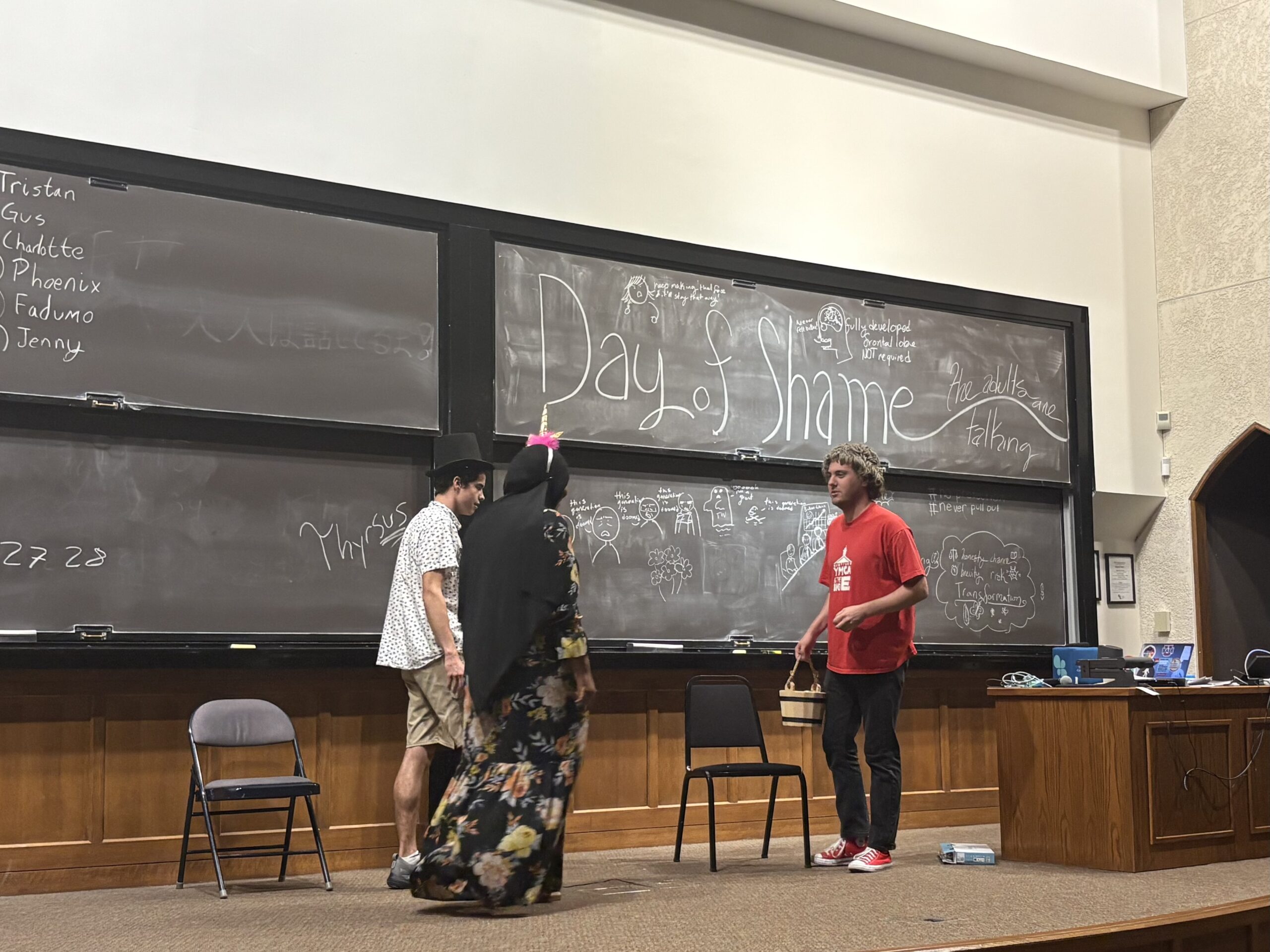
When Thyrsus president and senior Alanis Preciado Higgins and Co-Day of Shame Director and senior Tristan Dumas sat down to pick a theme for this semester’s Day of Shame, they decided to leave it up to chance. They shuffled songs on Spotify and landed on a theme once they found a song that stuck with them. Thyrsus shared their Day of Shame, themed “The Adults are Talking,” on Oct. 11, and the show carried the same spirit of spontaneity that Preciado Higgins and Dumas captured weeks earlier.
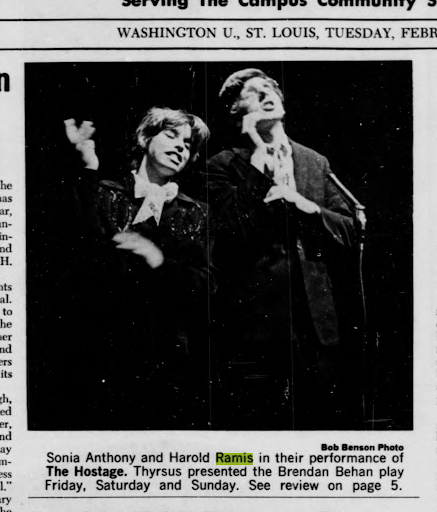
Thyrsus is WashU’s experimental theater group, guided by the five pillars of neofuturism: chance, honesty, risk, brevity, and transformation. Each semester, the group organizes a 24-hour playwriting festival, called Day of Shame, that embodies all five of these pillars. Starting on a Friday night, Thyrsus members have until the following Saturday night to write, produce, and rehearse 30 short plays. There are absolutely no guidelines for what a play should be, so writers can work with any form that speaks to them. Monologues, comedies, and musicals all coexist during Day of Shame. The only strict rule is that all 30 plays are performed on Saturday night in exactly 60 minutes. An onstage timer counts down the hour, and Day of Shame is over the moment the clock reaches zero.
The audience plays an important role in the progression of Day of Shame. At the theater entrance, audience members who are willing to act in the show are given a name tag with their role for the night. At any time, they can be called on to perform their role alongside Thyrsus performers. Though only a few audience members choose to participate as performers, everyone participates by calling out numbers from one to 30, each corresponding to the title of a play from the group’s repertoire. In this way, the audience has an active role in deciding what they see and when they see it.
For many writers, the 24-hour time crunch paired with a lack of any formal directions can be daunting, so many Thyrsus members rely on one neofuturist pillar in particular to get them started: honesty. Preciado Higgins uses experiences and encounters from her day-to-day life to inspire her writing. She is most drawn to writing a play that “has a clear narrative, that’s unique, and is at least somewhat drawn from reality.”
For this Day of Shame, other Thyrsus writers used the pillar of honesty as a guide to interrogate the world around them. First-year Fadumo Hussein said she was inspired by the theme of “The Adults are Talking” to explore familial dynamics and the ways in which children often feel unheard or misunderstood. Dumas’ three-part play about Mr. Rogers presents a similar idea.
“When someone says the adults are talking, they’re usually talking to children and talking down to children,” he said. Dumas was inspired by Mr. Rogers’ ability to foster “communication and a connection,” and hoped that his plays would do the same.
Day of Shame forces writers to trust their creative intuition. With such a short amount of time to assemble 30 plays, writers do not have time to overthink what they are putting on stage. Doubt and hesitation can slow down the process of putting together a Day of Shame. For first-year Charlotte Green, the quick turnaround leads her to take every idea for a play seriously.
“No one’s expecting it to be perfectly polished because you only had a day to do it anyway,” Green said.
While writing a play, Green is led by the mantra of “if you have an idea, it goes down.” Many other Thyrsus members echoed this sentiment during the writing process, where even the most outlandish proposition was met with, “That could be a play!” These moments of inspiration are captured, followed, and then eventually fully shaped into one of the 30 plays of the night.
On the night of Day of Shame, audience members typically know nothing about the forthcoming plays other than the titles. When they pick a number, they could be faced with any format of performance, including a musical number, a monologue, or a dance battle. Picking the right (or wrong) number could even eject a performer from the show, forcing an audience member to fill in for them while the original performer voices the lines. Senior Jacob Elliot was the lucky Thyrsus fan given the role of the Stunt Double to fill in for performer and sophomore Gus Lookingbill.
“I had a blast,” Elliot said. “Gus was voicing me, and I love Gus, so I enjoyed acting for them.”
Reflecting the pillar of honesty, the final play of the night featured a round of show and tell, where each performer spoke about an item that was meaningful to them. Many of the items held emotional connections to a person, time, or experience in the performers’ lives. Despite no audience participation, this was the closest moment between performers and audience during the show. There were no jokes to be made or characters to play, only the intimate and sincere truth.
True to Thyrsus’ promise of a 60-minute show, this Day of Shame was over exactly when the timer reached zero, even though there was still one play left uncalled. The beauty of a Day of Shame performance is its impermanence. No Day of Shame is like another, and there is excitement in not knowing what the day will hold, for both the audience and the cast.
“With a format like this, it’s kind of hard to say it can get stale, because it literally can’t,” Preciado Higgins said.
The originality of each performance is what keeps Thyrsus members and their audience coming back for each show.
Stay in Touch!
Get the latest and top news from StudentLife delivered to your inbox