Scene
‘Life of Pi’ the play: A better story or a shallow attempt?
Anna Dorsey | Illustration Editor
You don’t have to go far to find a movie, TV show, or play version of your favorite book, and although “the book is always better than the movie” is a cute saying, plenty of books have been made into great adaptations. There are things that a staged performance can do that a book just can’t, no matter how well written it is, and there is value in the kind of artistry that can go into visual mediums. For example, a musical score can add to dramatic scenes or evoke emotions. Actors and detailed sets and costumes can bring the story to life. It was this artistry that drew me in when I heard about the most recent adaptation of Yann Martel’s “Life of Pi.”
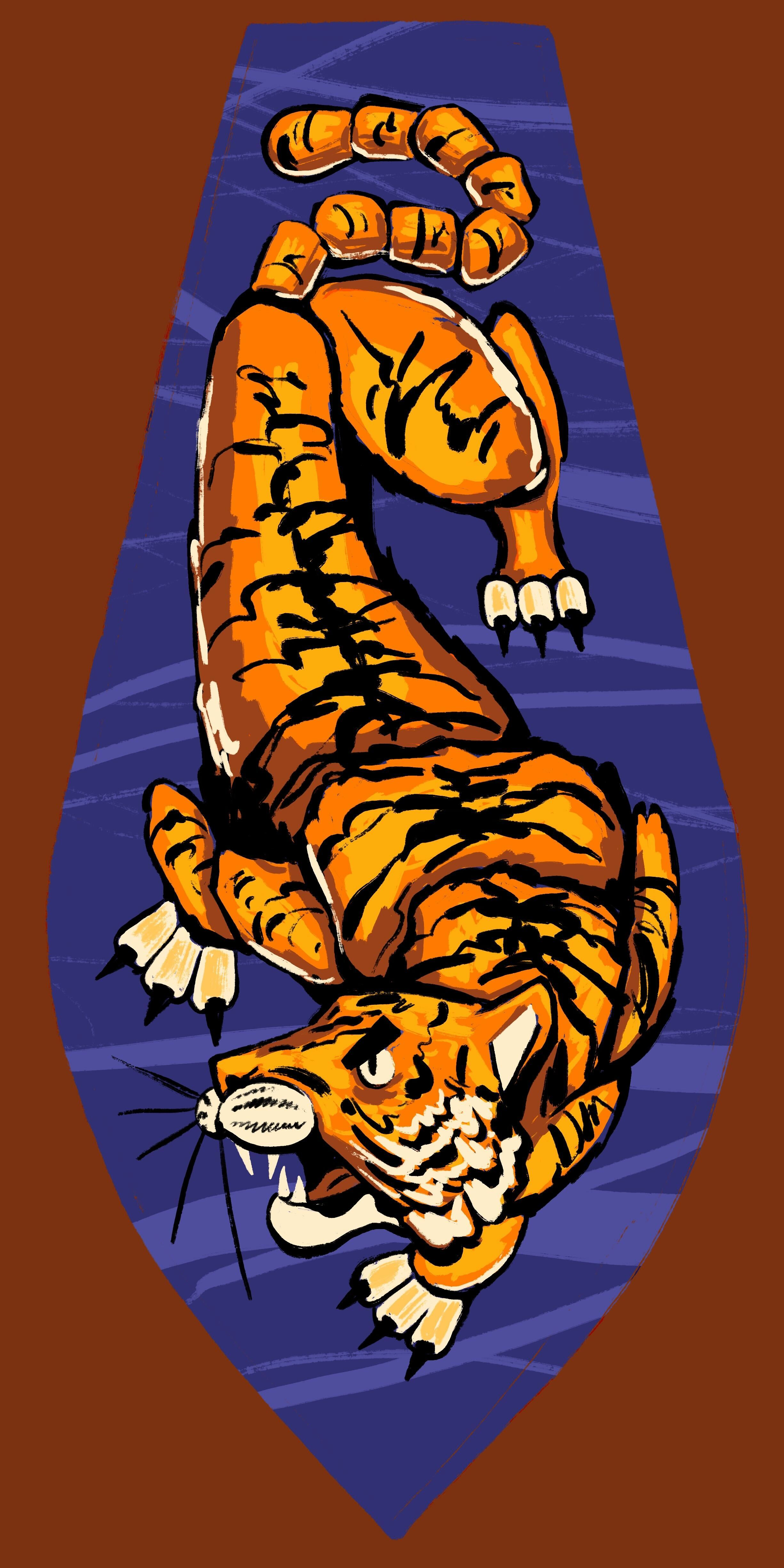
Upon hearing that its U.S. tour included the Fabulous Fox Theatre in St. Louis, I jumped at the chance to see the play. “Life of Pi,” the play adaptation by Lolita Chakrabarti, won five Oliver Awards (the British equivalent of America’s Tonys) in 2022, a year after its debut on the West End. One of those awards went to the actors who manned the play’s most interesting feature: puppets. “Life of Pi” is a story full of animals, each of which is portrayed on stage by a life-sized, intricately carved puppet. The puppets look pieced together out of driftwood, rather than being completely realistic, but the actors’ puppeteering and choreography are convincing enough to make the audience forget that there aren’t live animals on stage. In fact, the choreography overall is beautifully done. The way that the actors and background dancers interact with the set to create the illusion of a lively zoo or a raging storm is mesmerizing.
Unfortunately, good set design doesn’t make a good adaptation. “Life of Pi” is a book I would read over and over again. When it comes to the play, once is enough. For those unfamiliar with the book (or its movie adaptation), “Life of Pi” tells the story of a 17-year-old boy named Pi who is trapped on a lifeboat for 227 days, the only survivor of a shipwreck. The story is told twice. In the first version, he shares the lifeboat with an orangutan, a zebra, a hyena, and a Bengal tiger. In the second version, told much more quickly toward the very end of the book, he shares the boat with his mother, a sailor, and a French chef. The stories deal with dark topics such as starvation, the lengths creatures will go to for survival, cannibalism, loss, grief, and terror.
In the book, telling the story through animals softens the harsher scenes. Onstage, the animals exacerbate the violence. In writing, a narrator can convey the horror of something by describing how they couldn’t look at it, rather than with graphic gore. There is something strikingly different about a paragraph-long description of one animal killing another and a 2-minute stage rendition full of snarling, screaming, and red-cloth-blood. From my seat in the Fox on opening night, I could hear the discussion of two women who walked out in the middle of Act 2. One of them told the other that if she had to watch an animal maul another animal again, she was leaving. I didn’t blame her. Sections that were already gruesome and sad in the book gained an extra level of violence in 3D, especially without descriptions of Pi’s feelings to temper them.
In the book, these scenes are woven in with vivid descriptions of wonder and thought-provoking commentary on religion, belief, and hope. In the play, a combination of the lack of narration and the time limits of any stage medium meant that the nuances fell flat. Most information was conveyed through dialogue, so full descriptions of Pi’s experience practicing three religions at once, his wonder at the world around him, and the way he stays happy (and sane) through an awful situation ended up being condensed to a few lines. It makes a book that is already confusing even more so. The discussion of religion feels random and shoved in. The ambiguity that is so intriguing at the end of the book has to be explained in clear-cut terms at the end of the play because leaving it open-ended would leave the play feeling disconnected and confusing.
Additionally, the acting was energetic, overdramatic, and loud. Maybe it was a style that would fit with something different, but with the dark topic and the complexity and philosophical themes that make “Life of Pi” something more than just a survivor story, it felt off. It made deep conversations and points feel inauthentic or, at times, unserious. It made heavy scenes (for example, a scene where Pi, who has been a vegetarian his whole life, kills and eats a turtle) feel jarring or callous. To be clear, the novel as a whole is not overly serious. But it is reflective and gentle despite the dark subject matter.
The intense style of the play was also grating for two hours. A book written from a single character’s perspective is typical. It is a hard task for a single actor to be (mostly) alone on stage for the majority of a play. It puts all of the pressure on that actor to tell a good story and keep the audience engaged and still feel genuine. It is harder still to tell a story about that character going slightly crazy without feeling like it is making light of the situation. Whatever balance of storytelling and drama it takes to make the single-actor style work, “Life of Pi” didn’t have it.
Chakrabarti’s play left more out of the story than it added. The beauty of the sets and puppetry was quickly lost to the gruesome violence, tactless delivery, and confusion. If translating a book to a stage requires cutting out nuance and important themes, if it requires stripping the story down to just the plot, is there value in making the adaptation? The puppets were an amazing touch, the set design was wonderful — could they not have been part of an original story?
At the end of both the book and the play, Pi asks, “Which was the better story?” I asked myself a similar question: “Which of these two mediums told the story better?” Going into the theater, I had hoped that it would be a hard choice, but it wasn’t. Compared to the original, Lolita Chakrabarti’s “Life of Pi” falls flat.
Stay in Touch!
Get the latest and top news from StudentLife delivered to your inbox