Scene | WashU in Focus 2025
Max Schreiber thinks we should all take more risks
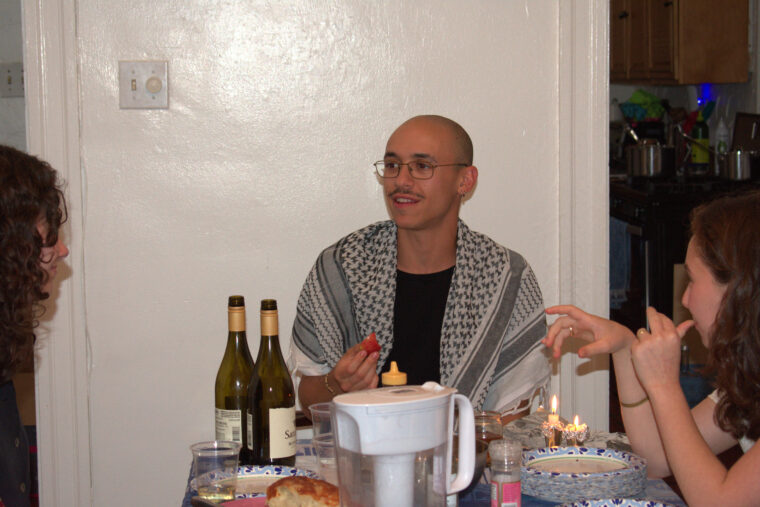
Schreiber sits at a Rosh Hashanah dinner while wearing a keffiyeh, a traditional Palestinian headdress. (Courtesy of Sonya Koffman)
When he transferred into Sam Fox in his sophomore year, Max Schreiber had only ever taken one college-level art class.
“Honestly, I was very intimidated when I got to Sam Fox,” Schreiber said. “I took [Intro to] Drawing second semester. I’d never drawn before, and it was something that I was very scared about.”
But Schreiber seems to thrive in the uncertain and the uncomfortable. After all, he says, what else are we in college for?
“My first goal when I got here was to try as many different things as possible,” Schreiber said. “I was just trying to try stuff out and see what stuck, and studio art definitely stuck.”
Schreiber eventually decided to commit himself to studio art and tried a number of mediums. Now a senior, Schreiber likes to ask difficult questions of viewers through his art and enjoys seeing how they interact with his sculpture and video pieces.
“I’m interested in how the public interacts with [my art],” Schreiber said. “I think it’s really cool to me when people are able to participate in it in their own way.”
Schreiber has taken the idea of public interaction to great lengths. In one project, he displayed a 200-square foot canvas and had people answer questions about remembrance and memory by painting on it.
“It was a sculpture, it was a painting, it was social practice, it was a community piece,” Schreiber said. “It’s always interesting when different mediums interact.”
Similarly, in April of 2025, Schreiber placed a white sculpture that resembled a tent down in Tisch Park and allowed others to come and paint on it. The project made headlines after he was asked to remove the piece from campus. Schreiber said that the tent was a “reflection” on the events that took place in the same location on April 27, 2024, when over 100 protesters were arrested while setting up a pro-Palestine encampment.
“We ended up getting threatened by the police and kicked off campus,” Schreiber said. “I had my studio searched, I received threats online, and I ended up with an academic sanction.”

Schreiber, at center, talks to others as they sit and paint on his sculpture. (Courtesy of Max Schreiber)
Schreiber, who is Jewish, considers himself an anti-Zionist and has included this theme in his works and as an activist. He cites discussions he had while at WashU for his current beliefs.
“I really think it all goes back to just talking to people and hearing different perspectives,” he said.
Schreiber said he does not shy away from discussion and disagreement, while still holding his beliefs deeply.
“We’re here to learn,” Schreiber said of college and his art courses. “I had a critique that was for a similar project I did [to the tent], and it was great. People didn’t necessarily have to agree with it, and they didn’t have to disagree with it.”
Schreiber said he has had a number of difficult conversations with his family about Judaism and Zionism. While their perspectives differ, he said that those conversations taught him to articulate and be firm in his beliefs.
“With my parents, even when we disagree, I still know that they’re proud of me for staying true to myself,” Schreiber said. “Even if I know that they don’t agree with the way I see a particular issue, like Israel, for example, I know that they still want me to stand up for what I think is right.”
Schreiber said that committing to his beliefs helped him find community at WashU. He has begun hosting Shabbat dinners and other Jewish holiday events for like-minded Jews.
“I think that at WashU, it can be hard to find communities of people who share your values and want to have a community outside of WashU,” Schreiber said. “Having people over for Shabbat dinner at my apartment has been a really great thing, because I want to have a Jewish space where people who maybe don’t feel like they’re accepted into the institutional Jewish spaces have a place to be.”
Schreiber said that his art is a place where he has both found and tried to create community. He said that it has been a theme in his works, like in one series called “Memory Practice.”
“I was interested in the idea of memory as an active rather than passive process,” Schreiber said. “I was interested in the act of remembering, and what it looks like individually, what it looks like in a group, and what social memory means.”
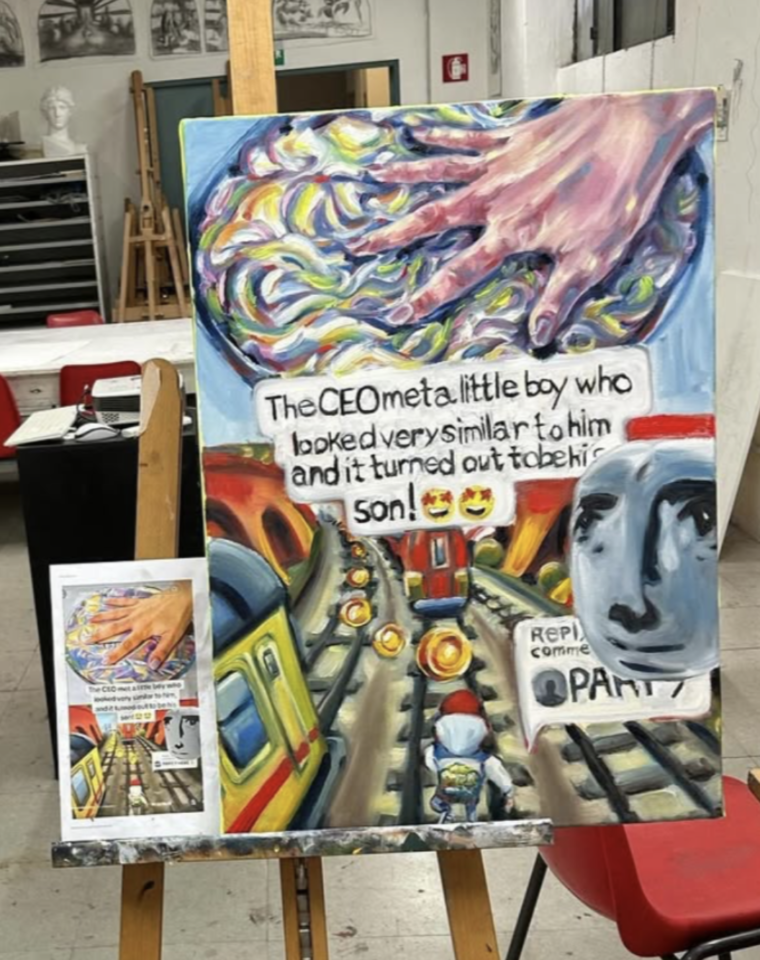
In the first piece, a sculpture titled “I Am Not You,” Schreiber said he focused on the act of memory as an individual process. The piece is a metal sculpture depicting two figures welded together.
“This was about the negative space felt after loss and the idea of processing memory within yourself,” Schreiber said.
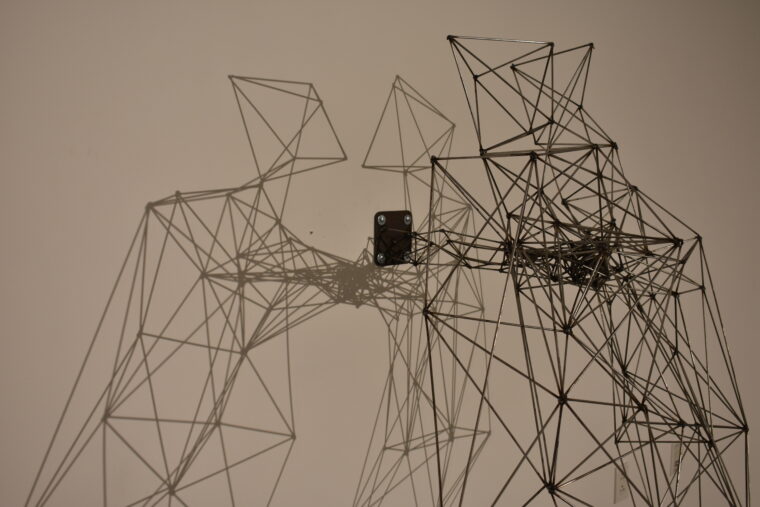
“I Am Not You” (Courtesy of Max Schreiber)
Moving toward understanding memory alongside others, the series’ second piece, titled “Loss Cycles,” involved Schreiber recording a video of him and another Sam Fox student, senior Maya Iskoz, untangling a seemingly never-ending knot of rope. Voice messages from his late aunt can be heard in the video.
“This piece was about the idea of memory, still as an individual practice, but when it includes this person who is no longer here,” Schreiber said. “It also ended up being about the idea of remembering someone by carrying on their memory by connecting with someone else.”
While untying the rope, Schreiber said that he discussed his aunt’s life. He and Iskoz did not know each other well at the time, but Schreiber said that the process brought them closer.
“We never finished untying it. So the piece became about how hard it is to untangle these relationships with people who pass and the legacies they leave behind,” Schreiber said. “I could only do that piece because Maya was willing to sit with me and talk about it for that long and commit to something many others wouldn’t.”
In the third piece in the series, Schreiber took clothing and metal to create a sculpture of a peace sign, something he said is a common symbol among Palestinians as they call for liberation and survival.
“In that piece, I included pledges that people in my community wrote to educate others on the Palestinian liberation movement,” Schreiber said. “The piece was about having a shared goal, the power of the collective, and what can come from collectively remembering people.”
Schreiber said that focusing on community has become even more important to him given the likelihood that this will be his last year in St. Louis and at WashU.
“St. Louis is a great city for so many reasons, and I’m beyond grateful that I’ve gotten to spend my college years here,” he said. “I’m feeling pretty uncertain about what I’m going to be doing come this summer, so I’m just trying to make the most of the time I have here.”
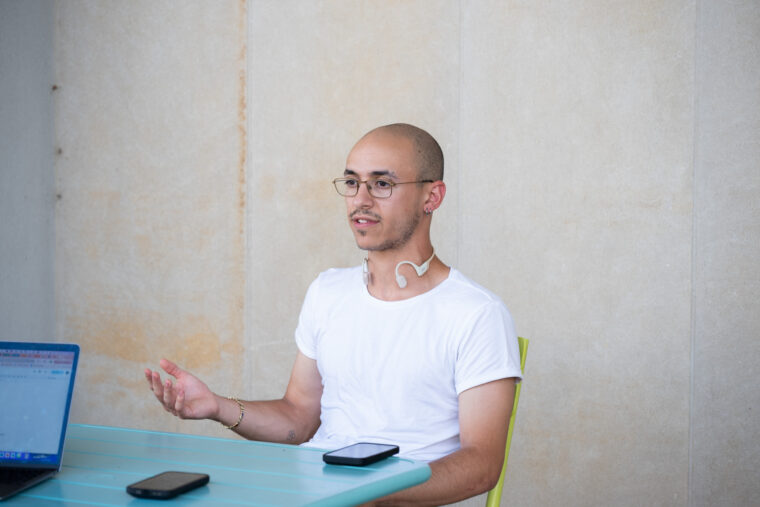
Schreiber talks with Student Life about his experience at WashU. (Bri Nitsberg | Managing Photo Editor)
Schreiber said he and Iskoz have made plans to host an art show in his apartment. They have selected pieces from WashU students and will make his apartment into a temporary gallery.
“Ideally, everyone will be welcome, and hopefully, a lot of students will show up,” Schreiber said. “Hopefully, a lot of people outside of WashU will show up, too, and it’ll be a nice space to see really cool work and get to know people in the community.”
Schreiber and Iskoz got the idea for the show when they realized that there was not a lot of students’ art on display at Sam Fox.
“It’s really hard to show your work as an artist without permission,” Schreiber said. “It’s increasingly more difficult to show the type of work you want to show wherever you want. One thing I’m excited about with hosting our own gallery is just having full control over that space.”
Schreiber said that the show represents going out on a limb and trying something new, something that he said he wishes he had done more of earlier in his time at WashU.
“Being in a university setting, there’s just always more you could be trying,” he said. “I think if I could talk to freshman me, I would want myself to take those risks and put myself out there more. I think you have to really lean into being vulnerable sometimes, and it’s only ever served me well to do that.”
He offered similar advice to readers.
“If you’re able to, take a studio. Take one that scares you. Not even just studio, take a dance class, take a public speaking class,” Schreiber said. “Do something that you’re interested in, that you wouldn’t usually do, that scares you, but that you think you’ll get a lot from.”
Student Life discloses all potential conflicts of interests; the author and Schreiber are friends and former roommates.
Stay in Touch!
Get the latest and top news from StudentLife delivered to your inbox