Scene
‘Chance-based collages’: A peek into student artist Helen Ives’ creative process
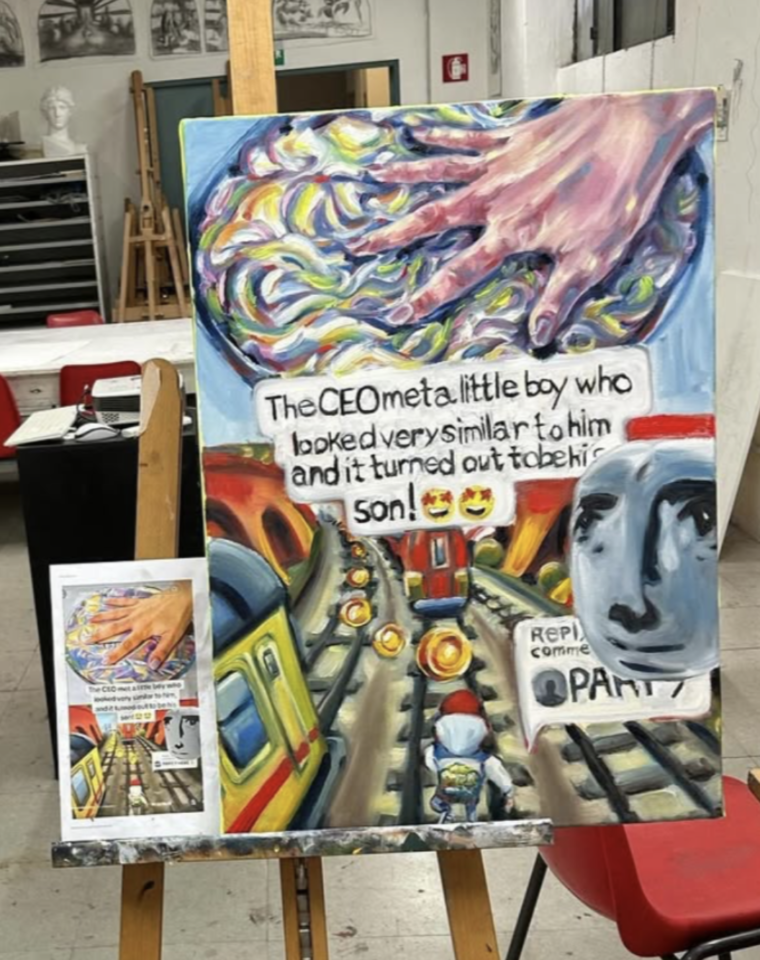
Ives’ “brain rot” inspired painting pictured next to its TikTok source material.
Before the term “brain rot” was popularized and named the 2024 Oxford word of the year, senior and studio art major Helen Ives translated a split-screen “brain rot” TikTok of a Subway Surfers game and an ASMR slime video overlaid with a “storytime” into a painting.
Ives curates images she happens upon either digitally or elsewhere and saves them for use in her paintings and collages.
“I work in this sort of chance-based collage process,” she said, “where I create these compositions from niche images or interesting images that feel very distinctly digital to me, that I find online — typically just by accident or in passing — and I collect them in a folder.”
Ives’ work draws inspiration from not only from digital spaces, but also from the physical process of collage. Her studio is filled with splashy, psychedelic pieces inspired, in part, by Berlin’s poster culture of overlapping images.
“Every now and then, I’ll play with making a composition digitally, and I’ll print that out and translate that into paint, so not only is there a digital collage process, but [also] a physical one,” she said.

Ives finds inspiration in the most unexpected of places, whether it be “brain rot” Skibidi Toilet memes or lorem ipsum — the placeholder text used in publishing and web design and the title of the red-colored painting. (Mac Motz | Photo Editor)
Ives is an art history major and French minor, in addition to her studio art studies. She studied abroad in Italy in the fall of her junior year and in France during the spring.
Her thesis for the art history department explores craft and technology in relation to artists’ reactions to ecological problems like climate change. Research Ives did for one of her paintings directly informed the development of her thesis topic. She sees the intersection of her art history and studio art interests as “one big self-informing circle.”

Ives works on a mixed-media collage for a screen printing class utilizing both screen printing techniques and acrylic on canvas. (Mac Motz | Photo Editor)
Ives — exposed to art from a young age by her mother, an elementary school art teacher — originally came to WashU interested in fashion design. However, she found that she especially enjoyed classes in sculpture, 2D design, and drawing.
“A lot of my professors were encouraging me to really take on the studio art major,” Ives said. “I could kind of feel it internally too, that I was really, really drawn to it [and] I always knew I was going to make some form of art.”
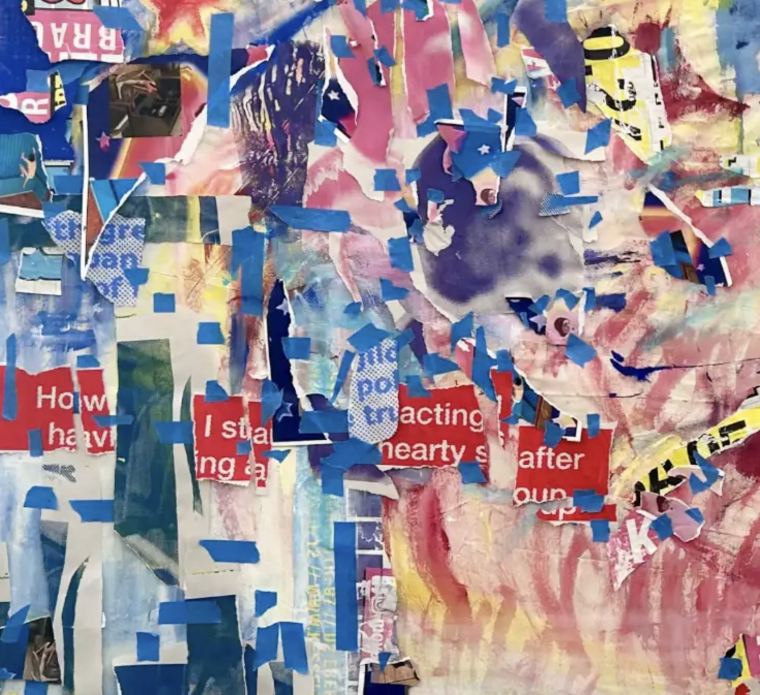
A close-up of one of Ives’ recent collages showing the attachment mechanism — blue painter’s tape in this case.
Ives continuously experiments with her works, such as showing the attachment mechanisms in her collages. She was influenced by artist Sarah Sze, whose work is currently on display at the Kemper Art Museum and who also features the means of attachment in her collages.
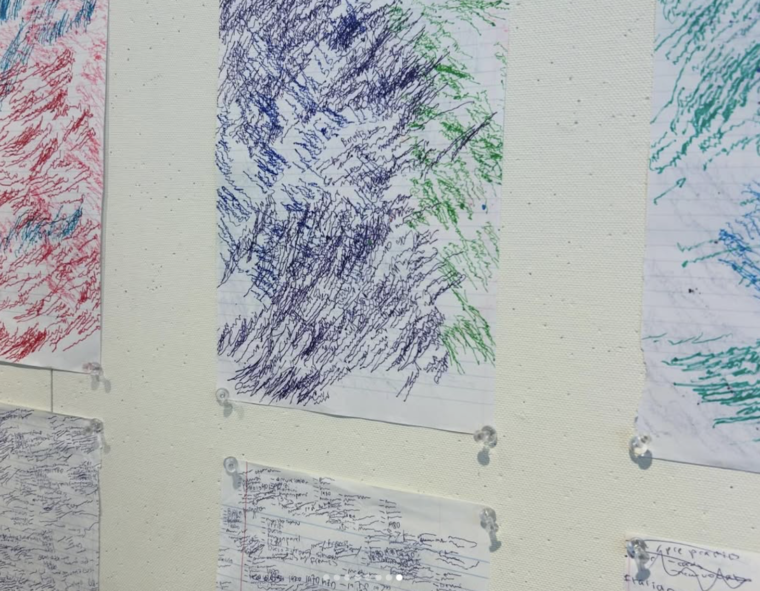
Ives describes her notetaking process displayed in “Value Map” as simultaneously “intentional, automated, unconscious, and variable.”
Other inspiration for her work comes from her notebook — literally. Ives’ studying scribbles were the subject of her recent project titled “Value Map,” which forms a “non-linear timeline” through the various pen colors utilized.
Ives’ prescient work is not only a commentary on phenomena like internet culture’s fascination with attention-span-annihilating “brain rot” content, but is also a testament to the idea that inspiration can be found in the most unexpected of places.
Stay in Touch!
Get the latest and top news from StudentLife delivered to your inbox