Scene
Flipping the “screenager” script: WashU community reverses phone addiction with flip phones
Anna Dorsey | Staff Illustrator
The first thing you reach for when you wake up, the last thing you put down before bed: Smartphone usage is nearly ubiquitous among adults. 97% of Americans ages 18-49 own a smartphone. Even our grandparents (who might need a lesson or two from us on how to use “that darn thing”) have one: 76% of US adults older than 65 have smartphones. More often than not, Americans across all ages have smartphones.
As scary as these numbers are, we know it goes deeper than just owning a phone. Call it what it is: smartphones are addicting. Every day, around 132 million Americans spend 5-6 hours on their smartphones. That’s close to the length of an elementary school day. The Harvard Business Review points to increased depression, worsened focus, and neglected relationships as just a handful of side effects of smartphone addictions. At WashU, students and professors alike feel these symptoms.
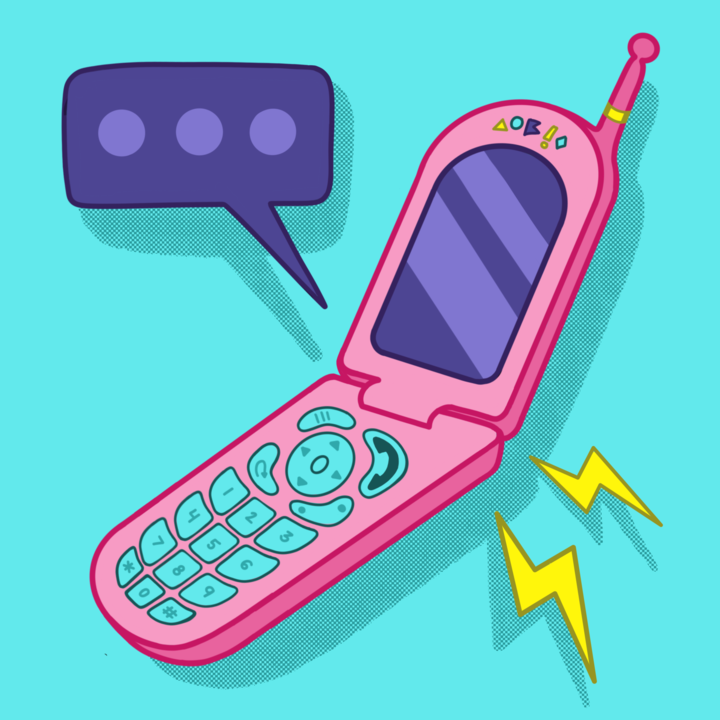
To take matters into their own hands, some WashU students have taken the smartphone out of their literal hands and replaced it with something else. Remember that archaic phone we saw in early 2000s movies? Think “The Fast and Furious: Tokyo Drift,” “The Sisterhood of the Traveling Pants,” or “The Devil Wears Prada.” Pick your poison out of any early 2000s movie, and it’s likely your favorite character was rocking a flip phone. Many WashU community members have been taking notes.
While scrolling on his iPhone in line at a Chipotle, then sophomore Reed Caney didn’t realize it was his turn to order. As trivial as it may seem, it was a wake up call for Caney to lessen his iPhone usage. A year later, during the fall of his junior year, Caney spotted a Black Tracfone Nokia 2760 in Walmart, and his plan took shape. He could downgrade his iPhone to a flip phone and upgrade his initial plan of “No Social Media November” to a “No iPhone November” challenge. One Walmart purchase and a $15 phone plan later, and he was locked in for the month.
“I was definitely more involved in conversations,” current senior Caney said. “Your phone is always buzzing in your pocket … If I get a text, I’m naturally going to sneak a look at it. Much less people had my flip phone number, and half the time it didn’t ring or buzz when it was supposed to.”
Sophomore Sochie Odunlami found herself in a parallel situation to Caney. Disheartened by how often she felt distracted and had trouble remembering what she did in a day, she bought a Nokia 2780 flip phone at a Best Buy last summer.
“I was disappointed with myself productivity-wise,” Odunlami said. “I had this many hours in a day, and I can’t even remember what I did for those hours. If you’re sleeping for eight hours and doing school work for eight hours, there’s still another eight hours in the day. What did I do for that entire time?”
While she was hesitant to stop using Snapchat (there goes her “goodnight streaks”), she noticed some immediate benefits. She was able to connect with her roommates, who she didn’t know well before moving in, and was generally more social.
Back to Caney: within only one month, he also began to notice he was more present, spent more time reading for fun, and even developed a slight affinity towards his little flip phone. He thought it was funny that he used “c” and “u” as abbreviations, and every once in a while he would play the snake game, one of the Nokia phone’s only apps.
Of course, there were some things Caney missed. He listened to the radio instead of Spotify (and subsequently learned a lot about local companies through rampant ads). He relied on his car’s navigation system instead of his old iPhone’s convenient maps. But he wasn’t completely 100% Team Flip: he used his computer to text friends, send Venmo requests, read the news, and play music. For these reasons, and the general convenience, he went back to his iPhone.
“For a month, it’s a novel, fun thing to do where you can reap the benefits of it,” Caney said. “But it just becomes kind of cumbersome. It’s good for a one month detox.”
This fall, he repeated the challenge. After his annual month off, he’s made more permanent changes. He doesn’t have social media apps on his phone, and his screen time is closer to only two hours.
Again, Odunlami’s path mirrors Caney’s. She picked her iPhone back up over winter break. Her mom wanted to track her when she was in Nigeria and she missed listening to music over Apple CarPlay while driving. At school, it was difficult to complete logistical tasks like returning an Amazon package or ordering on Grubhub. She also missed taking photos to look back on, and having functional group chats. However, her iPhone usage has also been lessened. She only has one page of apps, and has gotten rid of all social media apps and games on her phone.
While Odunlami and Caney dipped their toes in the flip phone world (a “flipuationship,” if you will), others are fully submerged in the smartphone rebuke, such as Director of Public Scholarship Christopher Schaberg and senior Aidin Yazdi.
After despising how much time he spent on YouTube, Yazdi started scouring Reddit forums, eager to find the smartphone replacement. He liked that his previous smartphone provided a million offerings (text, call, email, Slack), but he didn’t want to do them all the time. Reddit pointed him in the direction of the Cat S22 Flip, a $70 phone with a small screen.
“I was really adamant that I wanted a flip phone that can do everything,” Yazdi said. “I want to theoretically check emails or look things up, I just want it to suck at everything, so I’m not tempted to do it.”
Now, he’s hooked. Yazdi said he’ll continue using his flip phone indefinitely because it makes him feel better about himself, and he’s no longer replacing free time with screen time.
Around two years ago, Schaberg made a similar switch to the Light Phone II, a palm-sized phone with the mere capabilities of texting and calling. He documented his experience with the Light Phone II, and rid himself of the “horror[s] of the Apple store.”
Pretty quickly, he noticed some positive changes: he fell back in love with reading before bed, was more present with his kids, and embraced old challenges, like exploring St. Louis with only a paper map. Given his job as both a director and a dad, he still uses his computer to answer Microsoft Teams messages, complete all his banking, and shoot emails. Occasionally, he finds himself texting on his Light Phone II throughout the day. But it’s awkward to maneuver, forcing him to send short messages, often laden with typos. He prefers it this way.
“I just realized that having that stuff coming through my phone at all hours was really taking a toll on my brain,” Schaberg said. “This thing is really clunky to type on. I’m just sending one word texts because it’s annoying. That annoyance is what’s freeing.”
Stay in Touch!
Get the latest and top news from StudentLife delivered to your inbox